How much body can you reconstruct from almost nothing? Two 2026 preprints push the limit of sparse input: one rebuilds 3D football players from a single broadcast camera, the other a whole arm from one smartwatch. Both work without per-user calibration — and both lean on a built-in prior to fill what the sensor cannot see.
Table of Contents
Filling in what the sensor cannot see
A single sensor never sees enough: one camera loses depth, one wrist IMU knows nothing about the elbow or shoulder. What makes these systems work is a prior — pitch geometry for the camera, a motion model learned from mocap for the watch — that supplies the missing dimension and needs no per-user calibration. The same prior that fills the gap also sets the failure mode: each method breaks exactly where its built-in assumption stops holding.
Paper 01 — Putting broadcast players back on the pitch
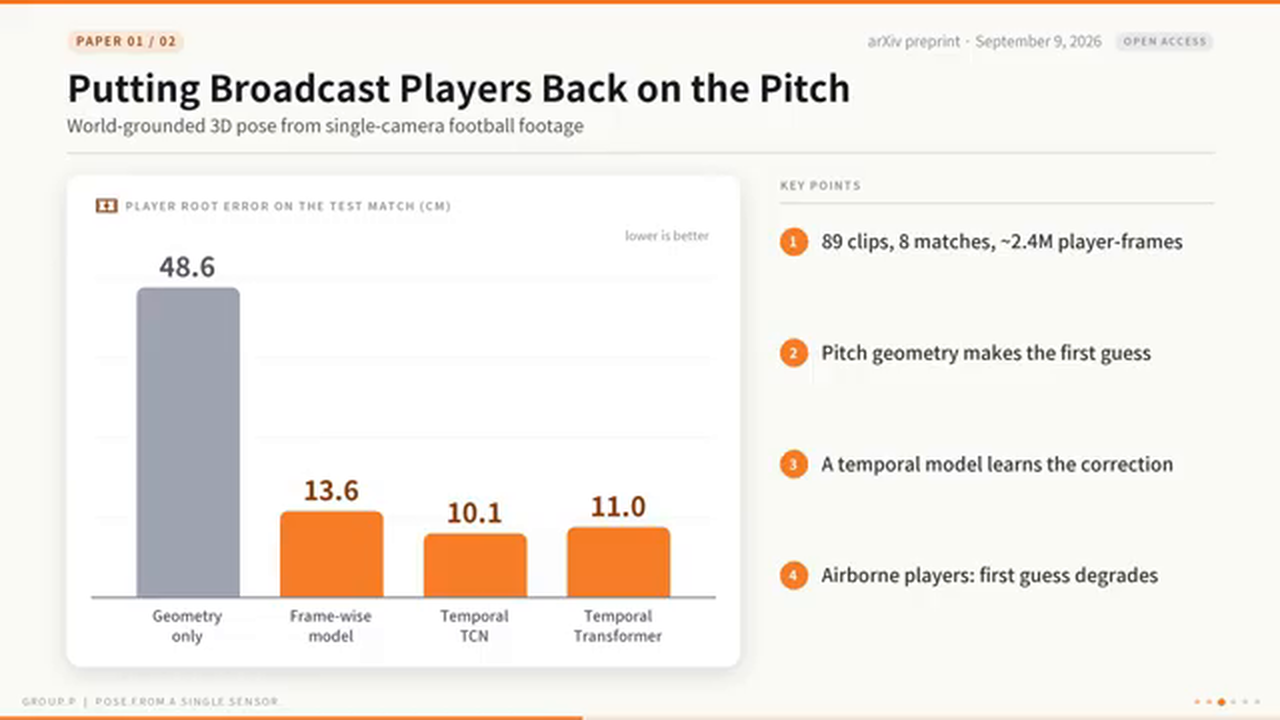
The first reconstructs world-grounded 3D pose of footballers from ordinary single-camera broadcast footage — 89 clips, 8 matches, about 2.4M player-frames. Pitch geometry makes the first guess, since the known dimensions of the field anchor depth, and a temporal model learns the correction, cutting player root error from 48.6 cm (geometry only) to about 10 cm. The assumption shows its edge with airborne players: when feet leave the pitch, the geometric first guess degrades.
Paper 02 — A whole arm from one smartwatch
The second recovers a whole arm — wrist, elbow, shoulder — from a single consumer smartwatch IMU, calibration-free. Trained on synthetic IMU generated from mocap and tested on 10 people across 30 activities and two watch platforms, ArmPoser cut median wrist-elbow error to 7.65 cm (versus about 9.6–10 cm for prior methods). Its limits are honest: exercises gave the largest error, it reconstructs the arm only, and it runs about 170 ms behind real time.
Priors in, assumptions out
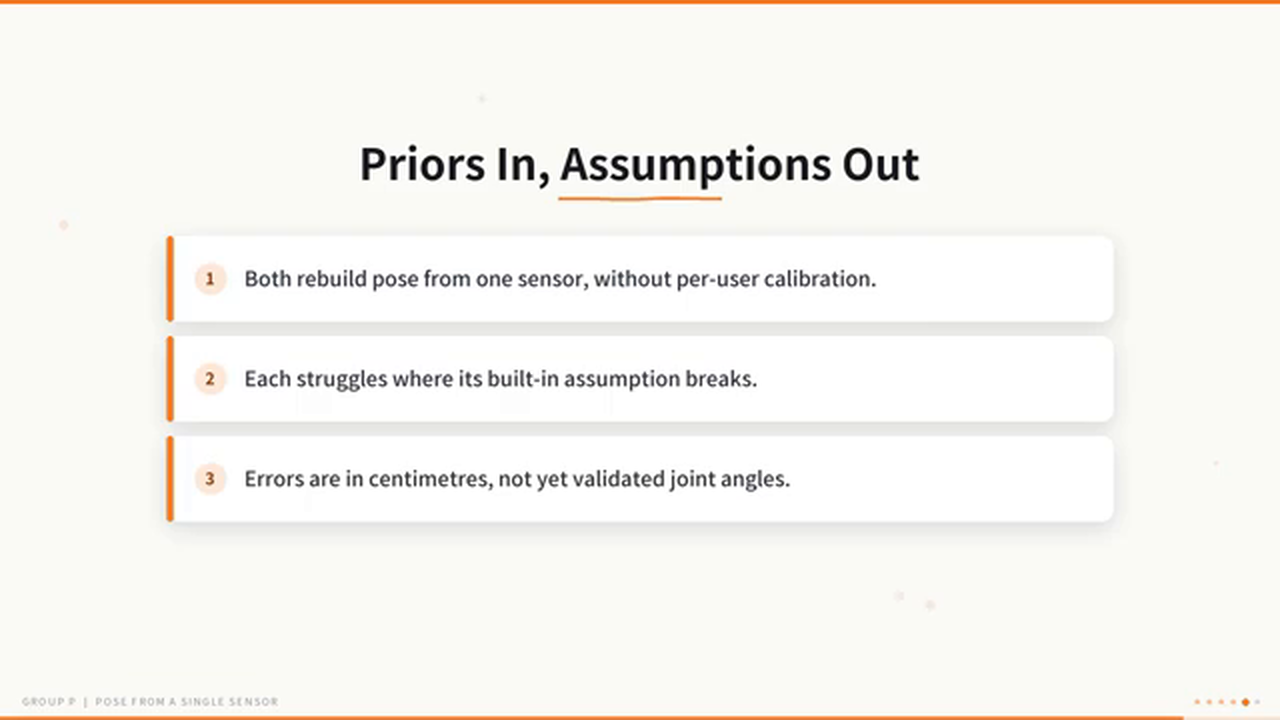
Both papers tell the same story: a strong prior turns one sensor into a plausible pose with no per-user setup — and each struggles exactly where its built-in assumption breaks (an airborne player, a gym exercise). Worth keeping in view: these errors are reported in centimetres, not yet as validated joint angles, so they are impressive reconstructions rather than clinical measurements. For the gap between a sensor’s signal and a trustworthy number, see the sensor is not the measurement, and for reusing a pose model on a new task, borrowing a pose model for a new job.
Frequently asked questions
Can you get 3D pose from a single camera?
For constrained scenes, increasingly yes. A 2026 method reconstructed world-grounded 3D football players from single-camera broadcast footage by using pitch geometry as a first guess and a temporal model to refine it, cutting root error from 48.6 cm to about 10 cm. It degrades for airborne players, where the geometric assumption weakens.
Can a smartwatch estimate arm pose?
A single smartwatch IMU can reconstruct a whole arm without per-user calibration. ArmPoser (2026), trained on synthetic IMU from mocap, reached a 7.65 cm median wrist-elbow error across 30 activities — best so far — but it covers the arm only, errs most during exercises, and lags about 170 ms behind real time.
Do single-sensor pose systems need calibration?
Both of these 2026 systems are calibration-free: they rely on a built-in prior (pitch geometry, or a motion model learned from mocap) instead of a per-user setup step. The trade-off is that the prior also defines the failure mode — accuracy drops wherever its assumption stops holding.
References
[1] Khan, S., Gajny, L., Lecompte, J., & Laporte, S. (2026). Field Converter: Geometry-Initialized Temporal Residual Refinement for World-Grounded Player Pose Estimation from Soccer Broadcasts. arXiv:2609.10498.
[2] Dev, B., Xu, V., Loh, X.-A., Gao, C., Hoffmann, H., & Ahuja, K. (2026). ArmPoser: Real-Time, Calibration-Free Arm Pose Estimation from Smartwatch IMU. arXiv:2609.08806.
Takashi Fukushima — Sports Science & Pose Estimation.
▶ Subscribe on YouTube · Website · ORCID · Contact