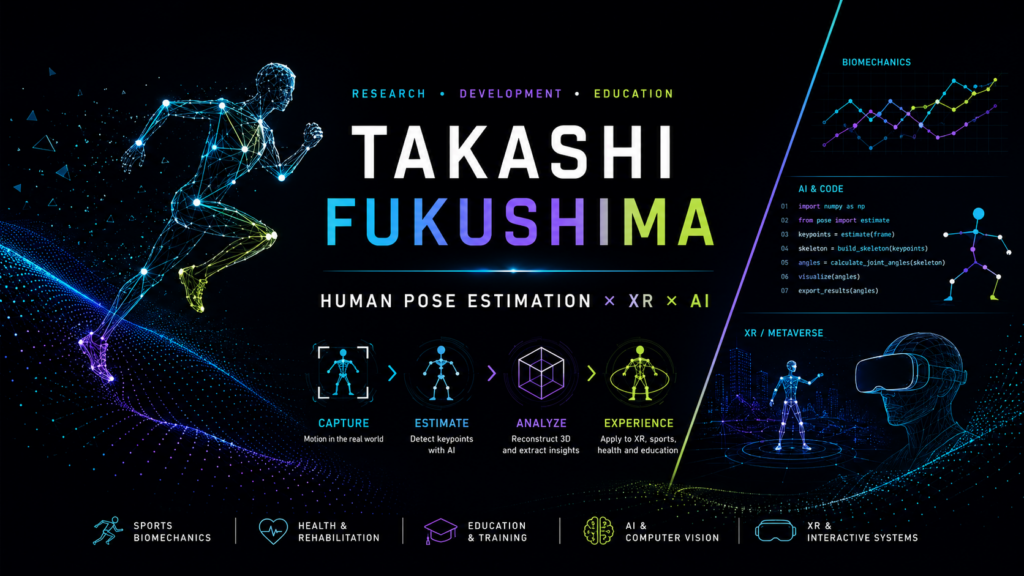
Sports Science × Pose Estimation × XR
Teaching AI to see human movement.
From sports & exercise science to AI — I build markerless human pose estimation and AI-driven movement analysis, and break down the research here and on YouTube.
- MediaPipe
- OpenPose
- ARKit
- OpenSim
- Unity
- Meta Quest
130+YouTube videos
10+international talks
EN · 日本語bilingual content
POSE DETECTED · 98.7%
Focus areas
Latest articles
- Pose from a Single Sensor: One Broadcast Camera, One Smartwatch
 Two 2026 preprints reconstruct body pose from strikingly sparse input — 3D football players from one broadcast camera, and a whole arm from one smartwatch — both calibration-free, both leaning on a built-in prior.
 - Is Markerless Ready for the Clinic? A Scoping Review and a Screening Study
 Two 2026 studies test whether markerless motion capture is clinic-ready: a 117-study scoping review of video-based joint angles, and an OpenCap landing score validated against Vicon. Readiness depends on the question.
 - How Far to Trust a Wearable’s Number: Velocity, Muscle Timing, Jump Height
 Four 2026 validation studies on wearables — velocity sensors, EMG timing, a wireless EMG device, and jump tools — agree: reliable for a group or a trend, shakier for one session, muscle, or device comparison.
 - The Sensor Is Not the Measurement: IMUs, Sweat, and Modelled Forces
 Three 2026 papers — multi-IMU sync, sweat biosensors, and video-to-force modelling — sit several inferential steps from what they want to measure. The sensor is not the measurement; every modelled step adds error.
 - Borrowing a Pose Model for a New Job: Squats, Table Tennis, and Fall Risk
 Three 2026 studies bolt a task-specific stage onto a general-purpose pose estimator — grading squats, measuring a table-tennis elbow, predicting a fall — and each hits the same wall: the accuracy number belongs to one camera setup.
 - Where Markerless Kinematics Holds Up: Two Reviews, Two Validation Tests
 Two 2026 reviews and two validation studies on markerless kinematics converge on one answer: accuracy is not a single number — it is specific to the joint, the plane, and the task.
Featured video

Profile
I’m Takashi Fukushima, a researcher and developer working across sports & exercise science, motion capture, and computer vision. My focus is markerless human pose estimation and AI-driven movement analysis, alongside XR development with Unity and Meta Quest. I publish peer-reviewed research and break it down here and on my channel.
- Human Pose Estimation (MediaPipe, OpenPose, latest methods)
- Motion Capture & Sports Biomechanics
- Computer Vision & AI movement analysis
- XR / Metaverse development (Unity & Meta Quest)
Achievements
Positions & Affiliations
- Specially Appointed Assistant Professor, Education Incubation Center, Tokyo Gakugei University
- Executive Board Member, Asia Council on Exercise & Sports Science (ACESS)
- Executive Board Member & Secretary, Global Metaverse Laboratory
- CTO, Aletheia LLC
- International Technological Partner, Sports Performance Analysis Association in Bharat (SPAAB) — Capacity Building Sessions; HALO (Human Analysis of Locomotor Optimization) Sessions 1/2/3
Commissioned & Funded Projects
- FY2024 — Japan Sports Agency, Support Project for Reiwa Japanese-Style School Physical Education: enriching PE classes in the GIGA School environment (Theme 1) and inclusive PE classes for children with and without disabilities (Theme 2) — Secretary-General
- FY2025 — MEXT commissioned project: Promoting the Use of Advanced Technology and Education Data for Next-Generation Schools (demonstration project on cutting-edge technology and education data) — Research Specialist (Engineer)
- FY2025 — Support Project for Reiwa Japanese-Style School Physical Education (improving teaching methods for inclusive PE classes) — Deputy Research Director
- FY2026 — MEXT commissioned project: Promotion of Moral Education that Fosters the Ability to Put One’s Way of Life into Practice — Specially Appointed Assistant Professor
Conference Presentations & Invited Talks
- Jul 2024 — International Alliance for Health, Physical Education, Dance, and Sport (IAHPEDS): conference presentation; conference secretary
- Sep 2024 — Mirai no Sensei (Future Teachers) Forum: research presentation (collaborator)
- Nov 2024 — International Association of Physical Education and Sports (IAPES): symposium speaker; conference secretary
- Dec 2024 — 8th International Teaching Games for Understanding (TGfU) Conference: research presentation (co-author)
- Feb 2025 — International Conference: Fit For Life (ICFFL): symposium speaker; conference presentation
- Mar 2025 — Metaverse dance app design presentation & workshops (Physical Education Metaverse 2.0) at Davao Oriental State University, University of Santo Tomas, and Transforming Education Through Virtual Reality, the Metaverse, and AI at Lyceum of the Philippines University
- May 2025 — University of Santo Tomas eLearning Conference (EdTech 5.0, ethical AI, and sustainable digital learning): panel discussion & workshop
- Jun 2025 — Inaugural Virtual Reality in Sports Medicine & Exercise Science Symposium (VRSMES): speaker
- Sep 2025 — 15th International Symposium on Computer Science in Sport (IACSS 2025): conference presentation; conference secretary
- Dec 2025 — Asia Pacific Conference on Exercise and Sports Science (APCESS): conference presentation
- Jan 2026 — Education Innovation Forum “New Teaching Methods Using Cutting-Edge Technology”: organizer & symposium speaker
- Mar 2026 — “Thinking About the Future of Physical Education” symposium: symposium speaker
- Mar 2026 — 1st International Metaverse Symposium in Physical Education and Sport, “Metaverse-Driven Innovation for Global PE and Sport”: conference presentation
- Mar 2026 — 2026 UMak-CITE International Summit on Education, “The Global Learning Renaissance: Harmonizing Technology, Equity, and Human-centeredness”: guest speaker
Teaching
- Jan 2025 — “Sports in Japan” lecture
- Fall 2025 — “Sports in Japan” part-time lecturer
- Jan 2026 — EdTech lectures (Jan 9 & Jan 23)
- Jun 2026 — “Collaborative Seminar in Educational Support D” lecture
- Jun 2026 — Human rights education lecture
- Jul 2026 — Human rights lecture, Graduate School of Teacher Education
Serial Publication
- 2025–2026 — Serial articles in the magazine Audio-Visual Education (視聴覚教育) — May, Jul, Sep, Nov, Jan & Mar issues