Does how high you can jump on one leg predict how hard you can kick a soccer ball? I looked at the link between single-leg jump strength and instep-kick speed in amateur players — and the most interesting finding came from the difference between the two legs. The short version: your soccer kick speed may depend as much on your support leg as your kicking leg. This post (summarised in the video above) walks through the biomechanics and the numbers.
Table of Contents
The energy transfer: how a kick generates speed
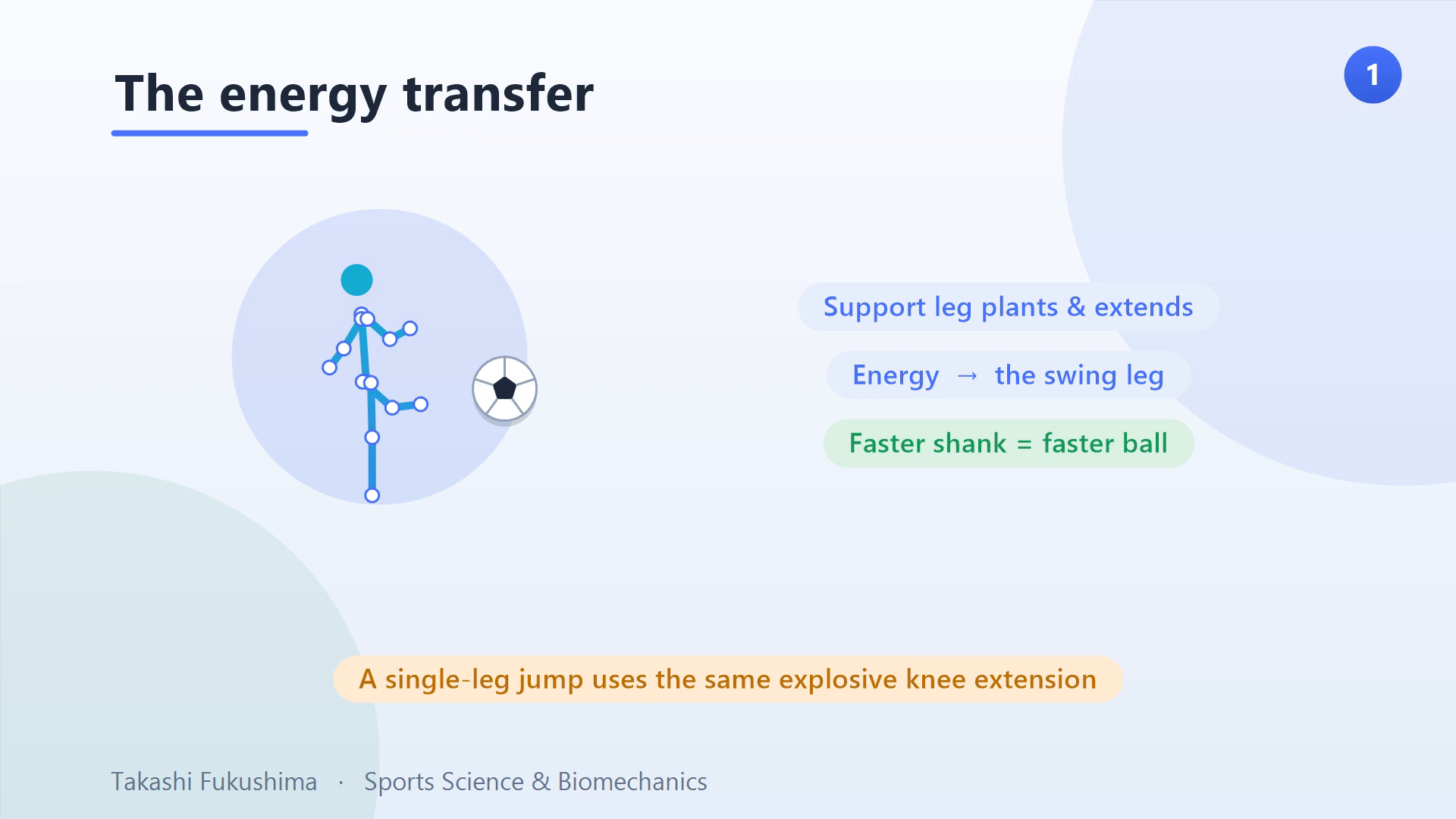
In a powerful instep kick, the support leg plants and extends right after absorbing the landing force, transferring energy up into the swinging leg. That whips the shank forward — and shank speed is what drives ball speed. A single-leg vertical jump uses that same explosive knee extension, which is exactly why a jump test might tell us something about a kick.
The question I tested
So the question: does the knee-extension moment — the turning force at the knee — during a single-leg jump predict the shank’s angular velocity during the kick? And what else might influence how fast that shank moves? Framing it this way lets a simple jump test stand in for a hard-to-measure kicking quality.
How I measured it
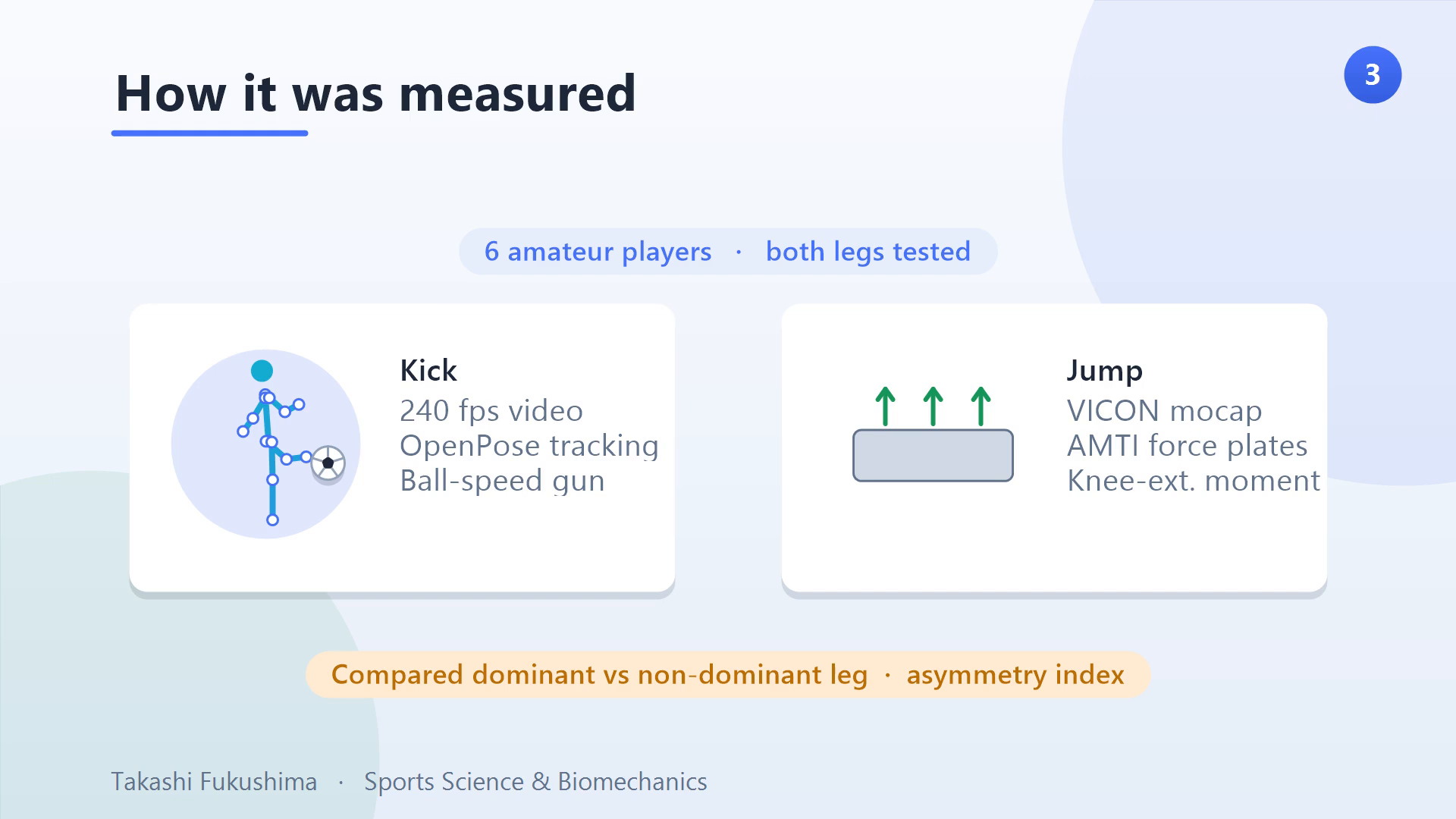
Six amateur players took part, and every measure was compared between the dominant and non-dominant leg. Kicks were filmed at 240 fps and tracked with OpenPose, while a speed gun measured ball velocity. Single-leg jumps were measured on force plates with a VICON system to get the knee-extension moment. Comparing dominant versus non-dominant leg gave an asymmetry index for each player.
A clear dominant-leg edge
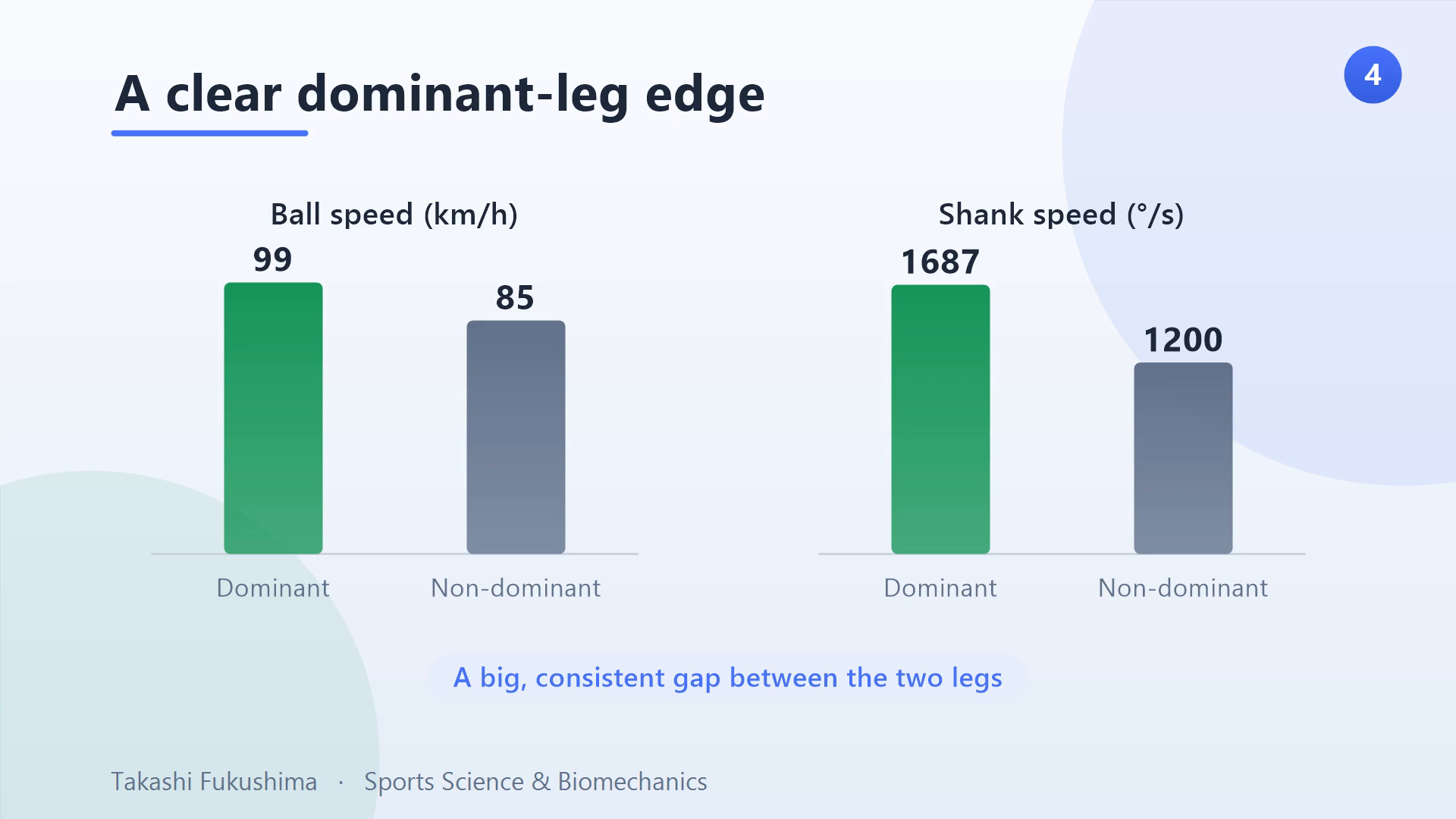
The dominant leg was clearly stronger. Ball speed averaged 99 km/h with the dominant leg versus 85 km/h with the other, and shank angular velocity was about 1687 °/s versus 1200 °/s — a big, consistent gap between the two legs.
| Measure | Dominant leg | Non-dominant leg |
|---|---|---|
| Ball speed | ~99 km/h | ~85 km/h |
| Shank angular velocity | ~1687 °/s | ~1200 °/s |
The surprising link: jump and kick asymmetry
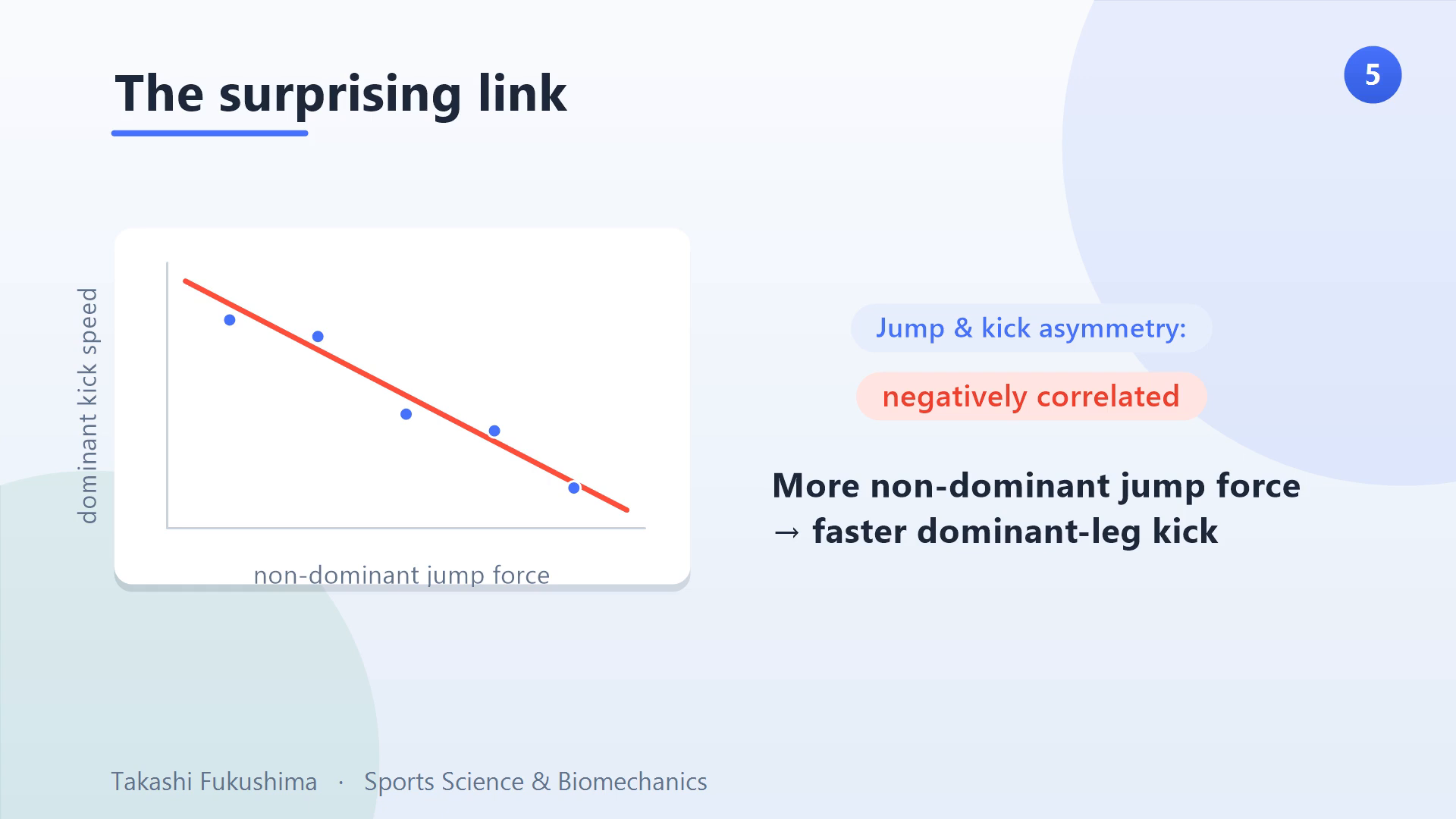
Here is the surprise. The jump and kick asymmetries were negatively correlated. Players who produced more knee-extension force with their non-dominant leg in the jump tended to kick faster with their dominant leg. In other words, a stronger “weaker” leg went with a faster strong-leg kick — the opposite of what you might expect.
Why the support leg matters
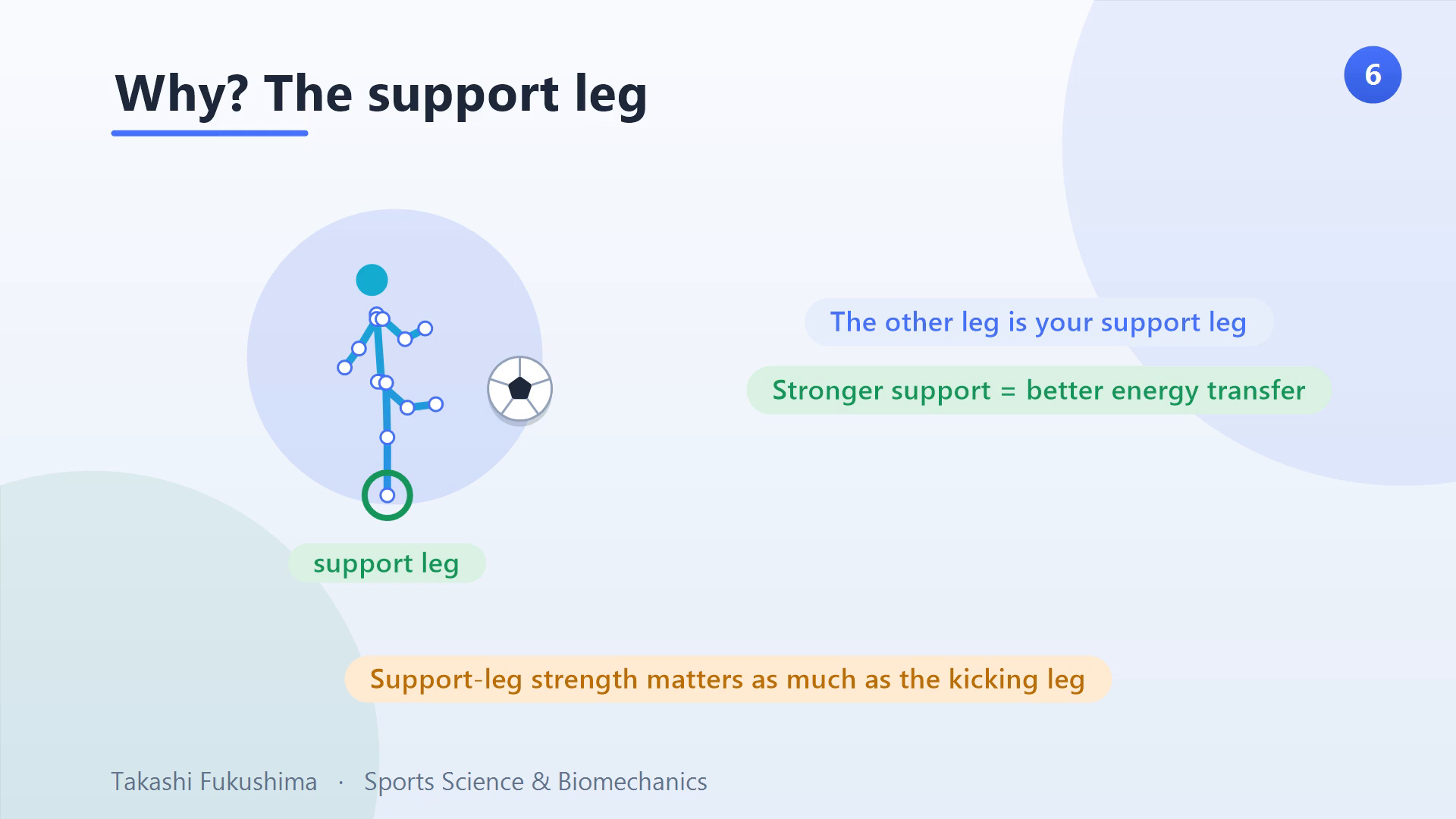
Which actually makes sense. When you kick with your dominant leg, your non-dominant leg is the support leg. A stronger, more explosive support leg gives the swing leg a better platform to transfer energy from — so a powerful “jump leg” on that side shows up as a faster kick on the other. Support-leg strength matters as much as the kicking leg.
Other signals: knee angle and leg-cocking time
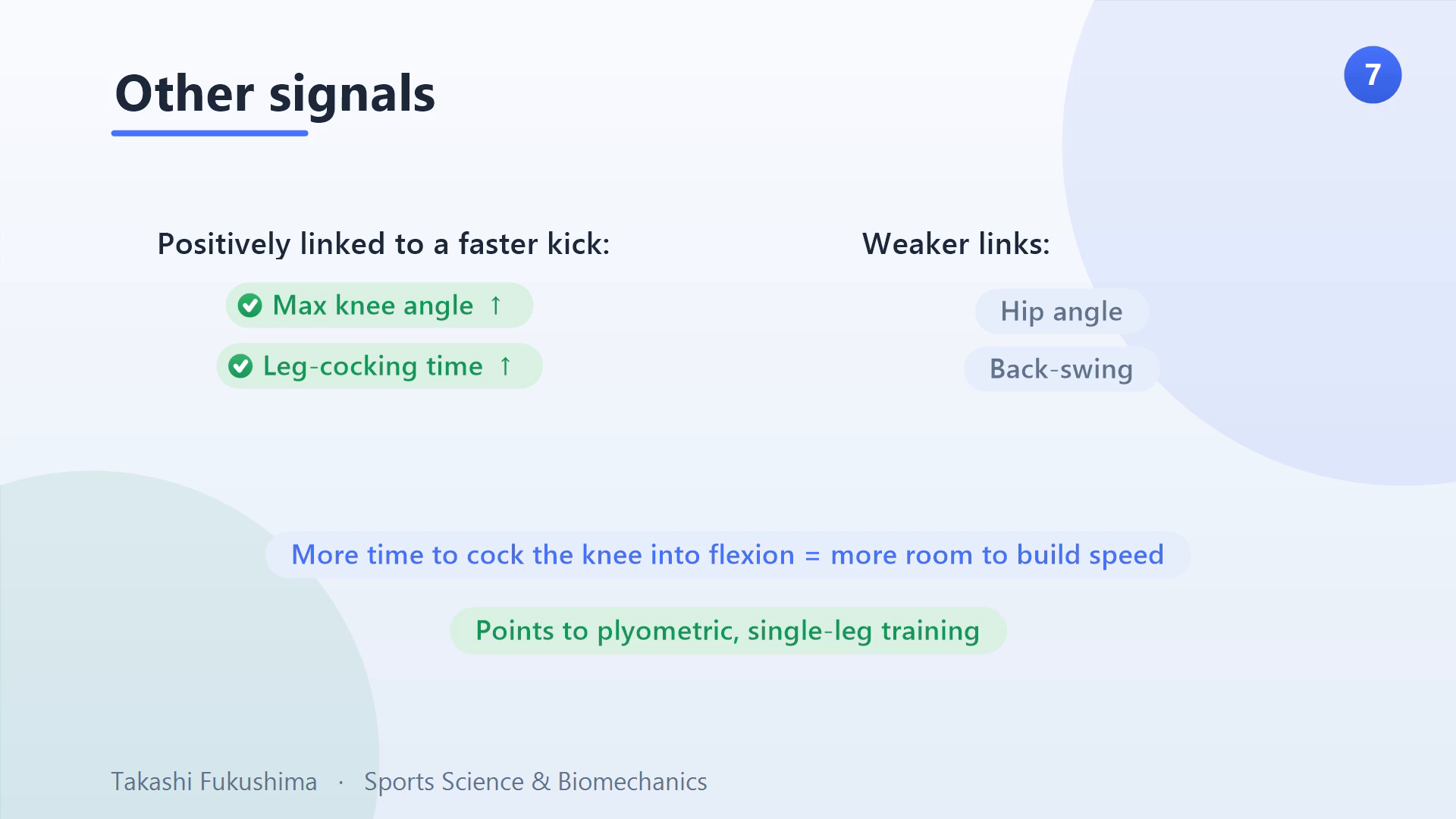
Two more signals stood out. Asymmetry in maximum knee angle and in leg-cocking time were positively correlated with shank-speed asymmetry: more time to cock the knee into flexion means more room to build velocity. Hip angle and back-swing mattered less. Together these point toward single-leg plyometric training as a lever for kick speed.
One big caveat
Now the honest caveat. With only six players, none of these correlations reached statistical significance. These are trends, not proof. A larger sample and a regression model would be needed to confirm which factors really drive kick speed. Treat everything above as a well-motivated hypothesis, not a settled result.

Frequently asked questions
Does jump strength predict soccer kick speed?
In this small study, single-leg jump strength showed a suggestive link to kick speed — but through the support leg, not the kicking leg. More non-dominant-leg jump force went with a faster dominant-leg kick. It is a promising trend, though not yet statistically proven.
Why does the support leg matter for kicking?
When you kick, the opposite leg plants as the support leg and helps transfer energy into the swinging leg. A stronger, more explosive support leg gives a better platform, so improving it can raise the speed of the shank — and therefore the ball.
How can I train for a faster kick?
The data point toward single-leg plyometric jump training, and toward developing the support leg rather than only the kicking leg. Longer leg-cocking time and greater knee flexion also linked to faster kicks, so drills that build explosive single-leg extension are a sensible place to start.
The takeaway
Your kicking power may depend as much on your support leg as your kicking leg, and single-leg plyometric jump training is a promising way to build it. It is a small study with a big hint. For how the kick was tracked, see our guide to using OpenPose and OpenCap, and for the wider context, our overview of motion capture and performance analysis.
Takashi Fukushima — Sports Science & Biomechanics.
▶ Subscribe on YouTube · Website · ORCID · Contact