“Ready for the clinic” is the wrong question until you ask: ready for what? Two 2026 studies answer from opposite ends — a field-wide scoping review of video-based joint angles, and a basketball screening study that skips the lab entirely. Together they suggest markerless capture may reach the clinic as a coarse screening score well before it delivers clinical-grade joint angles.
Table of Contents
Ready for what, exactly?
The honest answer is that readiness is not one threshold. Three facts frame it: the field-wide sagittal median error is still about 5–6°; the evidence base is 117 studies, mostly run in labs on healthy adults, mostly walking; and a summary score can tolerate error that a joint angle cannot. Ask “is a knee-flexion angle clinic-ready?” and the answer is no. Ask “can a pass/flag screening score be trusted?” and it moves closer to yes.

Paper 01 — 117 validation studies, one recurring gap
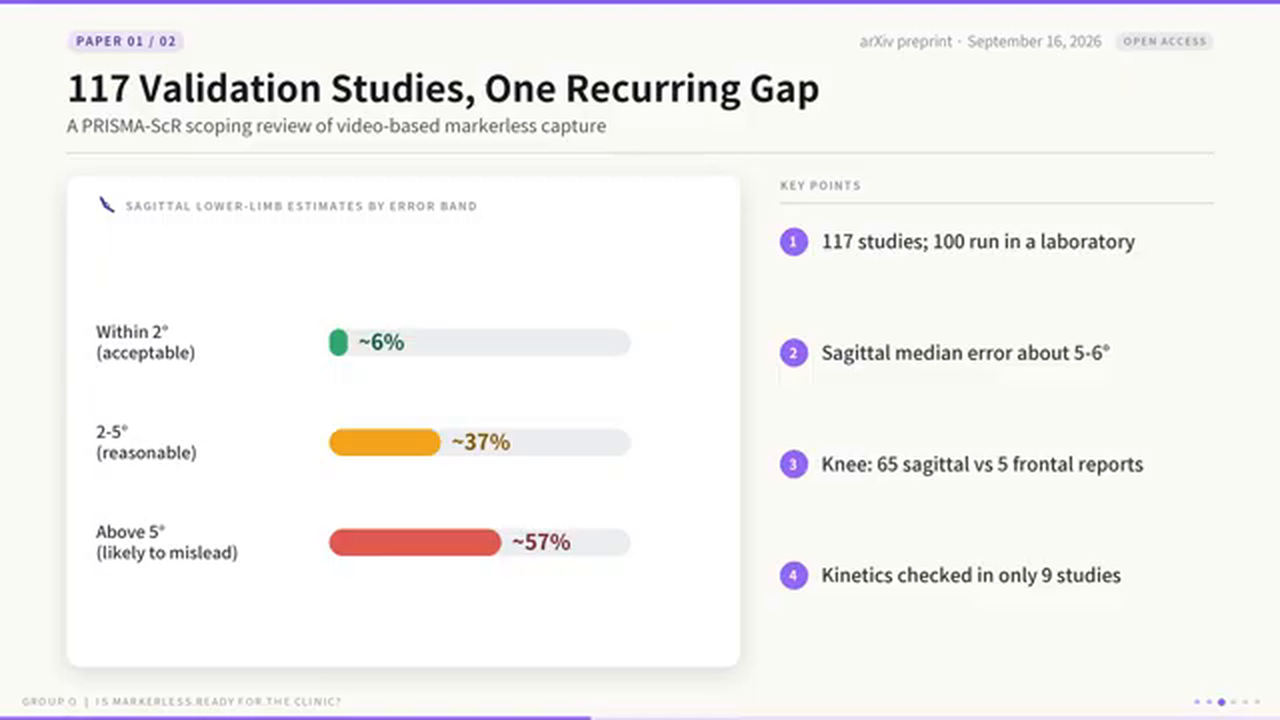
A PRISMA-ScR scoping review audited 117 validation studies of video-based markerless capture — and 100 of them ran in a laboratory. Sagittal lower-limb estimates cluster around a 5–6° median error: only about 6% land within a clinically comfortable 2°, while roughly 57% exceed 5°. The recurring gap is structural — the knee has 65 sagittal reports but only 5 frontal, and kinetics were checked in just 9 studies. The plane and the setting where clinics most need evidence are the least studied.
Paper 02 — A landing score without the lab
The second study skips joint-by-joint angles and goes straight for an outcome: an automated LESS (Landing Error Scoring System) score from OpenCap, validated against Vicon in 10 adults and then applied to 21 Division I basketball players across three time points. The automated total agreed well with the lab (ICC 0.88, mean difference −0.57 LESS points), stayed broadly stable across the season, and flagged that about one in three players had limited knee flexion — a coarser, clinically meaningful readout reached without a motion lab.
Readiness depends on the question
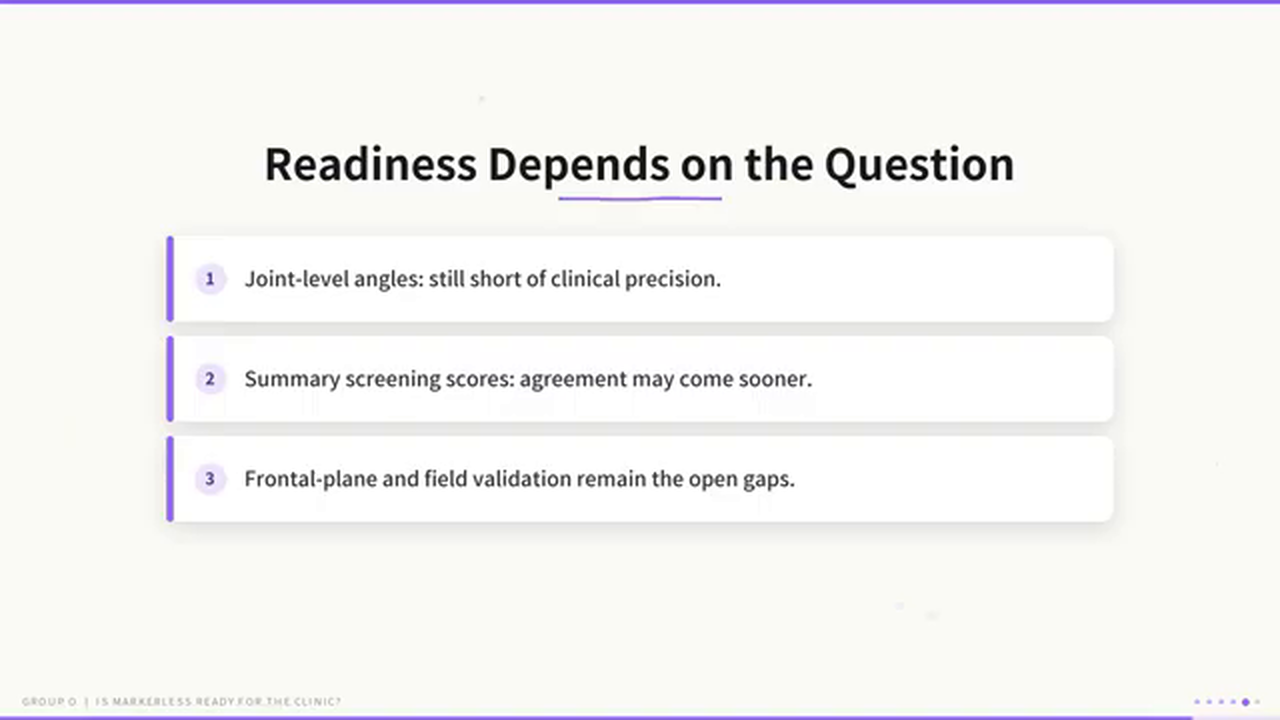
So: readiness depends on the question. Joint-level angles remain short of clinical precision, especially off the sagittal plane and outside the lab — the review’s two biggest open gaps are frontal-plane and field validation. But a summary screening score may reach usable agreement sooner, because it tolerates the per-angle error that sinks a precise measurement. For where those underlying joint angles stand, see where markerless kinematics holds up, and for the accuracy of the estimators beneath them, six models vs Vicon.
Frequently asked questions
Is markerless motion capture accurate enough for clinical use?
For precise joint angles, not yet: a 2026 scoping review of 117 studies found a sagittal lower-limb median error around 5–6°, with only ~6% of estimates within 2°. Accuracy is weakest exactly where clinics need it — frontal-plane angles and real field settings, both under-studied. Clinical-grade joint kinematics remain out of reach for now.
What is markerless capture good enough for today?
Coarser, summary-level outcomes. A 2026 study computed an automated LESS landing score from OpenCap that agreed with Vicon (ICC 0.88) and tracked a basketball season, flagging limited knee flexion in about a third of players. A screening score tolerates the per-angle error that would sink a precise measurement, so it can be useful sooner.
Why do frontal-plane angles matter for markerless validation?
Because they are the weak spot. In the review, the knee had 65 sagittal reports but only 5 frontal, and kinetics appeared in just 9 studies — yet frontal-plane motion such as knee valgus is central to injury screening. Until frontal-plane and on-field validation catch up, markerless clinical claims should stay cautious.
References
[1] Delaplace, F., Piche, E., Chorin, F., & Zory, R. (2026). Video-Based Markerless Motion Capture for Clinical and Rehabilitation Biomechanics: A PRISMA-ScR Scoping Review of Validated Architectures, Clinical Readiness, and Emerging Methods. arXiv:2609.18667.
[2] Pearson, E., Lemus, S. A., Otley, T., Jalife, O., Legaz, P., & Travascio, F. (2026). Automated LESS scoring using OpenCap: Validation and in-season application in collegiate basketball athletes. International Journal of Sports Science & Coaching. https://doi.org/10.1177/17479541261461182
Takashi Fukushima — Sports Science & Pose Estimation.
▶ Subscribe on YouTube · Website · ORCID · Contact