Pose estimation lets you measure movement straight from ordinary video — but pose estimation accuracy varies a lot between models, and for kinematic analysis that accuracy is what matters most. So which model should you actually use? In this validation study (summarised in the video above) we put six popular pose-estimation models and variants head to head against a marker-based reference system to compare their accuracy.
Table of Contents
The six contenders
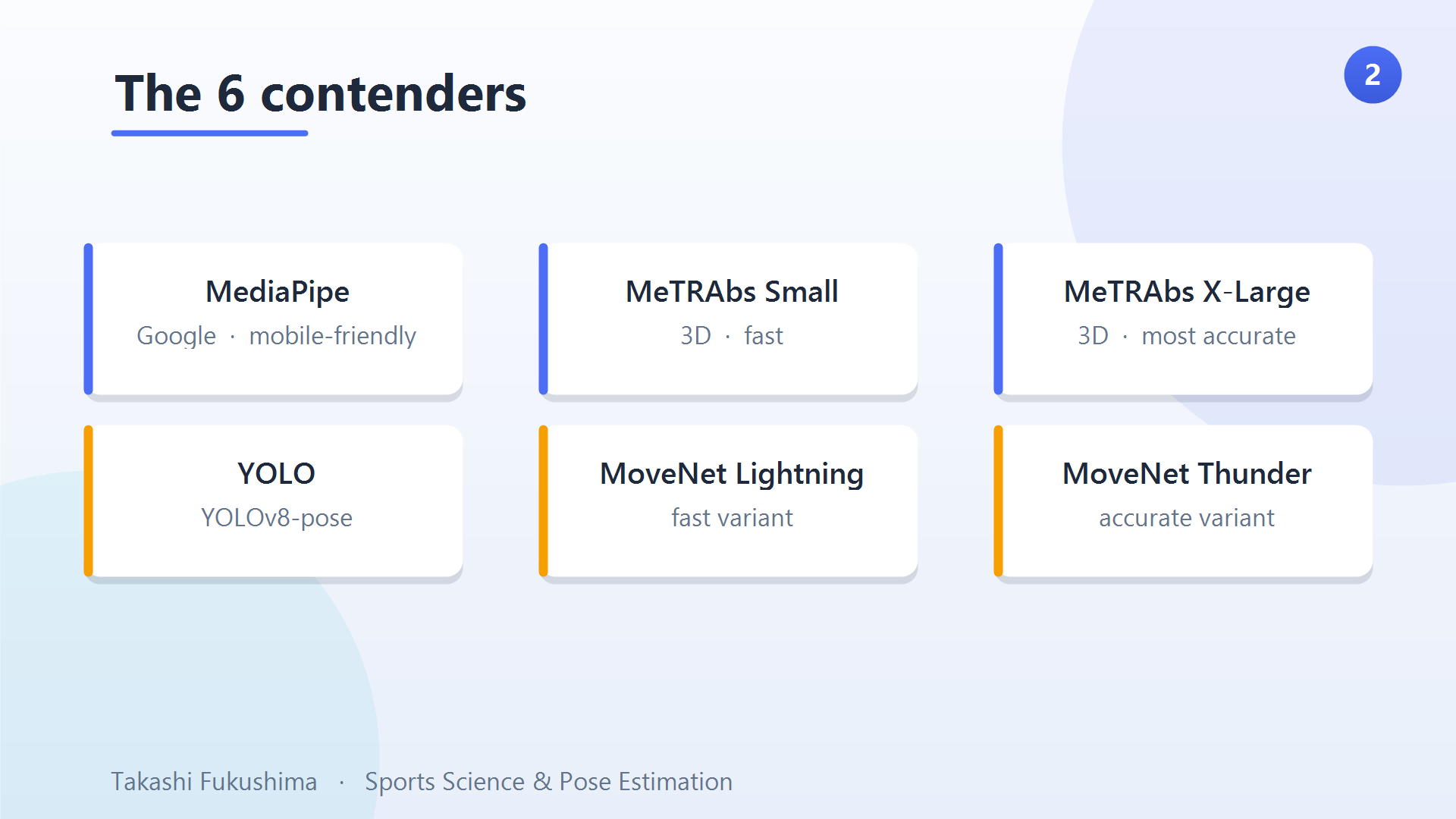
We compared six models and variants that span the speed–accuracy spectrum: MediaPipe, MeTRAbs Small, MeTRAbs X-Large, YOLO (YOLOv8-pose), MoveNet Lightning, and MoveNet Thunder. Each detects human body landmarks from an image, but they differ in architecture, output (2D vs 3D), and how fast they run.
The test
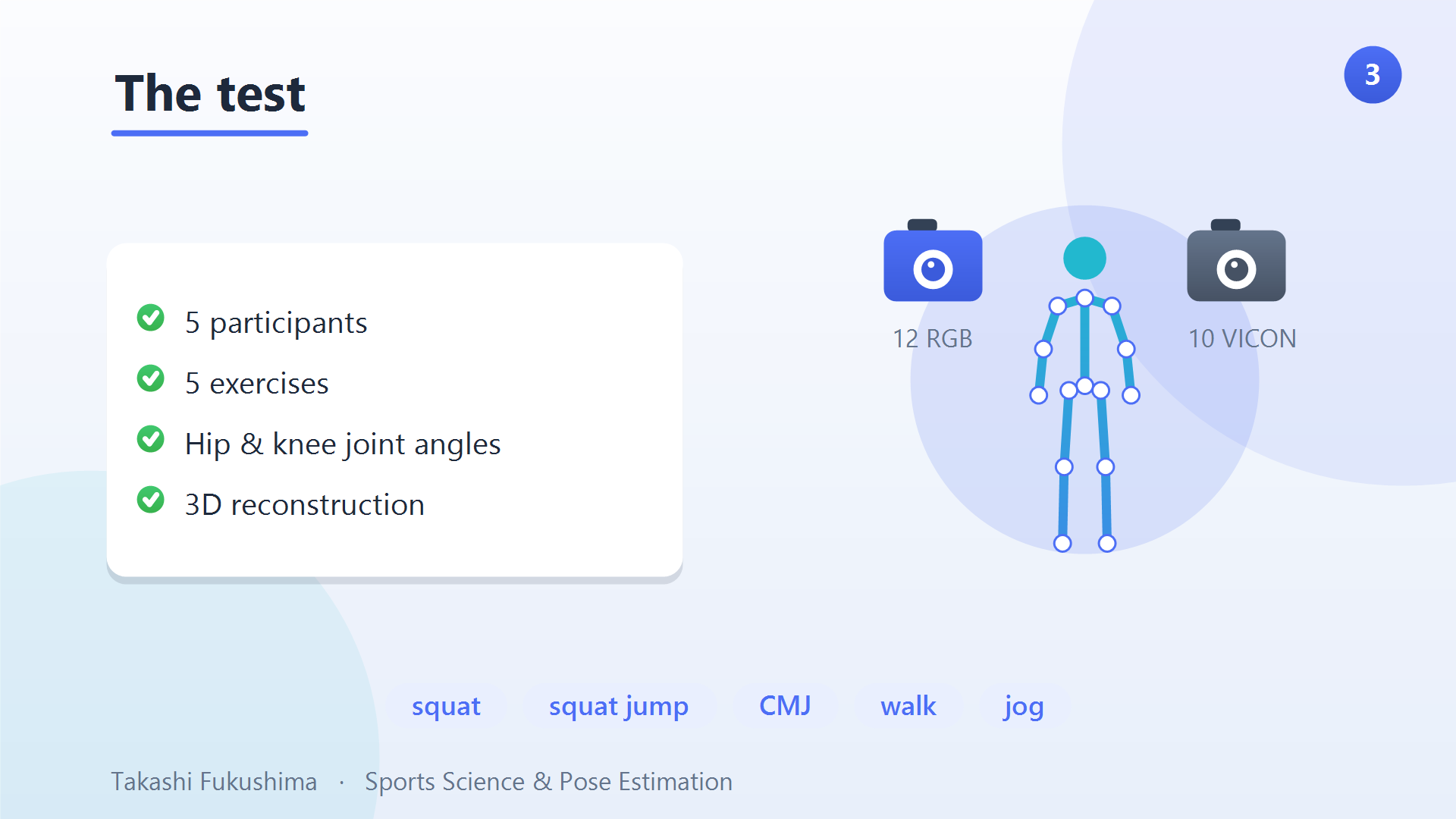
Five participants each performed five exercises — squat, squat jump, counter-movement jump, walking, and jogging — while being recorded simultaneously by twelve ordinary RGB cameras (feeding the pose-estimation models) and ten VICON infrared cameras as the gold-standard reference. The camera views were calibrated and triangulated to reconstruct the joints in 3D, and we then compared the hip and knee joint angles from each model against VICON.
Pose estimation accuracy: a clear split
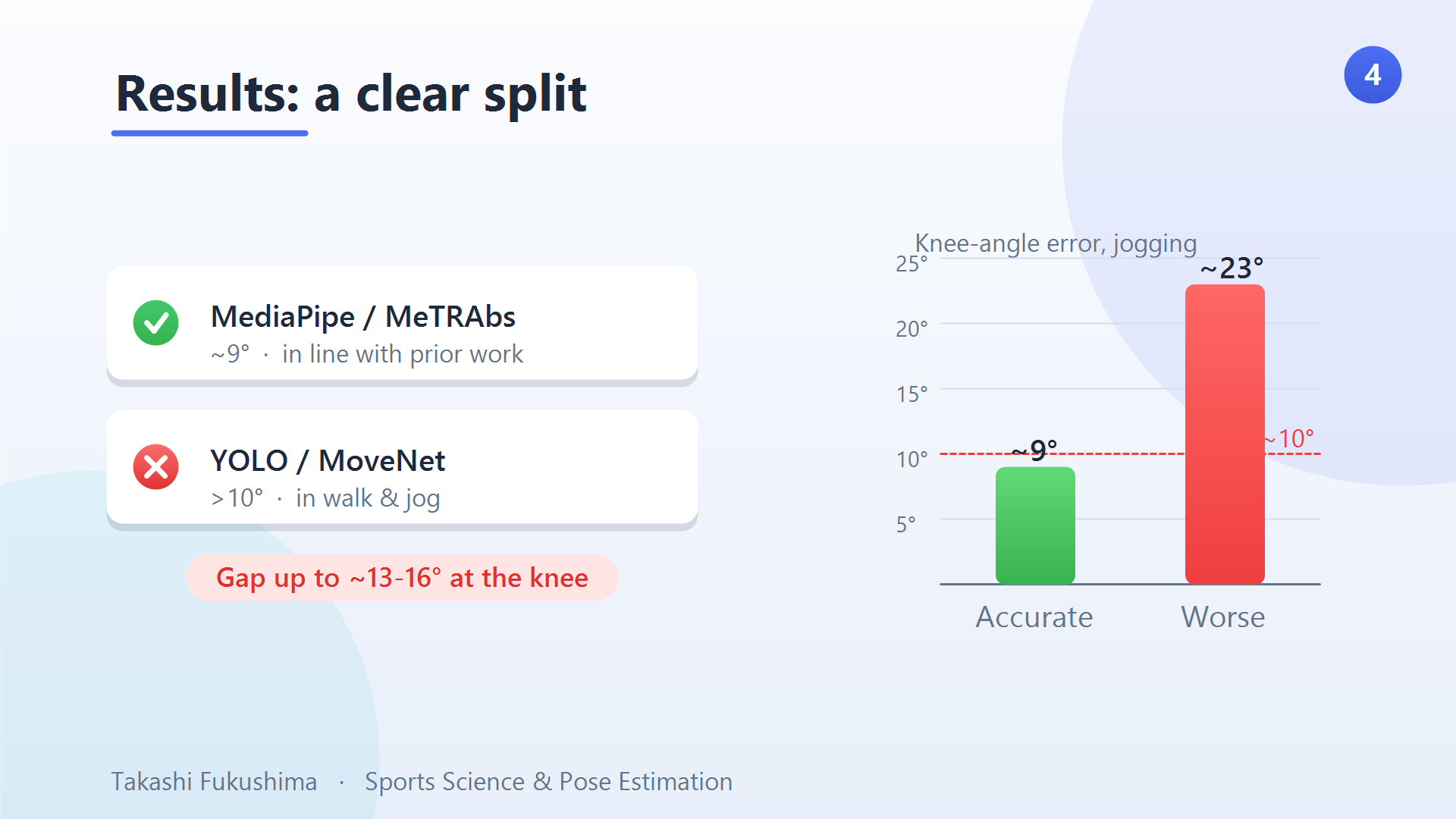
The models fell into two clear tiers. MediaPipe, MeTRAbs Small, and MeTRAbs X-Large stayed around 9° of error — in line with previous validation work. YOLO, MoveNet Lightning, and MoveNet Thunder, by contrast, exceeded 10° during walking and jogging, with the largest gap at the knee: in jogging, the difference between the two groups reached roughly 13–16°.
A Bland–Altman analysis showed that every model slightly over-estimated the angles, with biases ranging from +4.5° (MoveNet Thunder) to +6.6° (YOLO). The MeTRAbs models had the narrowest limits of agreement — in other words, the most stable agreement with the gold standard across the range of motion. YOLO was the most erroneous overall.
What drives the error?
A three-way repeated-measures ANOVA found that the model and the exercise significantly affected the error (both p < .001), but the specific joint did not (p = .301). Among exercises, squatting was the easiest to measure and walking the hardest — suggesting the models are well trained for slow, controlled movements but struggle with faster, more dynamic ones. That interaction between model and exercise is the key result: the “best” model depends on what you’re measuring.
Which model should you use?
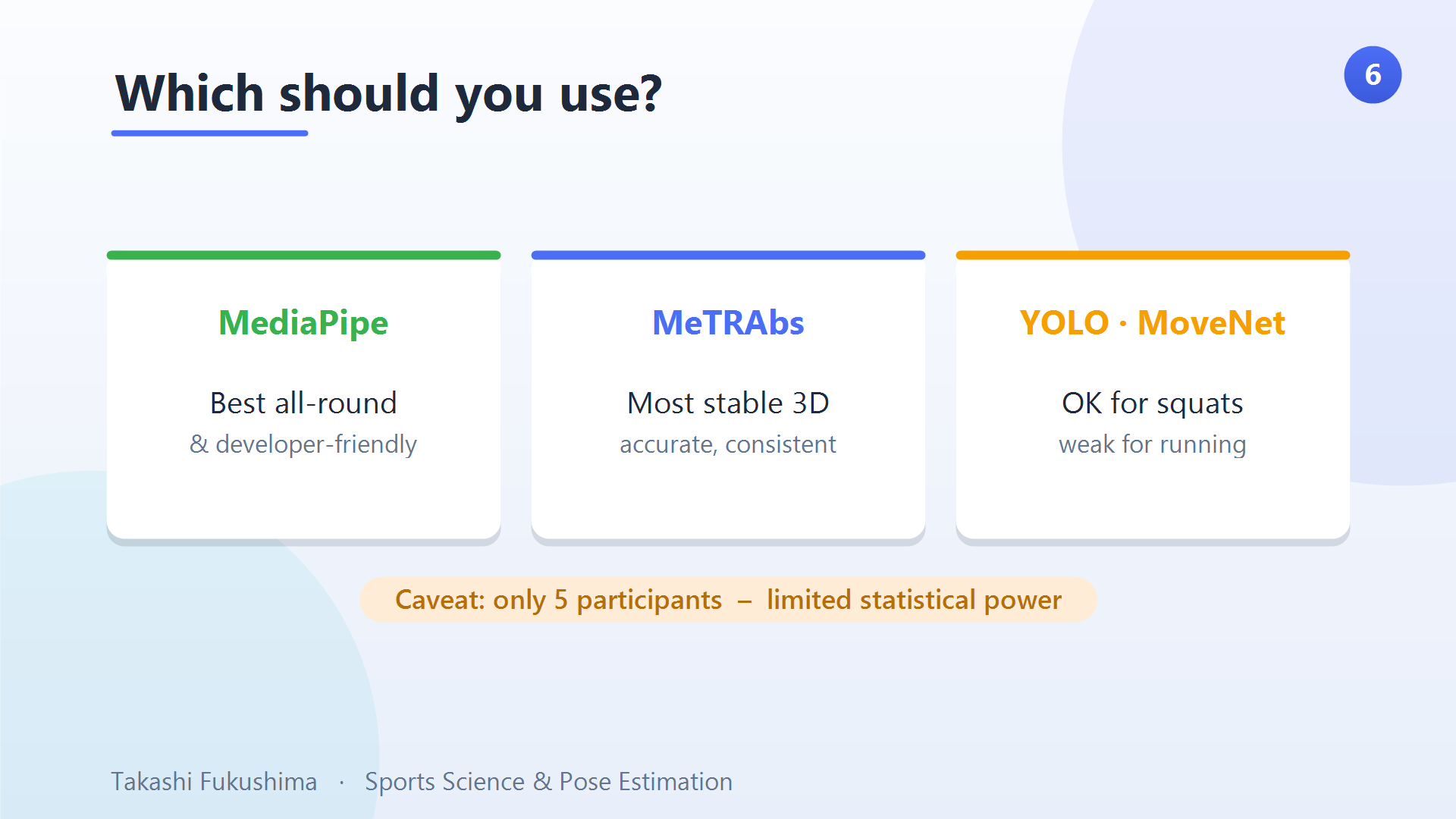
- MediaPipe — the best all-round choice, and the most developer-friendly. A sensible default for most applications.
- MeTRAbs (Small or X-Large) — when you need stable, consistent 3D; it showed the tightest agreement with the reference.
- YOLO / MoveNet — fine for slow or static movements like squats, but weak for fast running. YOLO in particular has room to improve with fine-tuning.
One important caveat: with only five participants, the statistical power was limited, so many post-hoc comparisons were not significant. Treat these as differentiated recommendations rather than definitive rankings.
Where accurate pose estimation matters
Markerless pose estimation is attractive because it measures joint angles from ordinary video — no reflective markers, no motion-capture suit, and a fraction of the cost of a lab setup. That is exactly why it is spreading into coaching, rehabilitation, and biomechanics research, where being able to film an athlete on a phone and get kinematics back is genuinely transformative. But the value of those numbers depends entirely on the underlying pose estimation accuracy: a 10° error at the knee can be the difference between a meaningful clinical finding and noise. This study is a reminder to check how accurate your chosen model actually is for the movement you care about before you build decisions on top of it.
Frequently asked questions
How accurate is markerless pose estimation compared with VICON?
In this study the best models — MediaPipe and the two MeTRAbs variants — stayed around 9° of error for hip and knee angles, in line with previous validation work. YOLO and MoveNet exceeded 10° during walking and jogging, so pose estimation accuracy ranges from “good enough for many applications” to “too coarse for fast movement,” depending on the model.
Which pose estimation model is best for sports movement analysis?
For dynamic lower-body movement, MediaPipe gives the best all-round accuracy and is the easiest to work with, while MeTRAbs produces the most stable 3D output. YOLO and MoveNet are better kept for slow or static tasks such as squats.
Why is pose estimation accuracy worse for running than for squats?
Fast, dynamic movements involve motion blur and rapid joint-angle changes that the models handle less reliably. A squat is slow and controlled, so every model tracks it well; jogging is where the two tiers separated most, especially at the knee.
Can I improve pose estimation accuracy?
Yes. Better camera coverage, careful calibration, and clean triangulation all help, and models such as YOLO have clear room to improve when fine-tuned on sport-specific data rather than used off the shelf.
The takeaway
There is no single “best” pose-estimation model — match the model to the movement you’re analysing. For dynamic, lower-body kinematics, MediaPipe and MeTRAbs are the safer bets; YOLO and MoveNet are convenient for simpler tasks. Knowing where each one breaks down — and how much pose estimation accuracy you really need — is what lets you trust the numbers. For the bigger picture, see our overview of how AI pose estimation compares with marker-based motion capture.
If you’re relying on a phone’s built-in tracking instead of a dedicated pose-estimation model, see how ARKit’s motion-capture accuracy held up across 10 exercises.
Read the full open-access study: Fukushima, T., Blauberger, P., Guedes Russomanno, T., & Lames, M. (2025). Comparison of different pose estimation models for lower-body kinematics: A validation study. Scientific Journal of Sport and Performance, 5(2), 253–268. https://doi.org/10.55860/XWJL7156 (CC BY-NC-SA 4.0)
Takashi Fukushima — Sports Science & Pose Estimation.
▶ Subscribe on YouTube · Website · ORCID · Contact