How do you measure exactly how an athlete moves — without markers, wires, or an expensive lab? That question sits behind our validation study, summarised in the video above and in this article. The real issue is simple to state and hard to answer: can markerless human pose estimation actually replace the gold standard of motion capture in sports?
Table of Contents
The gold standard, and its cost
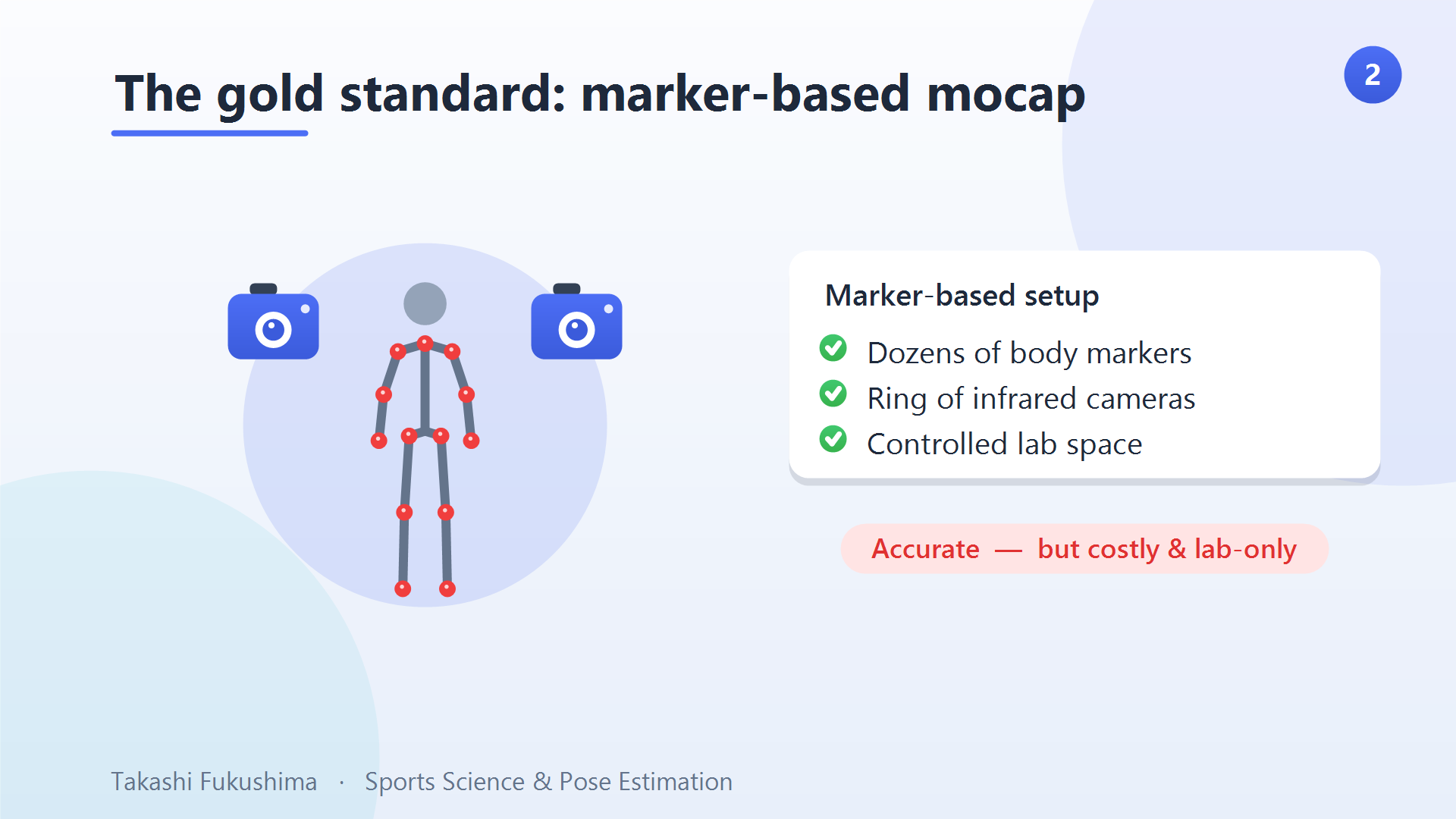
For decades, the reference method for kinematic analysis has been marker-based motion capture: dozens of reflective markers on the body, a ring of infrared cameras, and a controlled lab (systems such as VICON). It is genuinely accurate — which is exactly why new methods are validated against it — but it is slow to set up, expensive, and impossible at a real competition, where you simply cannot attach markers to athletes.
Enter markerless pose estimation
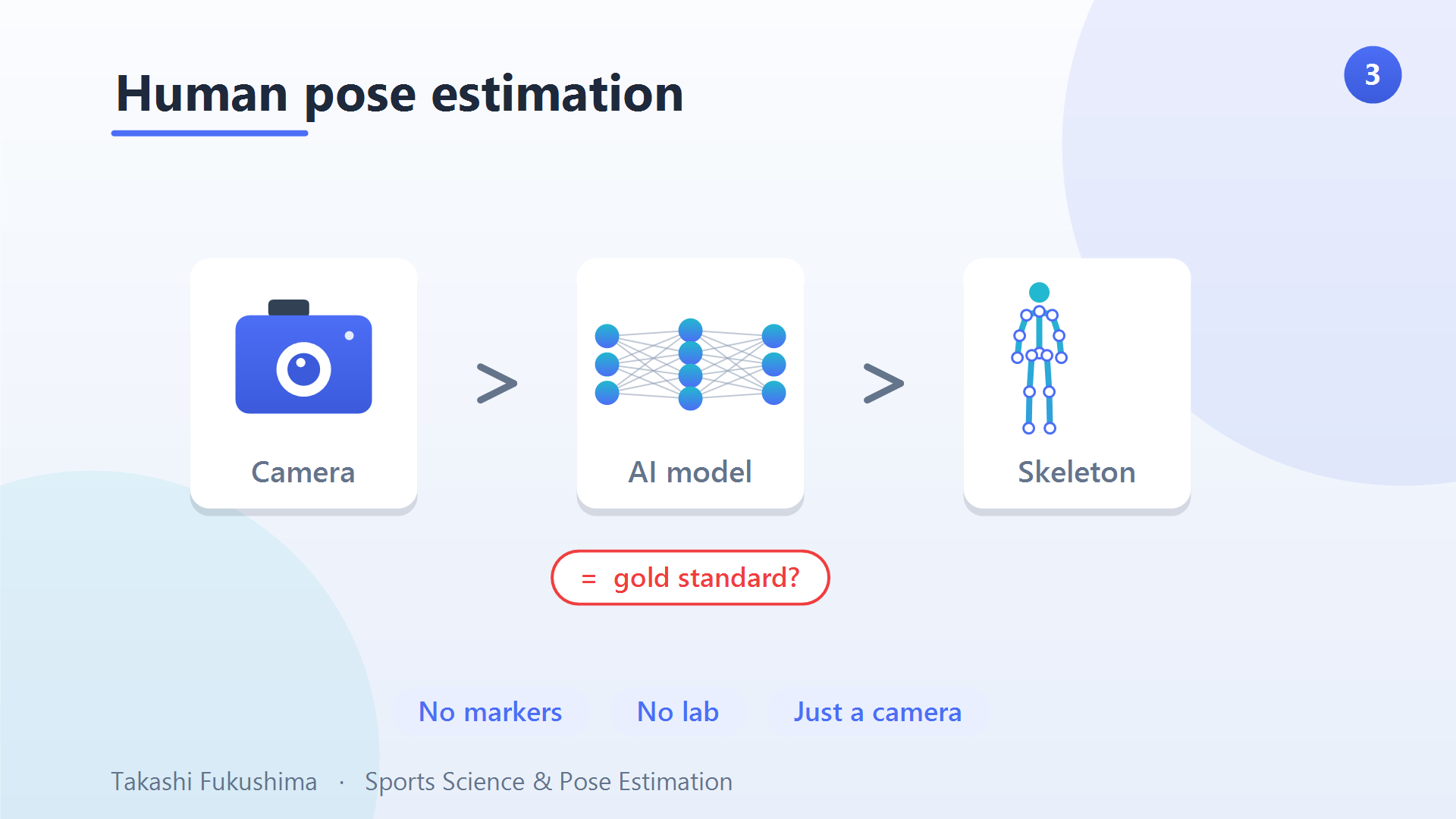
Human pose estimation flips the workflow. An AI model detects the body’s joints directly from an ordinary video — no markers, no lab, just a camera. That makes measurement cheap, fast, and possible almost anywhere, which matters because real performance happens at real competitions, not in a lab. The open question is accuracy: how close is markerless to the marker-based gold standard?
The study
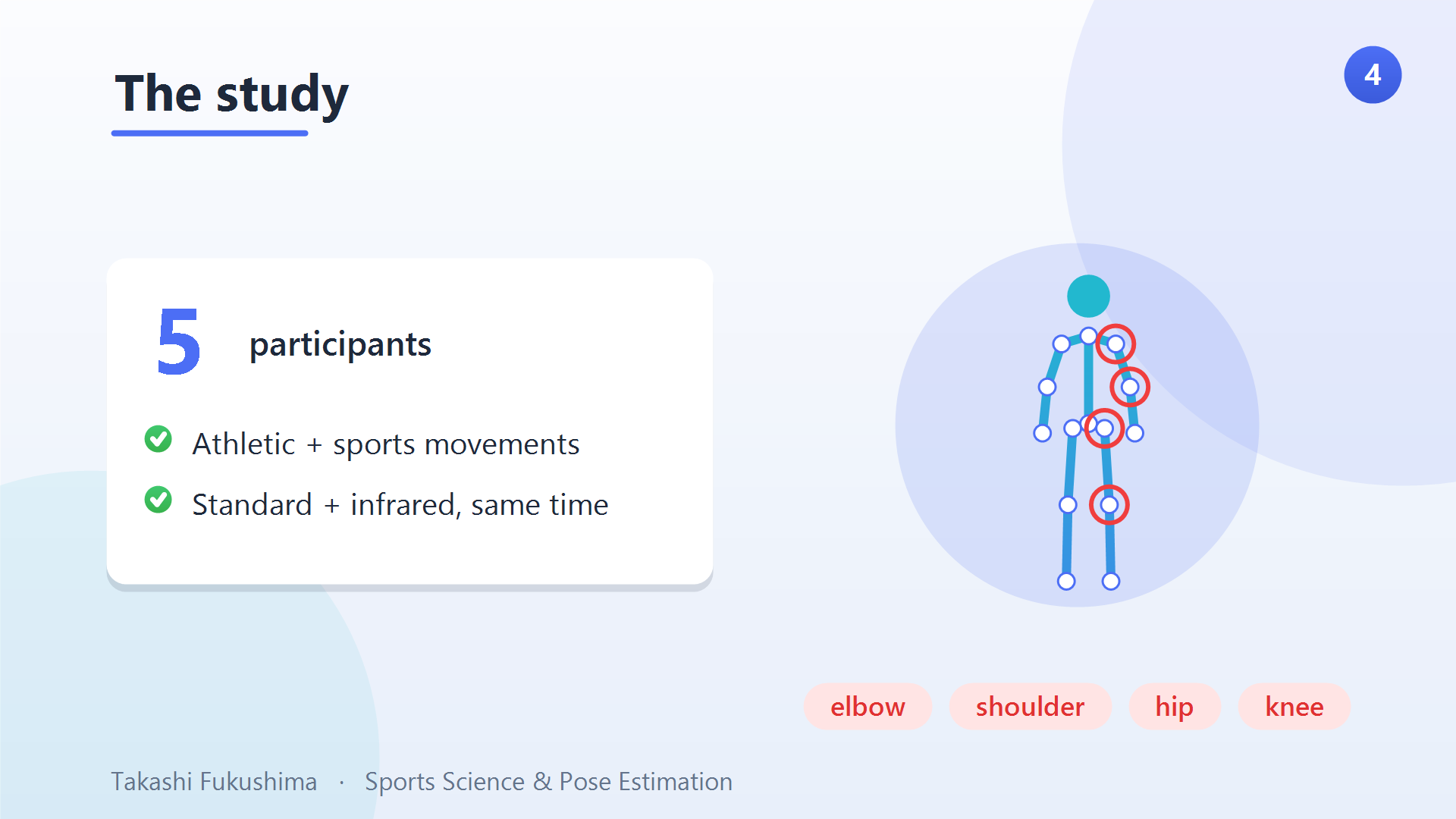
To find out, five participants performed two categories of movement — athletic movements and sports movements — recorded at the same time by ordinary cameras (for pose estimation) and an infrared marker-based system as the reference. We then compared the joint angles measured by each method at four joints: the elbow, shoulder, hip, and knee.
The results: about ten degrees
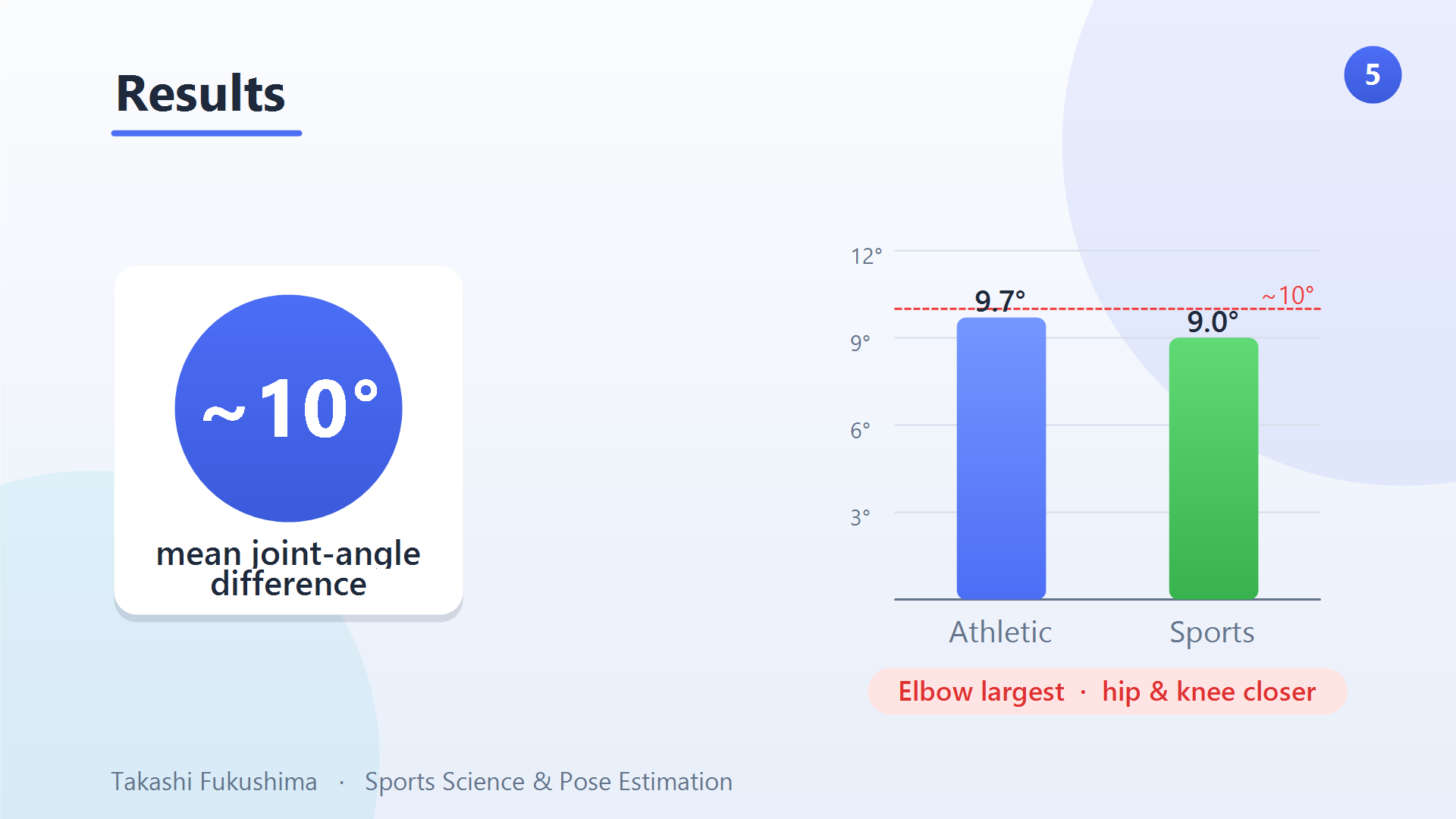
Overall, the mean difference between pose estimation and the gold standard was roughly ten degrees: 9.7° ± 4.7° for athletic movements and 9.0° ± 3.3° for sports movements. The elbow showed the largest discrepancy, while the hip and knee agreed more closely.
Ten degrees is essentially invisible in an eyeball comparison, but it is far too much for clinical-grade precision. In other words, whether that error matters depends entirely on the application.
Where does the error come from?
- Occlusion — the model only knows what the camera can see; a limb hidden behind the body has to be inferred.
- Training data — if the movement you care about is not well represented in the model’s training set, detection suffers.
- A systematic difference — and this one is subtle. A marker-based system tracks markers on the skin and then estimates the joint centre from anthropometry (an indirect measurement). Pose estimation detects the joint centre directly from the image. Because the two methods measure fundamentally different things, there is a consistent offset that inflates the averaged error — which means studies can actually overstate pose-estimation error for this very reason.
The takeaway
Markerless pose estimation is not yet a drop-in replacement for marker-based capture when you need clinical precision. But it already has real, practical value wherever strict precision is not required — screening, coaching feedback, and large-scale or in-competition analysis, exactly the settings where the marker-based approach cannot go. There is room to improve, and the potential is clear.
For a worked example of markerless capture applied to a real biomechanics question, see our study on whether jump strength predicts soccer kick speed.
Read the full open-access study: Fukushima, T., Blauberger, P., Guedes Russomanno, T., & Lames, M. (2024). The potential of human pose estimation for motion capture in sports: a validation study. Sports Engineering, 27(1), 19. https://doi.org/10.1007/s12283-024-00460-w
Takashi Fukushima — Sports Science & Pose Estimation.
▶ Subscribe on YouTube · Website · ORCID · Contact