How do you capture 3D movement from cameras — without markers? 3D markerless motion capture promises lab-quality kinematics from ordinary video, but “markerless” is not a single method. This post (summarised in the video above) walks through a conceptual framework and review that compares three practical approaches to 3D markerless motion capture in sport, so you can match the method to your budget, space, and accuracy needs.
Table of Contents
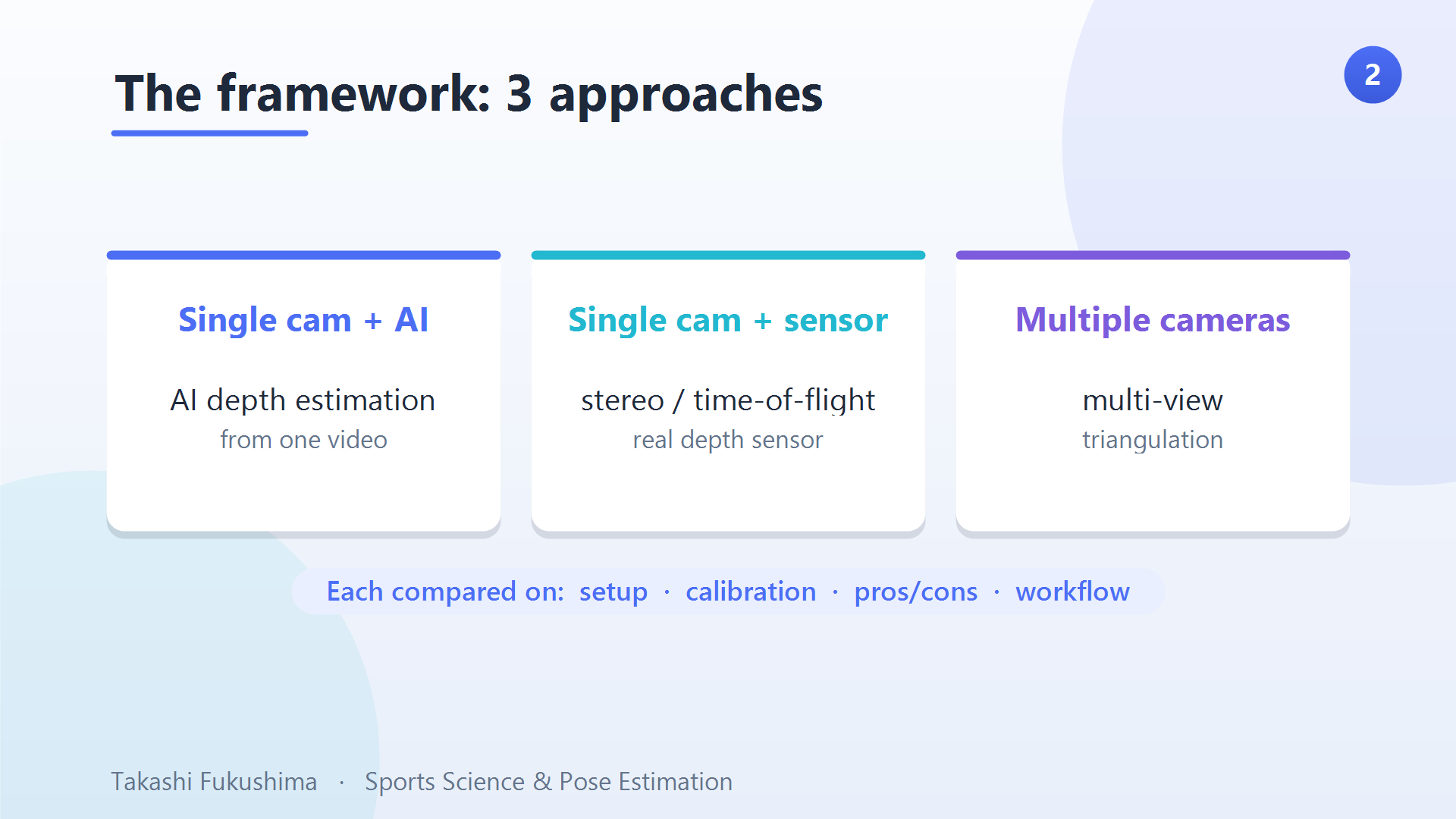
The three approaches at a glance
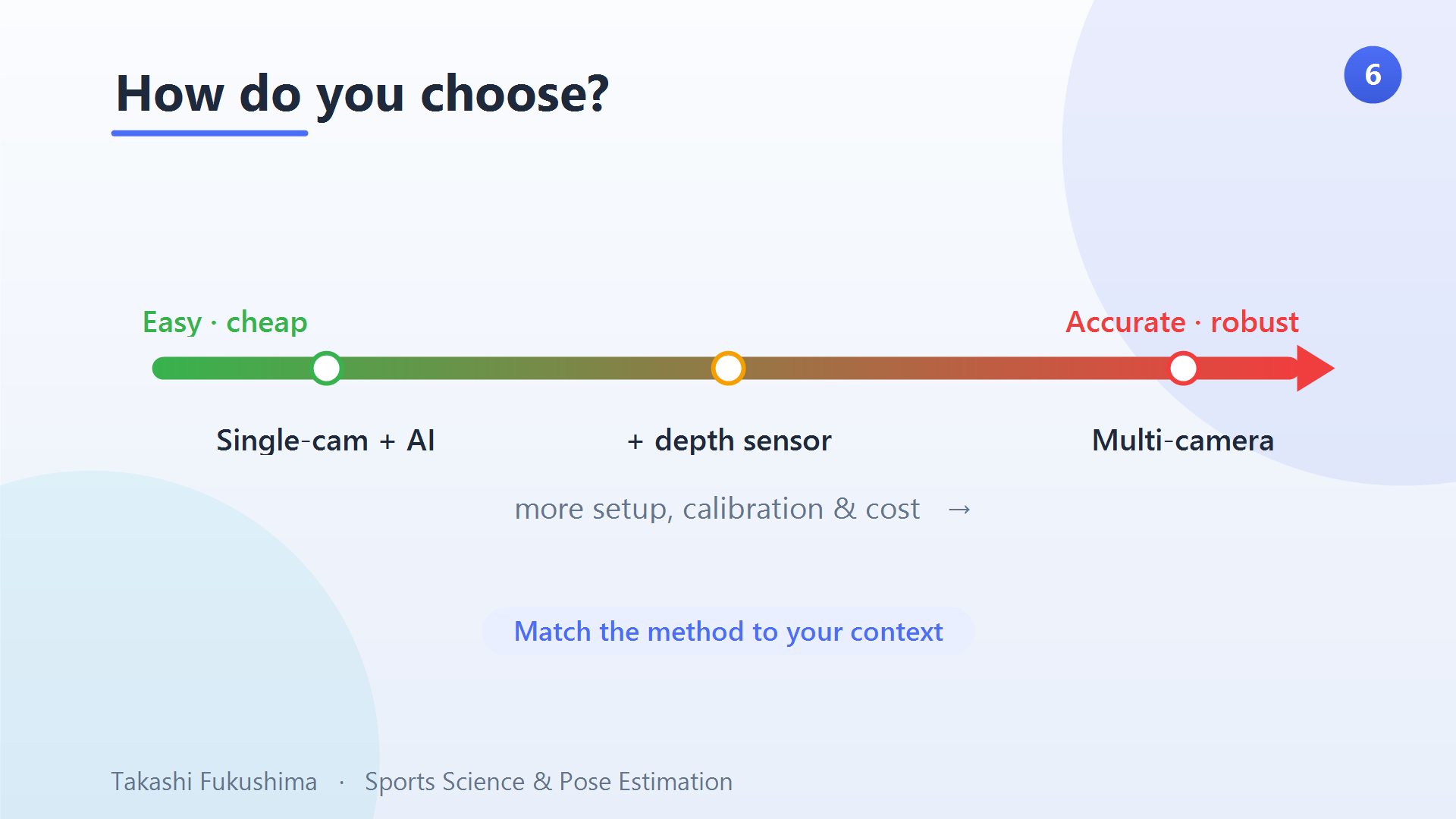
All three methods recover 3D joint positions without reflective markers, but they trade off accuracy, cost, portability, and setup effort very differently. In short: a single camera with AI depth is the cheapest and most portable; a single camera with a depth sensor adds real depth from one viewpoint; and multiple synchronised cameras give the most accurate 3D. The right choice depends on your context.
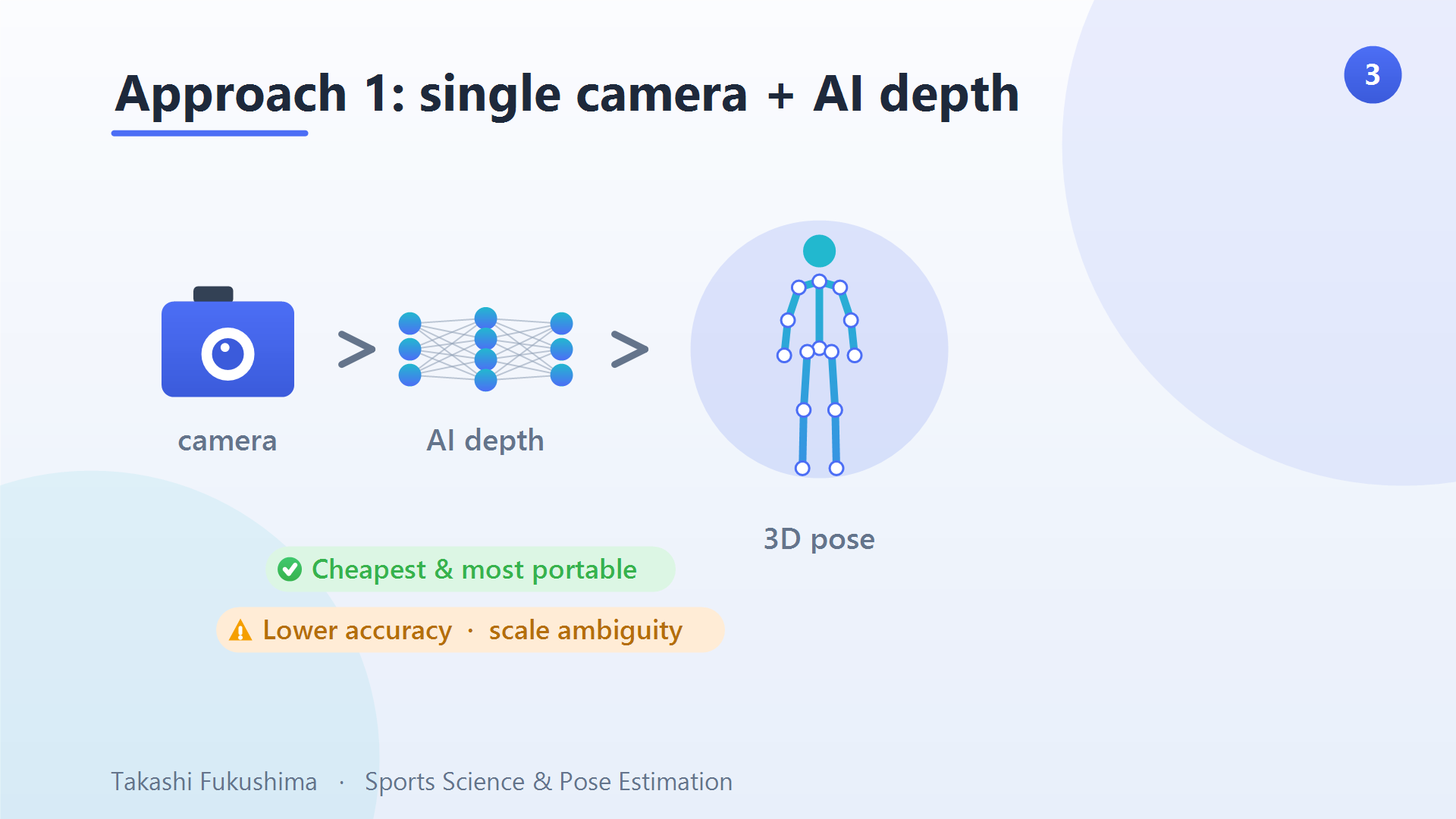
Approach 1: Single camera + AI depth estimation
The most accessible form of 3D markerless motion capture uses one ordinary video and a neural network that infers depth and lifts 2D pose to 3D. It is the cheapest and most portable option — a single phone can be enough — which makes it ideal for field work, remote testing, or quick screening. The trade-offs are lower accuracy and scale ambiguity: from one viewpoint the model has to guess absolute size and distance, so metric measurements are less reliable than multi-camera systems.
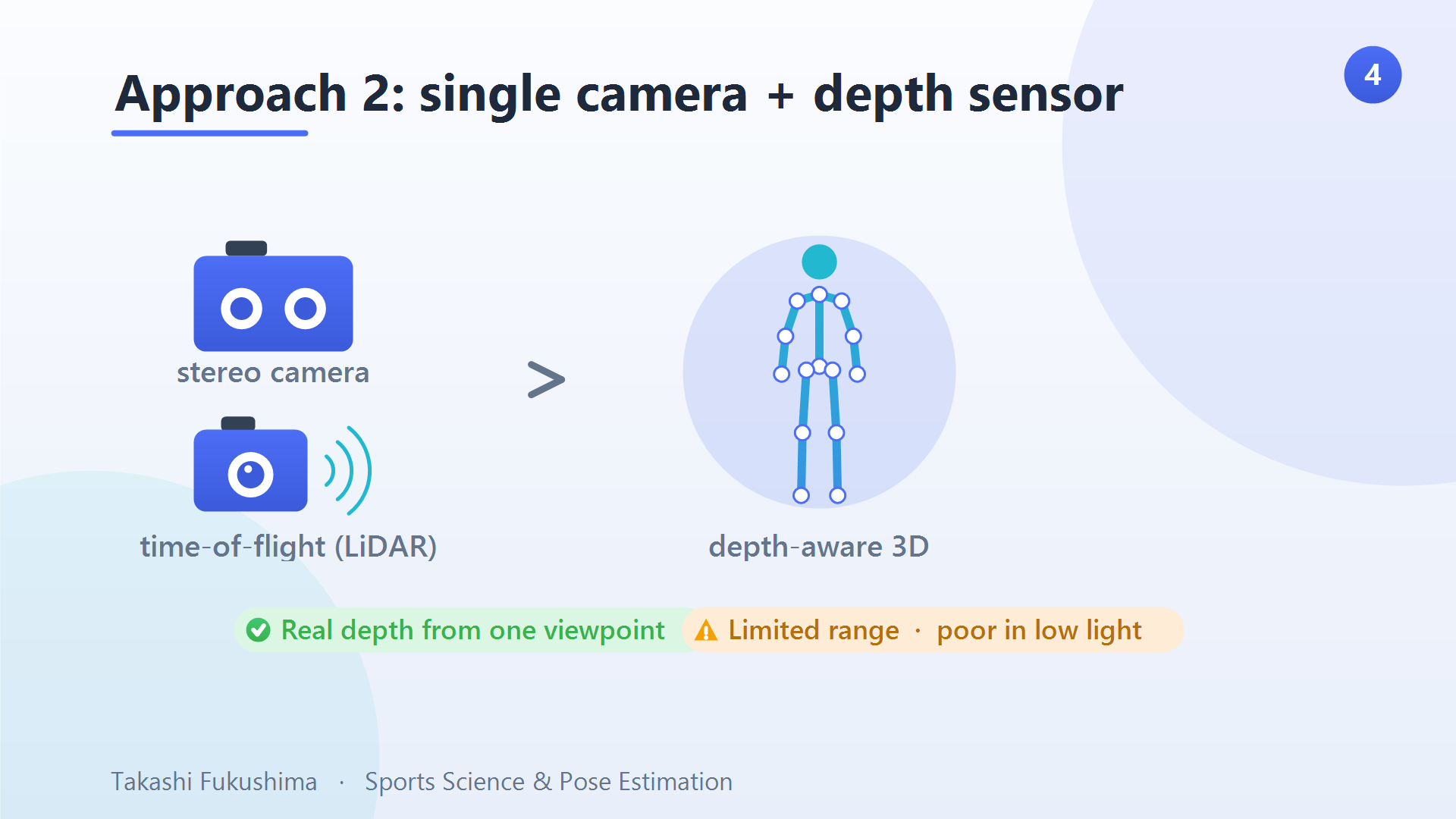
Approach 2: Single camera + depth sensor
Instead of inferring depth, this approach measures it with a stereo camera or a time-of-flight sensor — for example the LiDAR sensor now built into many phones and tablets. You still shoot from a single viewpoint, but you get real depth rather than an AI estimate, which improves 3D reliability without a full multi-camera rig. The limitations are a restricted measurement range and weaker performance in poor lighting or outdoors, where many depth sensors struggle.
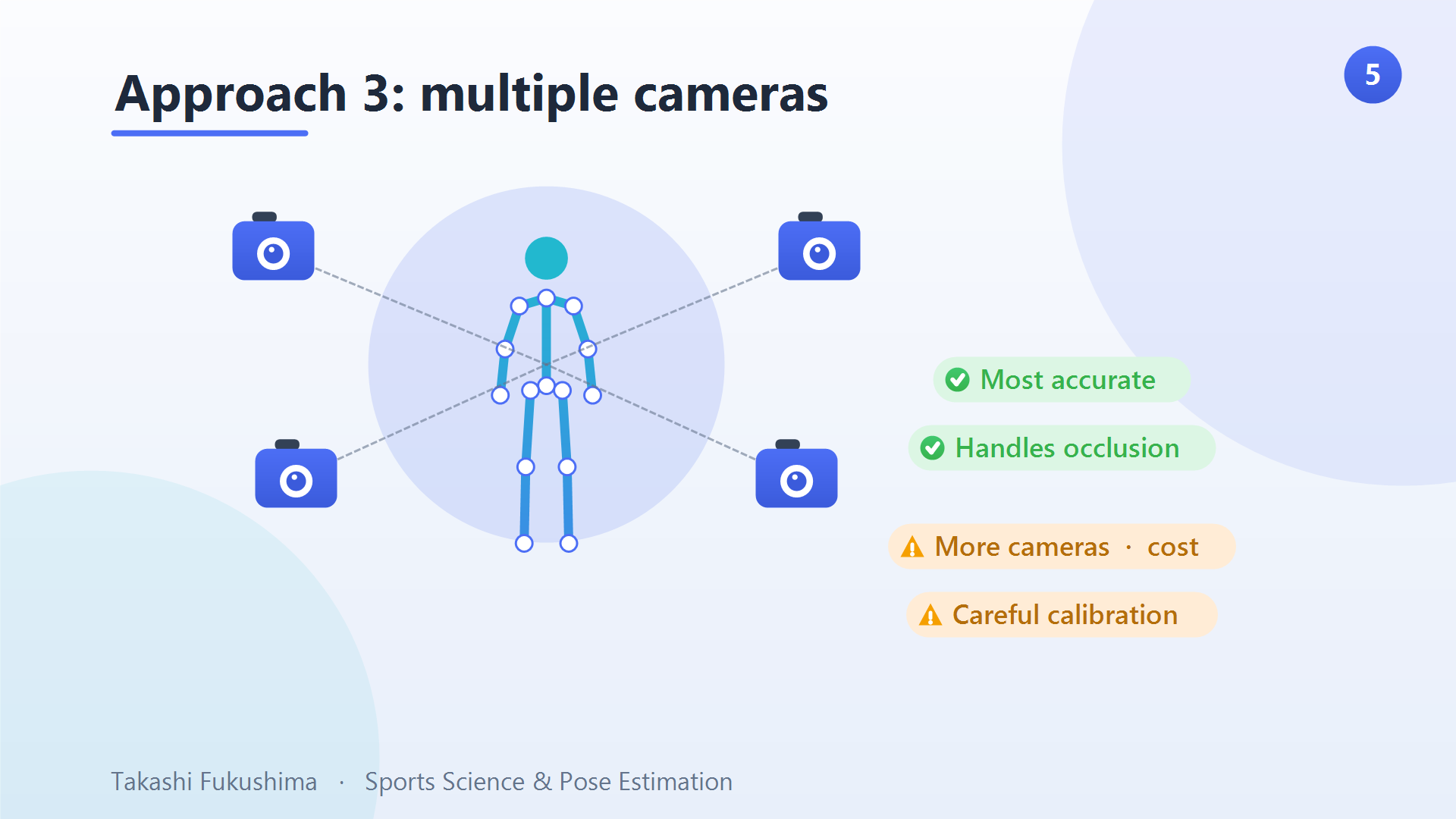
Approach 3: Multiple cameras
The most accurate approach uses several synchronised cameras. Their views are calibrated and triangulated into accurate 3D coordinates, much like a marker-based lab but without the markers. Multiple viewpoints also handle occlusion — when a limb hides behind the body in one camera, another still sees it. The cost is complexity: more cameras, synchronisation, and careful calibration. For a hands-on look at a multi-camera pipeline, see our guide to using OpenPose and OpenCap.
How to choose your setup
Each approach is compared on setup, calibration, pros and cons, and data workflow, and the honest bottom line is that there is no one-size-fits-all. Match the method to your context: choose single-camera AI for portability and cost, a depth sensor when you need real depth from one view indoors, and multiple cameras when accuracy is non-negotiable. The framework is designed to help researchers and practitioners choose deliberately — and to move the field toward standardisation and wider adoption. For how accurate today’s single-camera models actually are, see our breakdown of pose estimation accuracy across six models.
Frequently asked questions
Is 3D markerless motion capture as accurate as marker-based systems?
Not quite, but it is closing the gap. A well-calibrated multi-camera markerless setup gets closest to a marker-based gold standard, while single-camera methods trade accuracy for convenience. The right question is whether the accuracy is good enough for your measurement, not whether it matches a lab in every case.
Can I do 3D markerless motion capture with just a phone?
Yes. A single phone with AI depth estimation is the most portable option, and phones with a LiDAR sensor can measure real depth from one viewpoint. Both are great for field and remote work; for the highest accuracy you still want multiple cameras.
Which setup is best for outdoor sports?
Outdoors, depth sensors often struggle with sunlight and range, so a single-camera AI method or a multi-camera setup is usually more robust. Multiple cameras give the best accuracy if you can calibrate them on site.
The takeaway
3D markerless motion capture is not one technology but a spectrum of setups, each with a clear place. Decide what matters most — portability, real depth, or accuracy — and pick the approach that fits your budget and space. For the wider context of markerless capture in sport, start with our foundational overview of motion capture and performance analysis.
Read the full open-access paper: Noorbhai, H., Moon, S., & Fukushima, T. (2025). A conceptual framework and review of multi-method approaches for 3D markerless motion capture in sports and exercise. Journal of Sports Sciences, 43(12), 1167–1174. https://doi.org/10.1080/02640414.2025.2489868 (CC BY-NC-ND 4.0)
Takashi Fukushima — Sports Science & Pose Estimation.
▶ Subscribe on YouTube · Website · ORCID · Contact