You captured the motion. You’re not done. Two July 2026 papers trace what happens after capture — from validated kinematics to a modeled injury-risk number — and how the error bars stack up at each step. One maps where a popular markerless system’s accuracy holds up and where it doesn’t; the other takes lab-grade capture and layers a biomechanical simulation and a machine-learning model on top to reach an estimated ligament load. Read together, they make one point: measuring movement accurately is necessary but not sufficient, and every added inferential layer carries its own separate uncertainty.
Table of Contents
Measured, then modeled
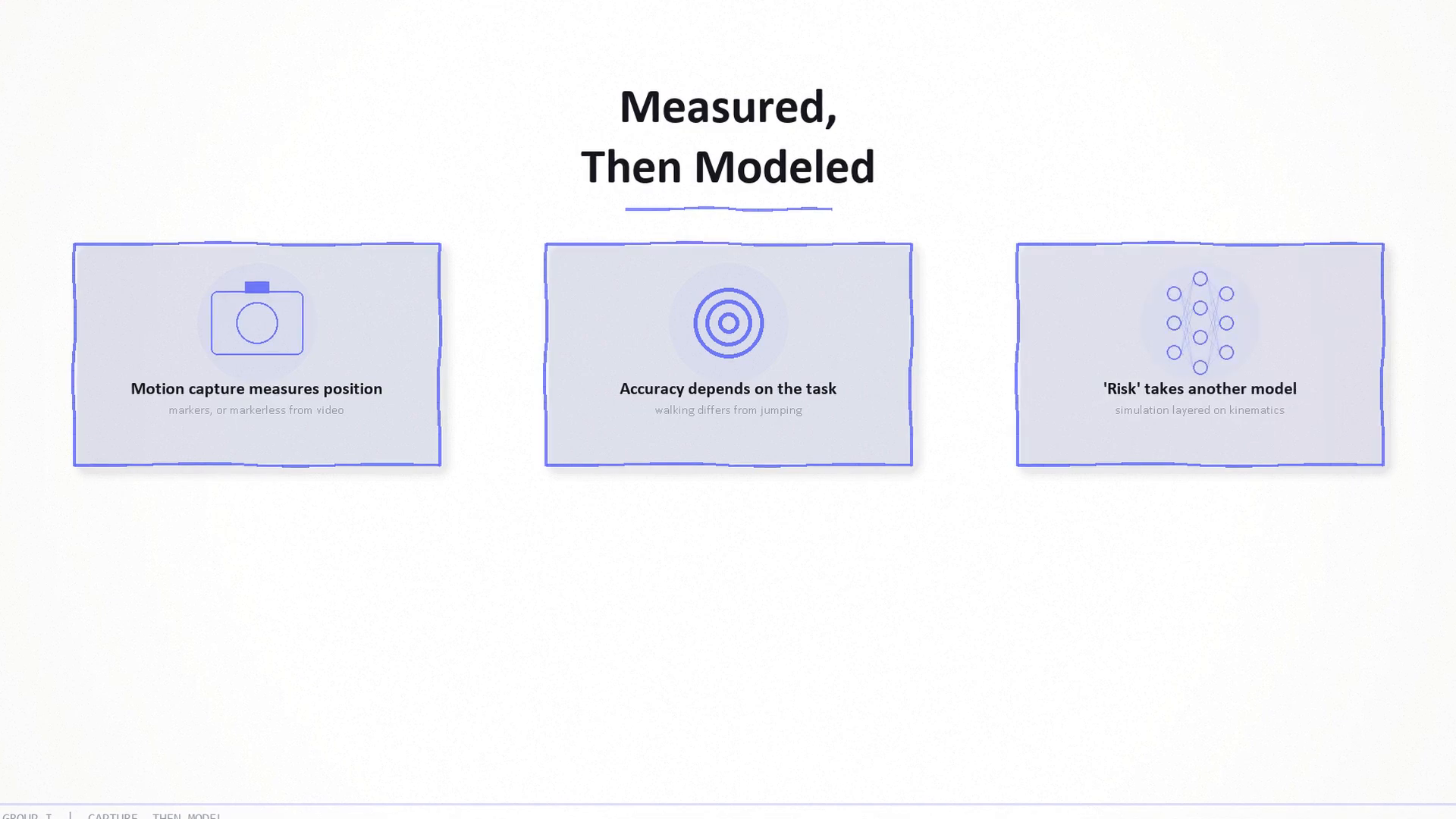
Neither paper treats motion capture as the end product. Capture measures position — where the joints are. But accuracy depends on the task: walking is not jumping. And any “risk” number takes another model layered on top of the kinematics. That framing is the spine of both papers: measured first, then modeled — and the modeling is where a clinically useful number actually comes from.
Paper 01 — Where markerless capture holds up (OpenCap)
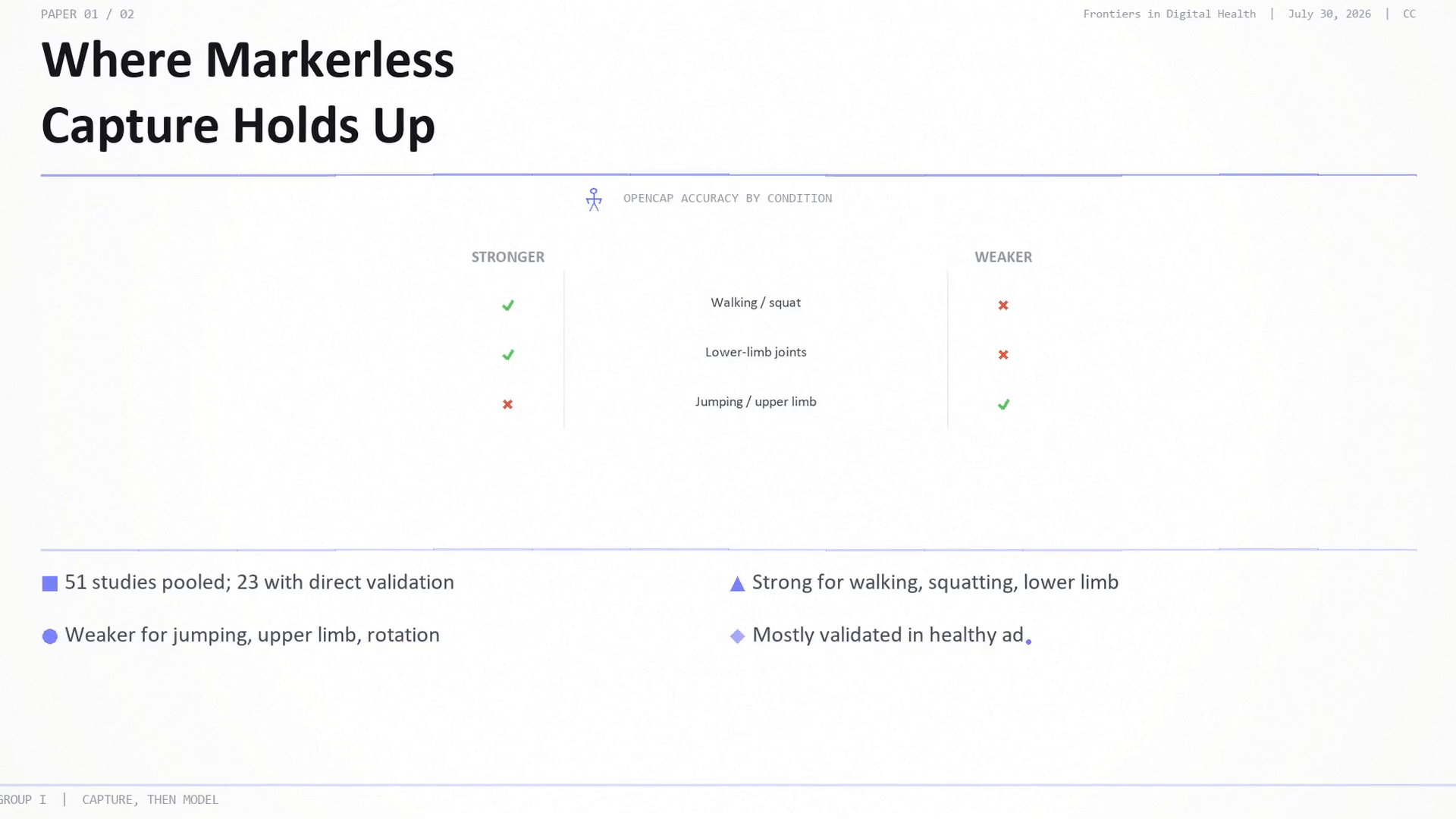
The first paper is a scoping review of OpenCap validation: 51 studies pooled, 23 with direct validation. Because it synthesizes evidence rather than reporting one new validation, its picture is uneven by design. Sagittal-plane, lower-limb, steady tasks like walking and squatting come out well; jumping, the upper limb, and multi-planar movement show larger and more variable error. And most of the underlying evidence still comes from healthy adults, not clinical or pediatric populations — a real limit on where you can trust it.
That unevenness matters for what comes next. A badminton lunge is neither steady nor purely sagittal — exactly the regime where markerless accuracy is weakest — so whether a system like OpenCap could capture it with confidence is an open question this review doesn’t answer. Which is presumably why the second paper reached for lab-grade marker-based capture instead. For more on where camera-based capture holds up, see our review of how good camera-based assessment really is.
Paper 02 — From a badminton lunge to an ACL load
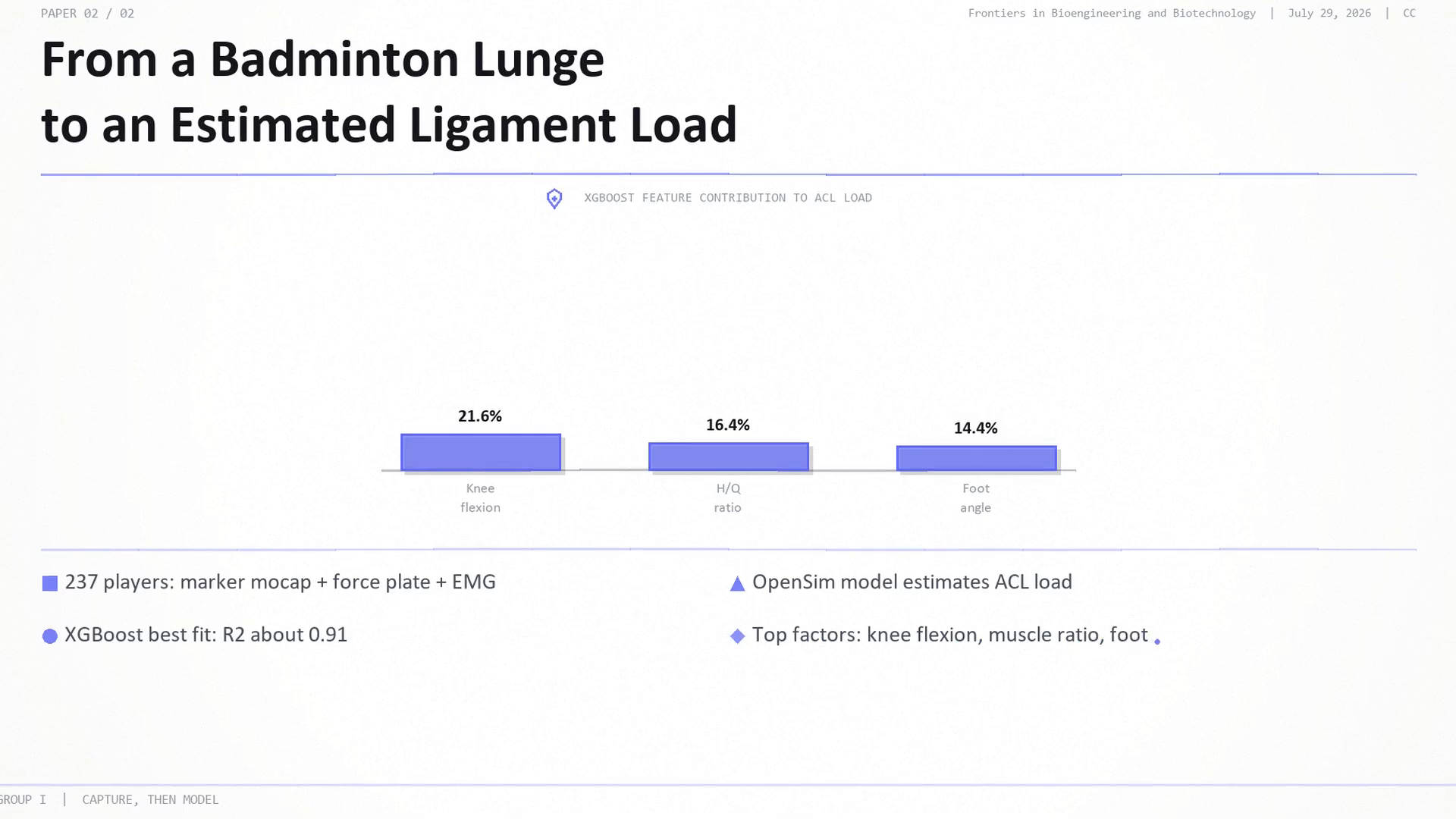
The second paper starts from exactly the gold-standard input the review used as its comparison point: marker-based motion capture, paired with force plate and EMG data from 237 amateur badminton players. And even that cannot measure anterior cruciate ligament (ACL) loading directly. Instead it passes the kinematics through a musculoskeletal simulation (OpenSim) to produce a model-estimated load, then fits several machine-learning models to that estimate — with XGBoost explaining roughly 91% of the variance (R² ≈ 0.91) and pointing to insufficient knee flexion, a quadriceps-dominant muscle balance (H/Q ratio), and foot positioning as the largest contributing factors.
The caveats matter here. The outcome variable is itself a simulation output, not a directly measured force — so the model is predicting a model. And the players performed an isolated lunge, not in-game movement, so how these particular risk factors hold up during live play or in elite athletes is untested here.
Every layer has its own error bar
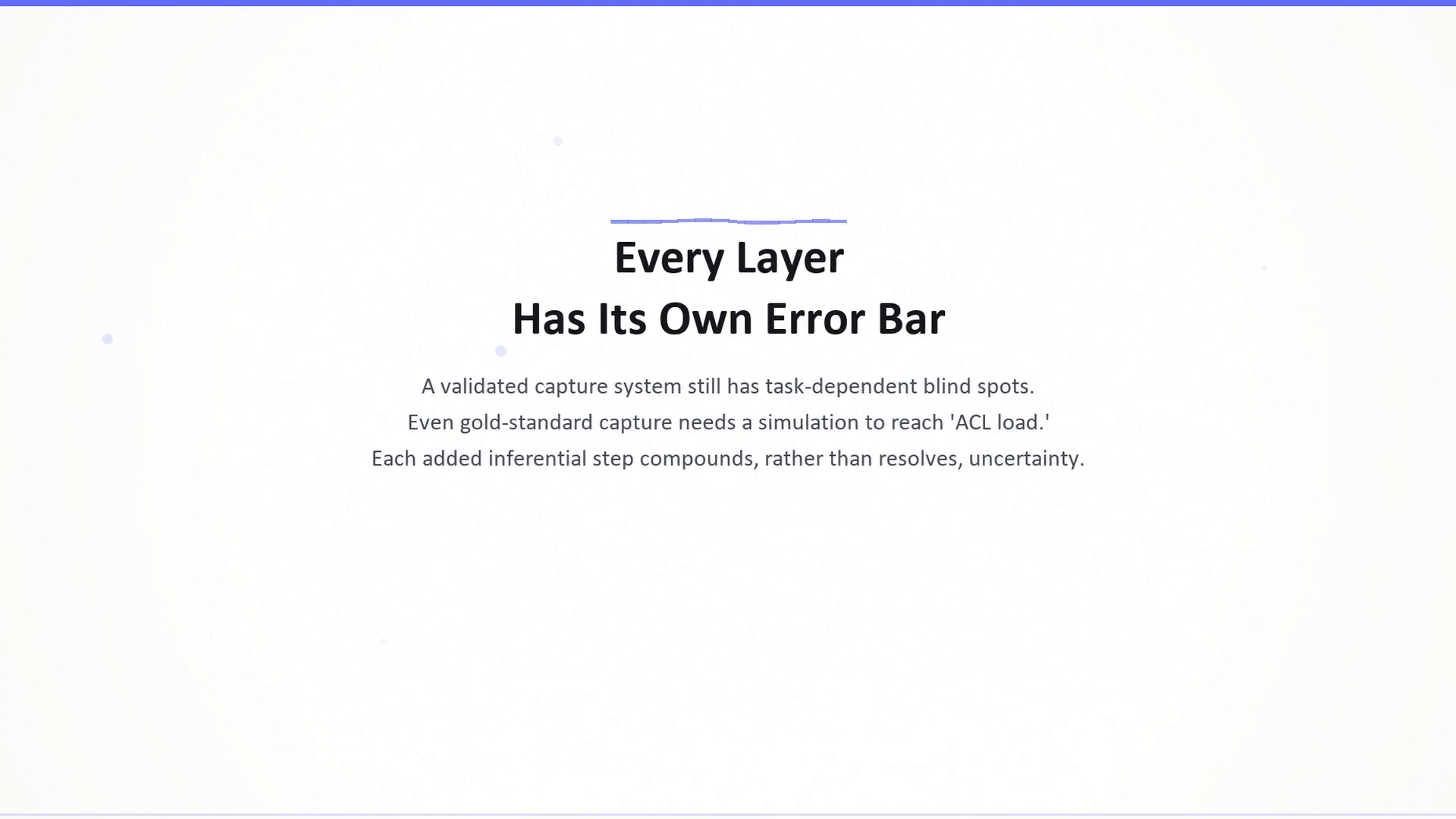
Across both papers, accuracy is not a single number attached to a device. It shifts with every added step: the movement being measured, the plane it happens in, and whether the final output is a directly captured kinematic value or a simulated biomechanical quantity built on top of it. A validated capture system still has task-dependent blind spots; even gold-standard capture needs a simulation to reach an “ACL load” number; and each added inferential step compounds uncertainty rather than resolving it.
That layering isn’t a flaw unique to either study — it may be close to unavoidable for any system that wants to go from raw motion to a clinically meaningful risk estimate. But it does mean a reported accuracy number from one layer should not be read as describing the layers built on top of it. For the wider landscape of setups this sits within, see our overview of 3D markerless motion capture approaches.
Frequently asked questions
How accurate is OpenCap markerless motion capture?
It depends heavily on the task. Across the 51-study scoping review, OpenCap agrees well with reference systems for sagittal-plane, lower-limb, steady tasks like walking and squatting, but shows larger and more variable error for jumping, the upper limb, and multi-planar movement. Most validation is also in healthy adults, so clinical and pediatric use is less certain.
Can motion capture measure ACL load directly?
No. Even gold-standard marker-based capture with force plates and EMG cannot measure ligament load directly. It has to be estimated by passing the kinematics through a musculoskeletal simulation — so any “ACL load” figure is a modeled quantity, not a measured force.
What raises ACL load in a badminton lunge?
In this study the top contributing factors to the model-estimated load were insufficient knee flexion, a quadriceps-dominant muscle balance (H/Q ratio), and foot positioning. These come from an isolated lunge, though, so whether they transfer to in-game play or elite athletes is not established.
References
[1] Zhang, X., Mao, D., Shang, H., Ma, L., Jia, J., Yu, J., & Zhang, M. (2026). Validations and applications of markerless motion capture using OpenCap: a scoping review. Frontiers in Digital Health.
[2] Fang, M., Zhu, Y., Wang, G., Ma, Q., Yin, Y., Zhang, Y., & Chen, S. (2026). Machine learning prediction of ACL loading during the wide lunge. Frontiers in Bioengineering and Biotechnology.
Takashi Fukushima — Sports Science & Pose Estimation.
▶ Subscribe on YouTube · Website · ORCID · Contact