Same ingredients — detect a pose, track it, classify it — but very different evidence. Two 2026 papers build pose-keypoint pipelines; one checks its output against expert-labeled ground truth, the other explicitly cannot, and says so. The pipeline shape (an off-the-shelf detector and pose estimator feeding a downstream classifier) is now almost a template across sports and clinical computer vision. What separates a validated tool from an exploratory one isn’t the detector or tracker — it’s whether an independent ground truth exists to check the classifier against.
Table of Contents
Pose in, label out — the shared recipe
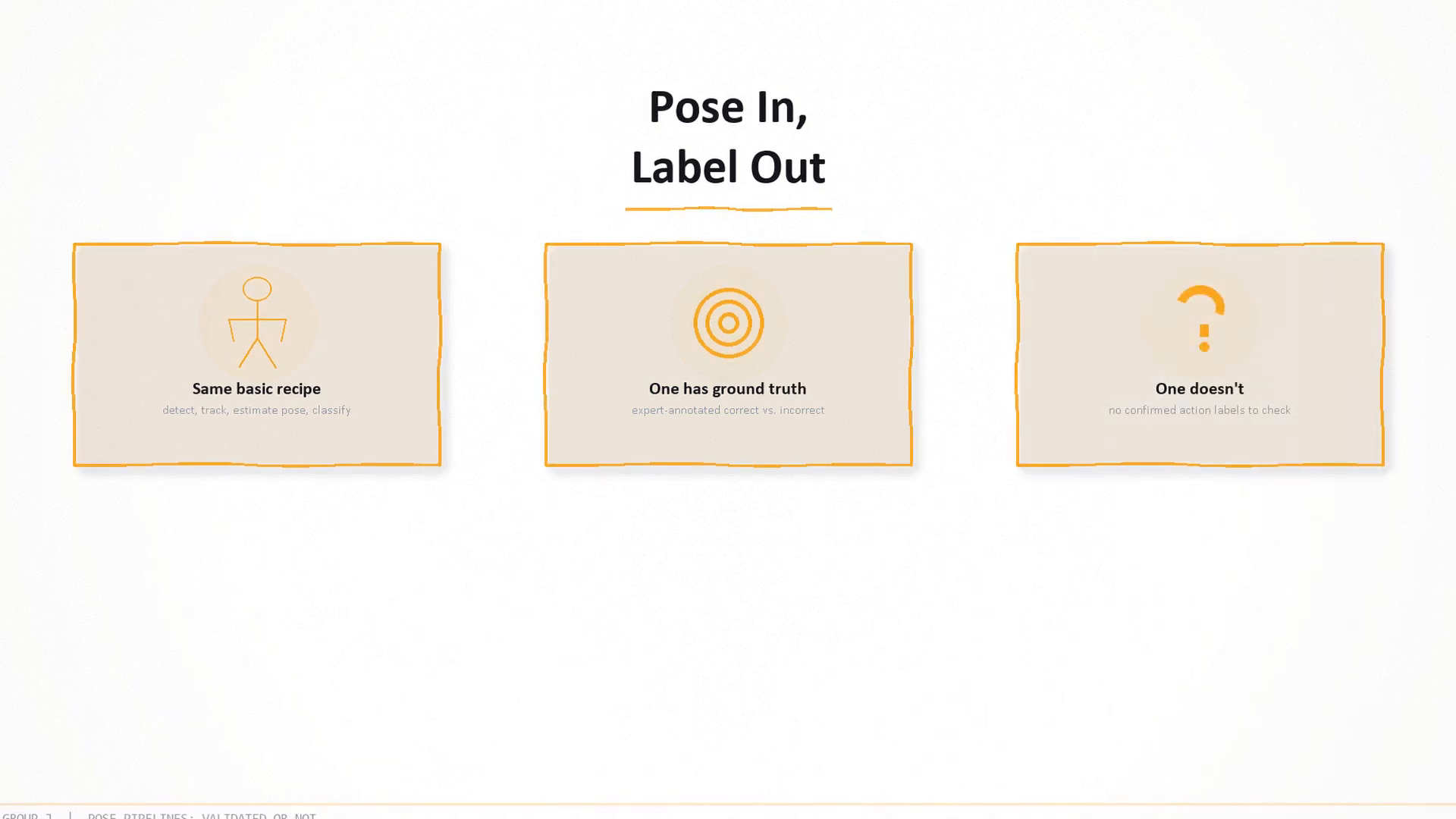
Both papers route video through an off-the-shelf detection and pose stack before handing the result to a downstream classifier — a pipeline shape now common across sports and clinical computer vision. So the basic recipe is the same: detect, track, estimate pose, classify. What differs sharply is what that classifier’s output can actually be checked against — one has ground truth, the other doesn’t — and that difference is arguably more consequential than any architectural choice either paper makes.
Paper 01 — Grading a physical therapy exercise
Built for a physical-therapy classroom rather than a clinic, this pipeline chains an off-the-shelf detector, pose estimator and tracker — RTMDet + RTMPose + ByteTrack — into a system that also has to work out which of two people on screen is the therapist and which is the patient (using pose-embedding similarity). A compact recurrent model (a GRU) then grades whether a passive range-of-motion exercise was executed correctly: 95%+ joint detection, ~96% classification.
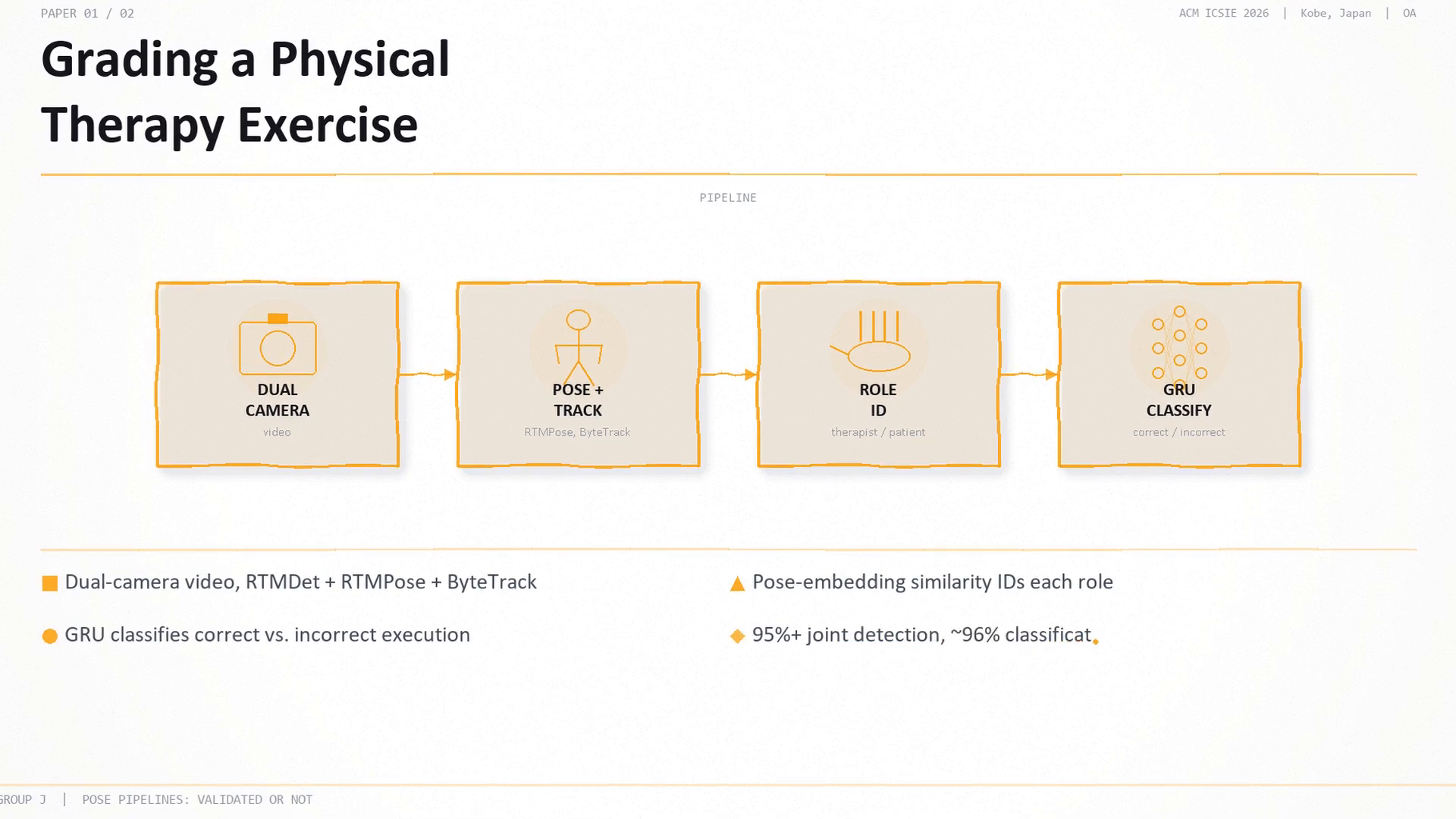
The key point is what those numbers are checked against: expert annotation of one specific setup — a fixed dual-camera arrangement, a defined exercise set, a student population. That’s real validation, but it’s narrow. How the same recipe performs on a different exercise, camera arrangement, or patient population is not established here.
Paper 02 — Profiling a basketball move, without a score
The second study feeds the same broad family of tools — pose keypoints turned into biomechanical features (elbow angle, asymmetry, trunk orientation), then grouped into pattern classes. But it works from an existing multiplayer tracking dataset (37,134 frame-player pose observations), not newly collected, expertly labeled footage, and the grouping is rule-based, not a trained classifier. Crucially, it has no ground-truth action or outcome labels — nothing equivalent to the PT paper’s therapist-verified truth.
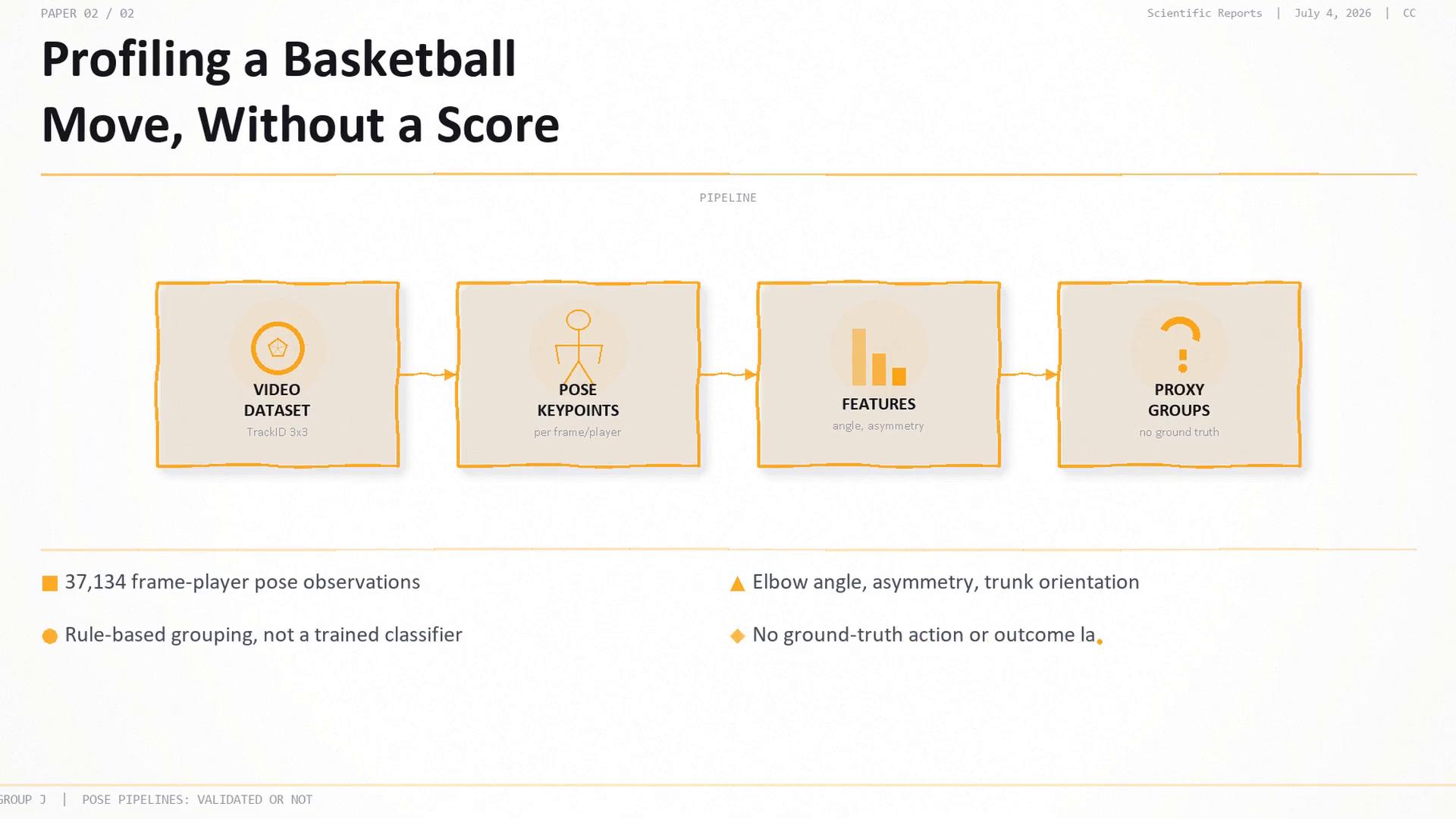
And the honest part: the paper’s own stated conclusion is that the groupings should be read as proxy-label separability — a demonstration that the features can be clustered, not a validated read on which basketball actions or outcomes actually occurred. It profiles patterns, and is careful not to claim it grades them.
Same recipe, different confidence
Placed side by side, the two papers show that a pose-estimation-to-classifier pipeline is now common enough to be almost a template — but the template alone says little about how trustworthy any particular application of it is. What separates a validated tool from an exploratory one is not the sophistication of the detector or tracker, but whether an independent ground truth exists to check the classifier’s output against, and whether the authors are explicit when it doesn’t.

Both papers here are explicit about their own evidentiary status — which may be the more generalizable finding than either paper’s individual accuracy numbers. For where the underlying pose estimation stands, see our breakdown of pose estimation accuracy across six models, and for what a purpose-built validation benchmark looks like, our write-up of the CalTennis sports-AI benchmark.
Frequently asked questions
What is a pose-estimation classifier pipeline?
It’s a now-standard shape: run video through an off-the-shelf person detector and pose estimator (and usually a tracker), turn the resulting keypoints into features, and feed those to a downstream classifier or grouping step. Both of these 2026 papers use exactly this shape — the difference is in the evidence behind the final label, not the architecture.
Why does “ground truth” matter so much here?
Because a classifier’s accuracy number is only meaningful relative to something you can check it against. With expert-labeled ground truth (the PT paper), “~96% correct” means something. Without it (the basketball paper), you can show the features cluster, but you can’t claim the clusters correspond to real actions or outcomes — which is exactly what that paper is careful to say.
Does high joint-detection accuracy mean the whole system is validated?
No. High detection or pose accuracy is about the upstream keypoints, not the downstream label. A pipeline can track beautifully and still produce an unvalidated classification if there’s no independent ground truth for that classification. The two questions are separate — and only one of them is about the detector.
References
[1] Hao, Z. B. D., Operario, K. I., Sibreno, C. L. M., & Pilongo, G. A. (2026). Computer Vision and Machine Learning Pipeline for Quantitative Analysis of Passive Range of Motion Exercises for Physical Therapy Education. Proceedings of ICSIE 2026, 135–144.
[2] Gao, Y. (2026). Pose-derived biomechanical feature profiling and proxy pattern classification of basketball player movements. Scientific Reports.
Takashi Fukushima — Sports Science & Pose Estimation.
▶ Subscribe on YouTube · Website · ORCID · Contact