Cameras got cheap. Three 2026 studies test what that actually buys you — a full 3D reconstruction pipeline feeding a musculoskeletal model, a systematic review synthesising accuracy across many such systems, and a single smartphone running free software. Read together, they let us ask a sharper question about markerless motion capture: does accuracy scale with hardware cost, or do the same failure modes appear regardless of price?
Table of Contents
The camera got cheaper
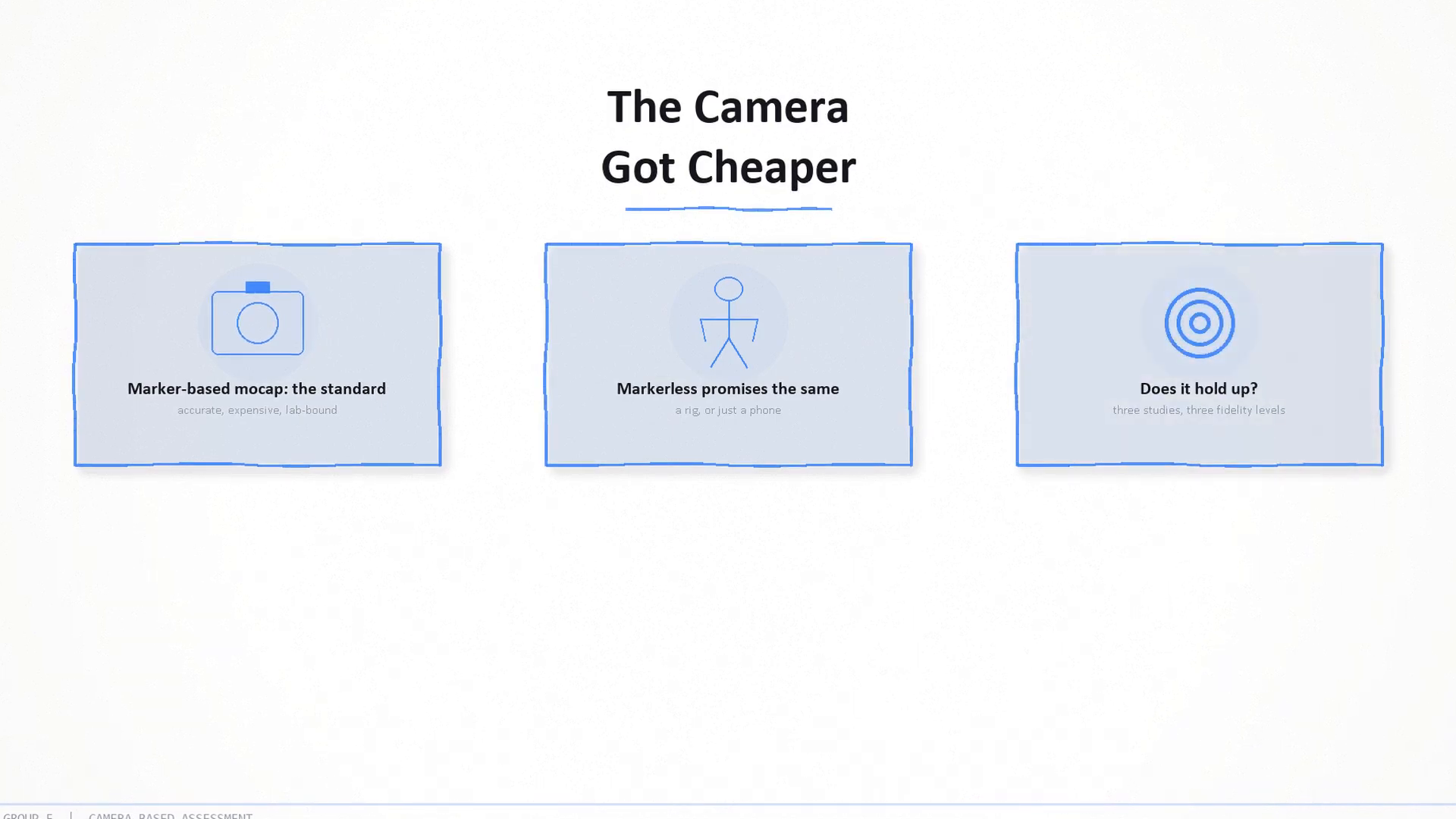
Marker-based mocap is the accurate, lab-bound standard. Markerless promises the same from a rig — or just a phone. These three papers sit at three different price points and levels of sophistication, which is what makes reading them together informative rather than repetitive.
Paper 01 — 3D reconstruction + OpenSim
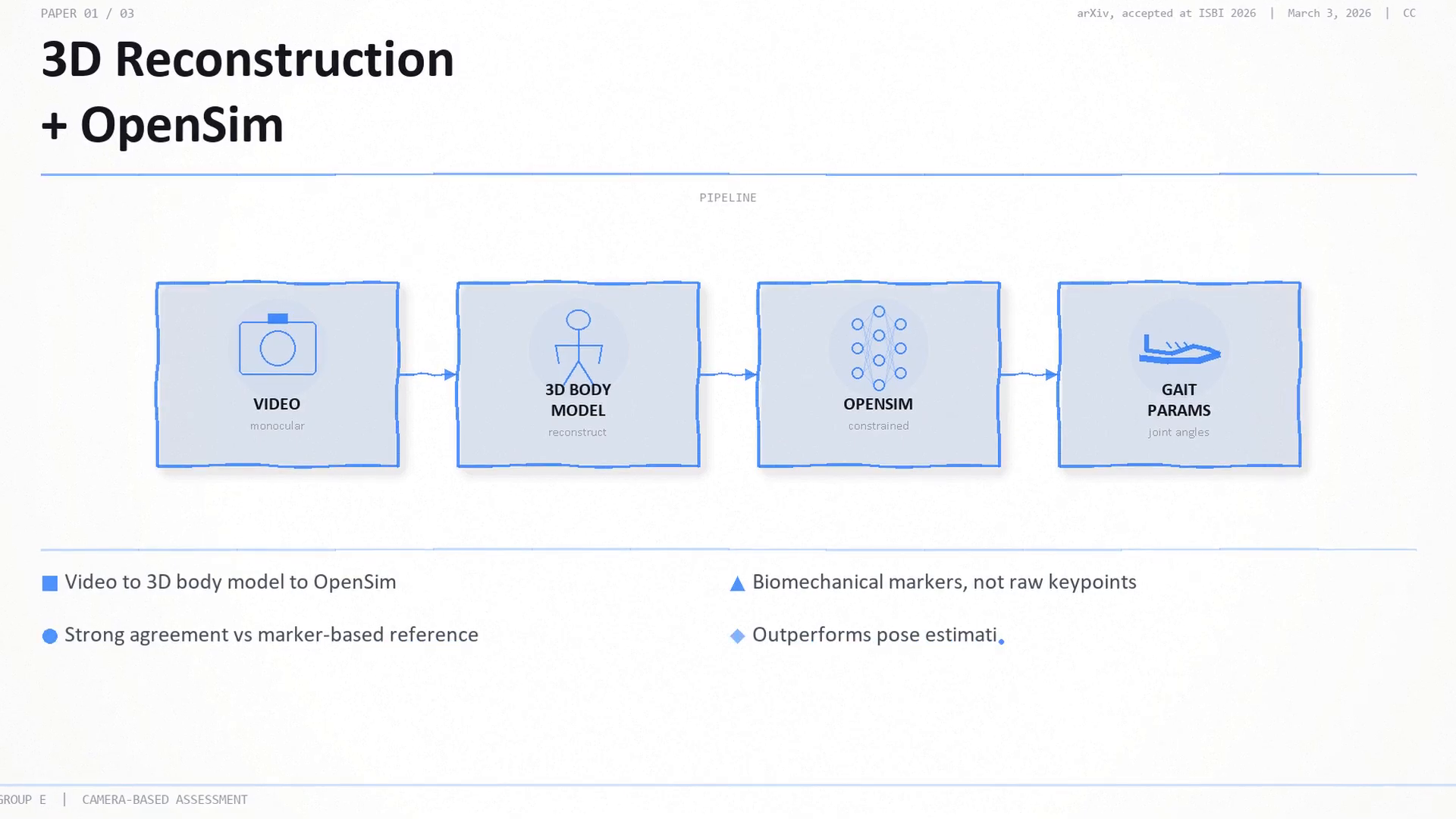
Video → 3D body model → OpenSim, producing biomechanical markers rather than raw keypoints. Routing video through a musculoskeletal model instead of treating pose keypoints as the final answer is consistent with the idea that anatomical constraints filter out noise that pose estimation alone would pass straight through. Reported agreement against a marker-based reference is strong, and it outperforms pose estimation alone.
The open question: sample size and the diversity of gait patterns tested are not detailed. So whether this holds for markedly abnormal gait — arguably the population that would benefit most from accessible assessment — is not established by this paper alone.
Paper 02 — What the evidence shows
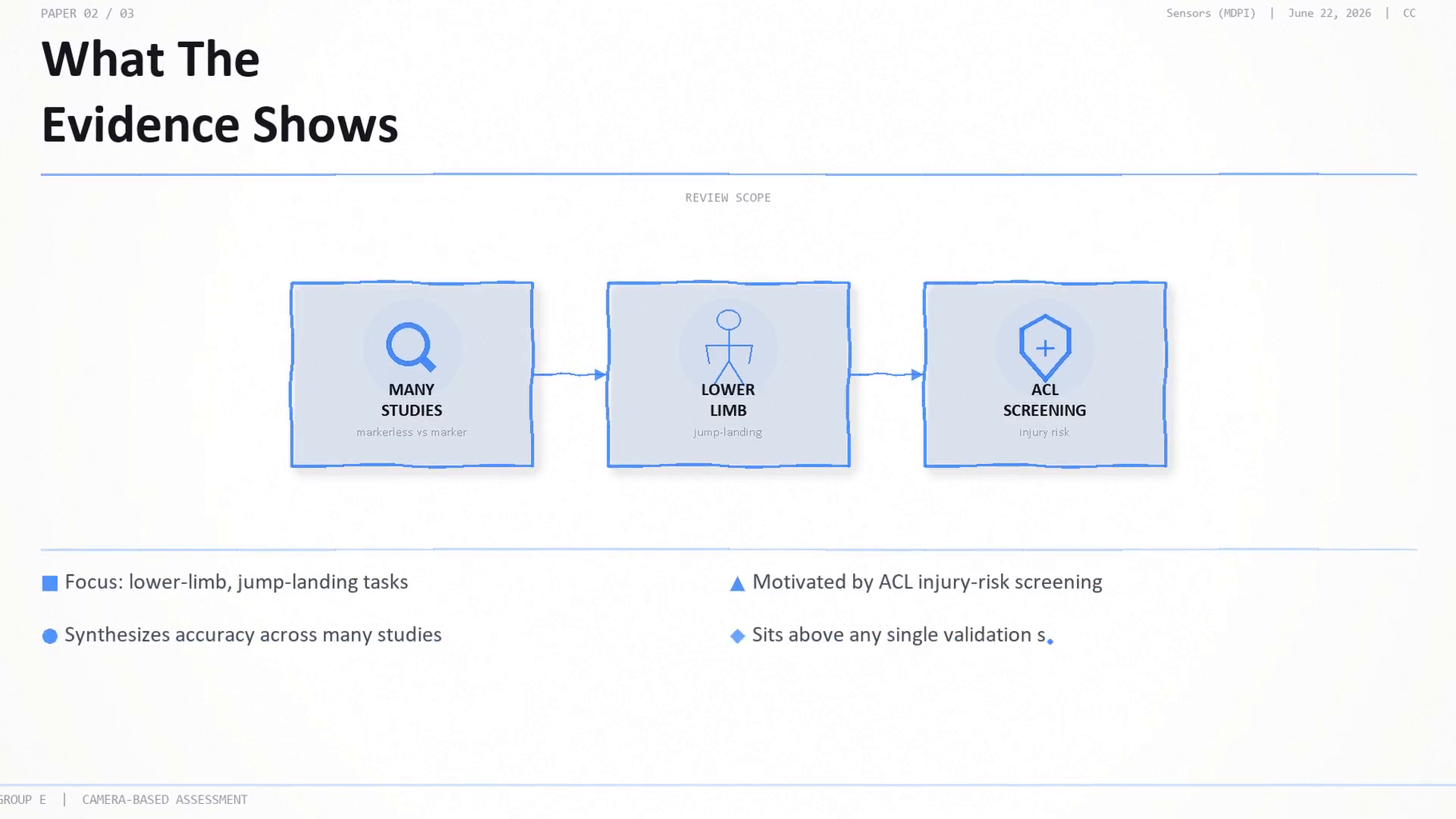
A systematic review of markerless versus marker-based capture, focused on lower-limb jump-landing tasks and motivated by ACL injury-risk screening. A review sits a level above any single validation: it asks whether reported agreement is representative across the literature, or an outlier from one particular pipeline.
That a review of this kind is being written at all is itself informative: it suggests the field does not yet treat markerless capture for ACL screening as settled, but as a body of evidence still being assembled and compared.
Paper 03 — One phone, different examiners
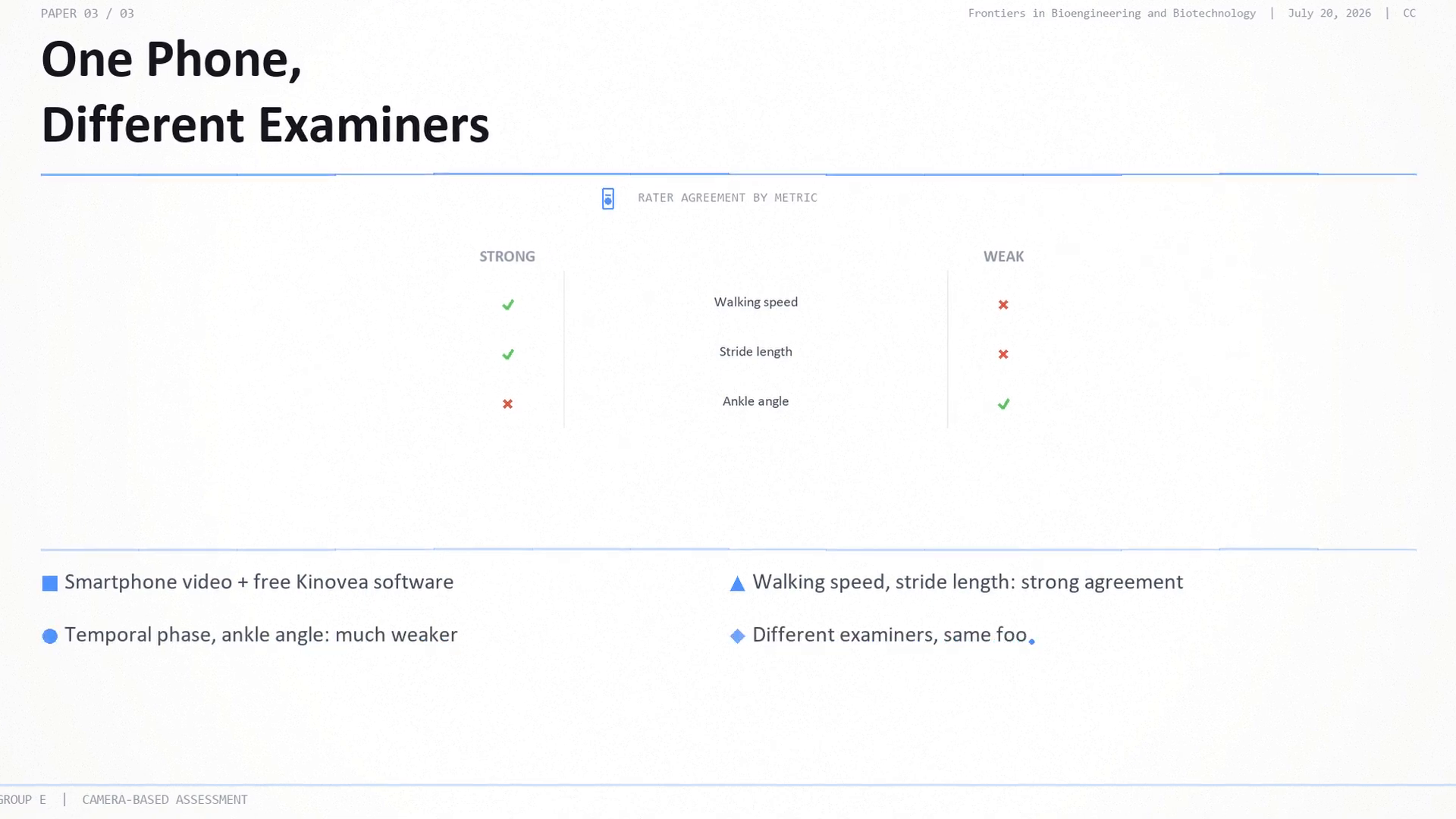
Smartphone video plus free Kinovea software, testing inter-rater reliability. Walking speed and stride length showed strong agreement. Temporal phase and ankle angle were much weaker — same footage, different examiners.
The important part is that this split echoes the more expensive systems in the same group. Fine-grained timing and angular precision look like the harder problem across every capture method here — not a limitation specific to the cheapest one.
Fidelity has a floor
Across all three, what fails is more consistent than what works. Coarse, global spatiotemporal measures replicate reasonably regardless of hardware tier, while fine temporal phasing and joint-angle precision remain difficult even for the more expensive multi-camera pipeline.
That pattern is consistent with the bottleneck being a shared limitation in how current pose estimation resolves fast, subtle motion — rather than simply camera cost or resolution. Confirming it would require testing the same participants across all three methods directly, which none of these studies did. The same depth-and-timing ceiling shows up in our write-up of the CalTennis sports-AI benchmark and in our breakdown of pose estimation accuracy across six models.
Frequently asked questions
Is smartphone gait analysis accurate enough to use?
For global measures like walking speed and stride length, yes — those showed strong agreement between examiners using a phone and free Kinovea software. For temporal phase and ankle angle, no: agreement was much weaker on the same footage.
Does a more expensive camera setup fix the problem?
Not the fine-detail part. The full 3D reconstruction pipeline improves on raw pose estimation, but fine temporal phasing and joint-angle precision stay difficult across all three studies. What fails is consistent across price points.
Why route video through OpenSim instead of using pose keypoints?
Because a musculoskeletal model applies anatomical constraints, which filter out noise that raw keypoints would pass straight through. That is why the pipeline outperforms pose estimation alone against a marker-based reference.
References
[1] Pemasiri, A., Goan, E., Lichtwark, G., Schuster, R., Kelly, L., & Fookes, C. (2026). Biomechanically Accurate Gait Analysis. arXiv:2603.02499
[2] (2026). Accuracy and Validity of 3D Markerless Motion Capture Compared to Marker-Based Systems for Lower-Limb Biomechanical Assessment: A Systematic Review. Sensors, 26(12), 3956.
[3] Puig-Divi, A., Costa-Tutusaus, L., Garcia-Gil, J., Sartori, F., & Picanol, J. (2026). Accessible 2D video-based system for gait kinematic analysis. Frontiers in Bioengineering and Biotechnology.
Takashi Fukushima — Sports Science & Pose Estimation.
▶ Subscribe on YouTube · Website · ORCID · Contact