Wearable motion capture used to mean a 17-sensor suit. Four 2026 studies ask a narrower, more practical question: what is the smallest IMU sensor set that still measures what a given sport actually needs? Each one reduces a full-body inertial suit down to a small, field-deployable set for a single sport skill, and validates it against a gold-standard reference. The thread running between them — and the question none of them answers alone — is whether a minimal sensor configuration validated for one skill transfers to another.
Table of Contents
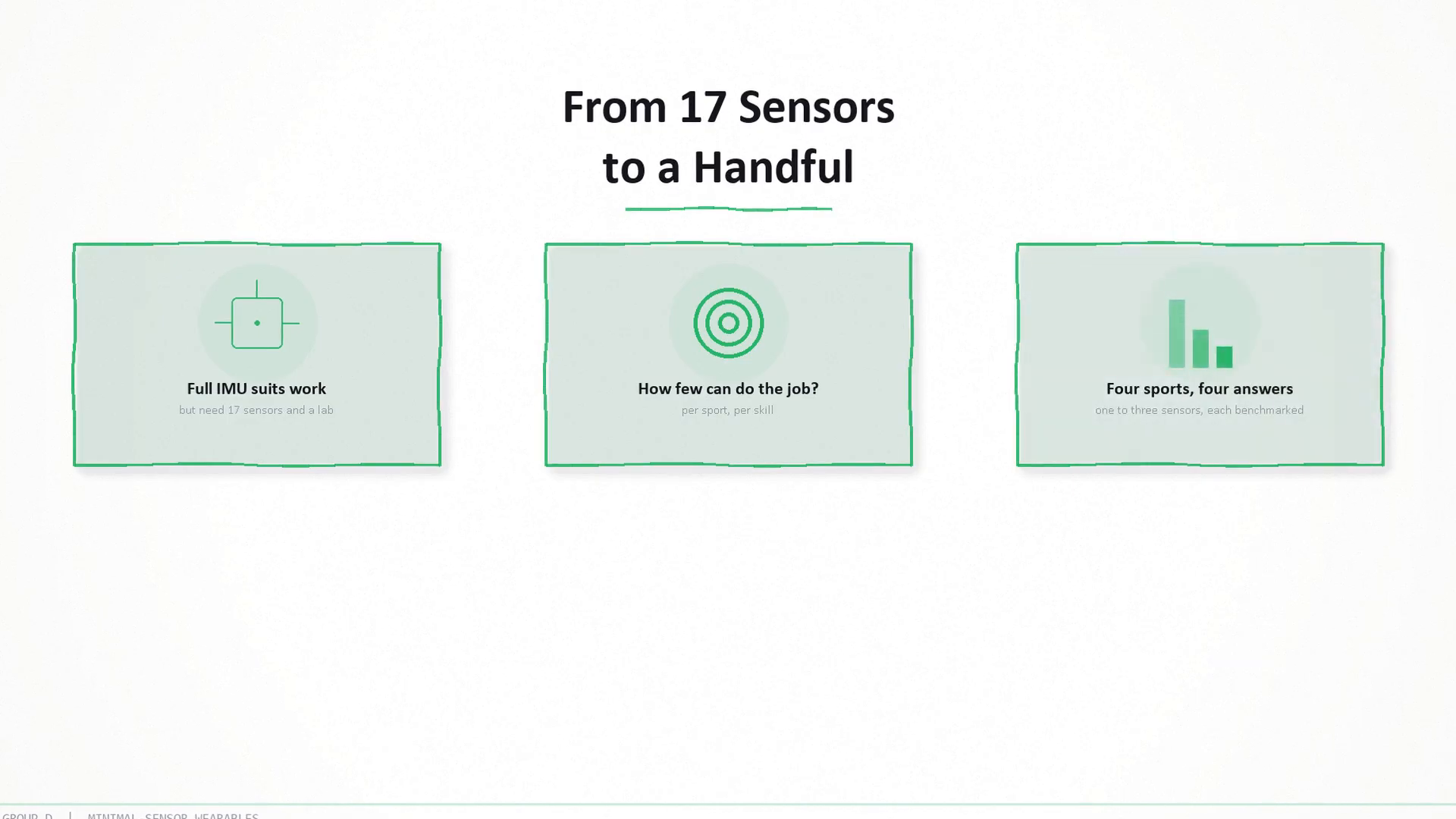
From 17 sensors to a handful
Full IMU suits work — they just need 17 sensors and a lab. The practical question is how few will do the job, and the answer plainly depends on the sport and even on the specific metric. Four sports, four answers.
Paper 01 — Minimal IMU sets for running gait
25 runners at three treadmill speeds. A single lumbar sensor recovered most gait metrics with R² above 0.95 — but it consistently missed left-right asymmetry (R² 0.52) until two ankle sensors were added, which lifted it to 0.91. That three-sensor set matched the full 17-sensor rig.
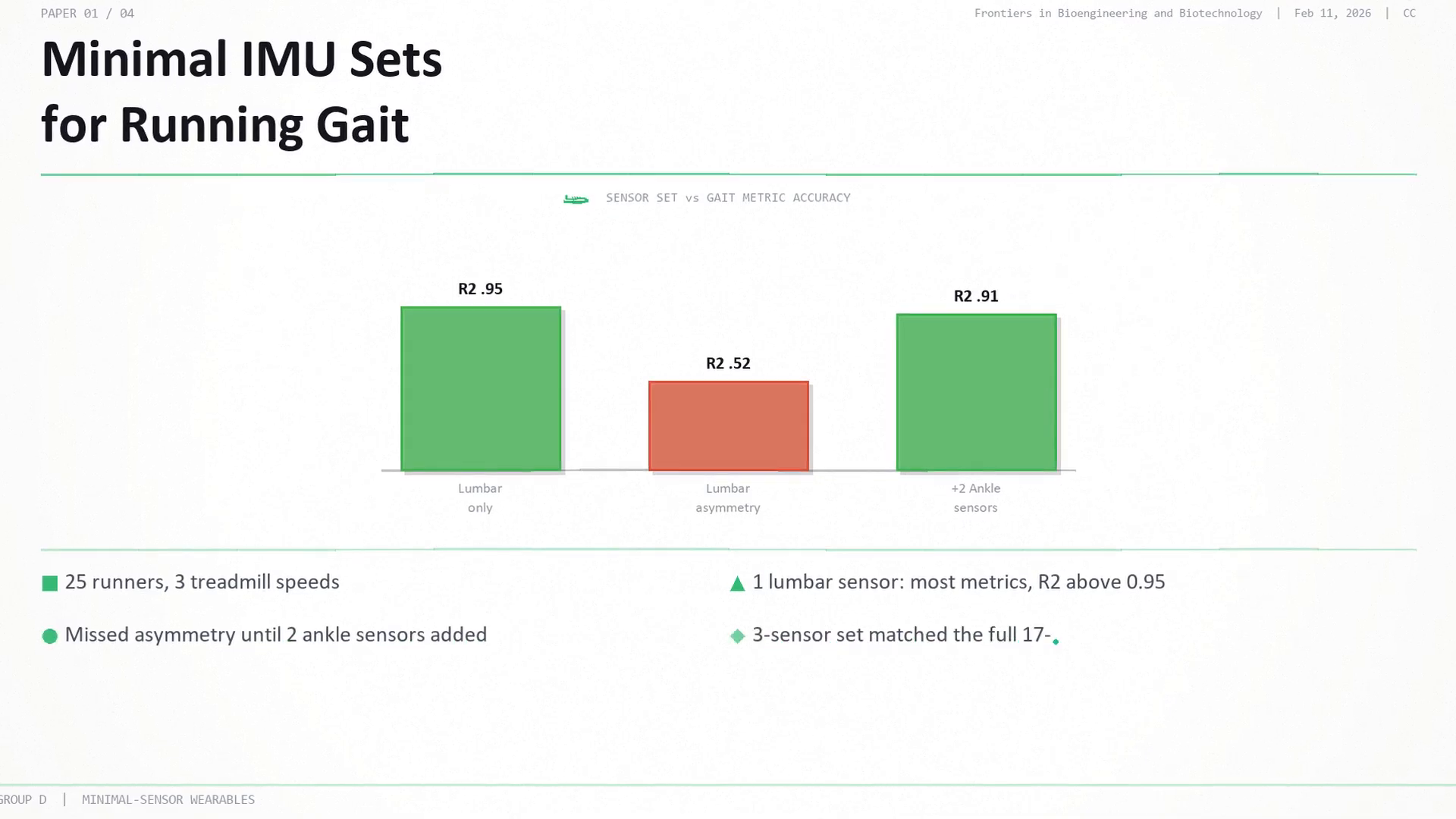
The caveat: the test was steady-state treadmill running at three speeds — not sprinting, not outdoor terrain. Whether this specific three-sensor recipe holds outside the lab is not established here. What it does establish is the question the rest of the group returns to: is there one minimal set that works across sports, or does every skill need its own?
Paper 02 — Reading base-running from a foot pod
A foot-mounted sensor, no lab required, comparing linear sprint capacity against the curved path of an actual base path. It is worth being precise about what this is: a case-based methodological framework for coaches, not a large-sample validation like the 25-runner study above. How reliably the interpretation generalises across athletes is not yet demonstrated.
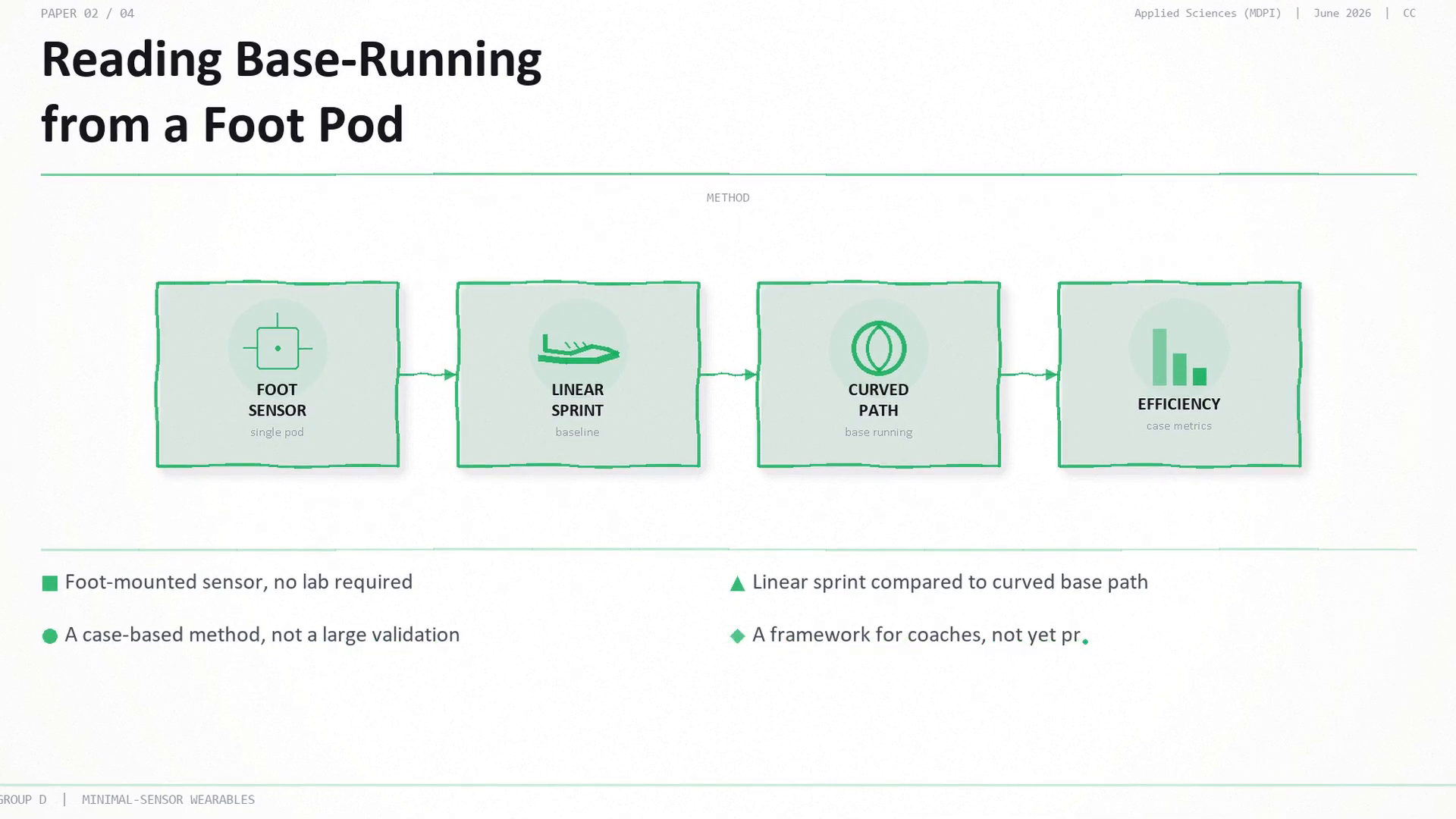
There is also a biomechanical reason not to borrow conclusions from the running paper: base-running is curvilinear, with lean and cutting, so lessons from linear gait may not transfer directly.
Paper 03 — A single sensor for the jump test
A custom-built 1 kHz lumbar sensor over Bluetooth, benchmarked against a force platform across 119 jumps from 19 participants. A high sampling rate and a derivative-based take-off/landing algorithm gave strong agreement, with a detection rate above 97% and low bias.
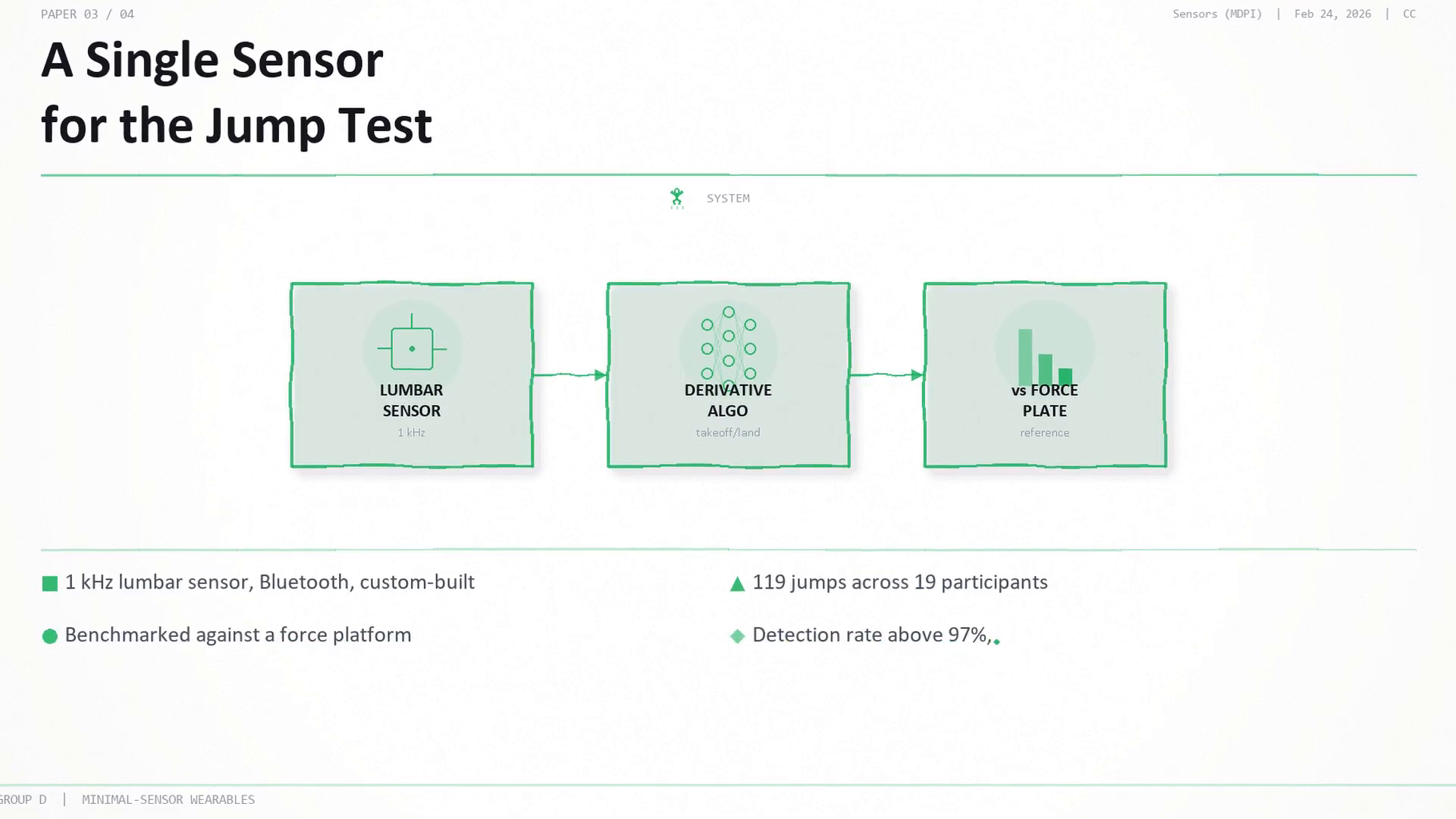
Note what makes this the easy case: a countermovement jump is vertical and largely symmetric — a more constrained, repeatable task than base-running’s cutting or the rotational throw that follows. Whether the same single-sensor approach degrades once movement becomes asymmetric or rotational is exactly what the next paper tests.
Paper 04 — Three sensors for the hammer throw
Wrist, foot and lower back — deployable in ordinary training sessions, measuring phase durations and angular displacement, benchmarked against professional motion capture. The hammer throw is rotational, multi-axis and explosive: a harder case than the linear or vertical tasks in the first three papers. Reported agreement suggests the minimal-sensor approach extends to this more complex movement class too.
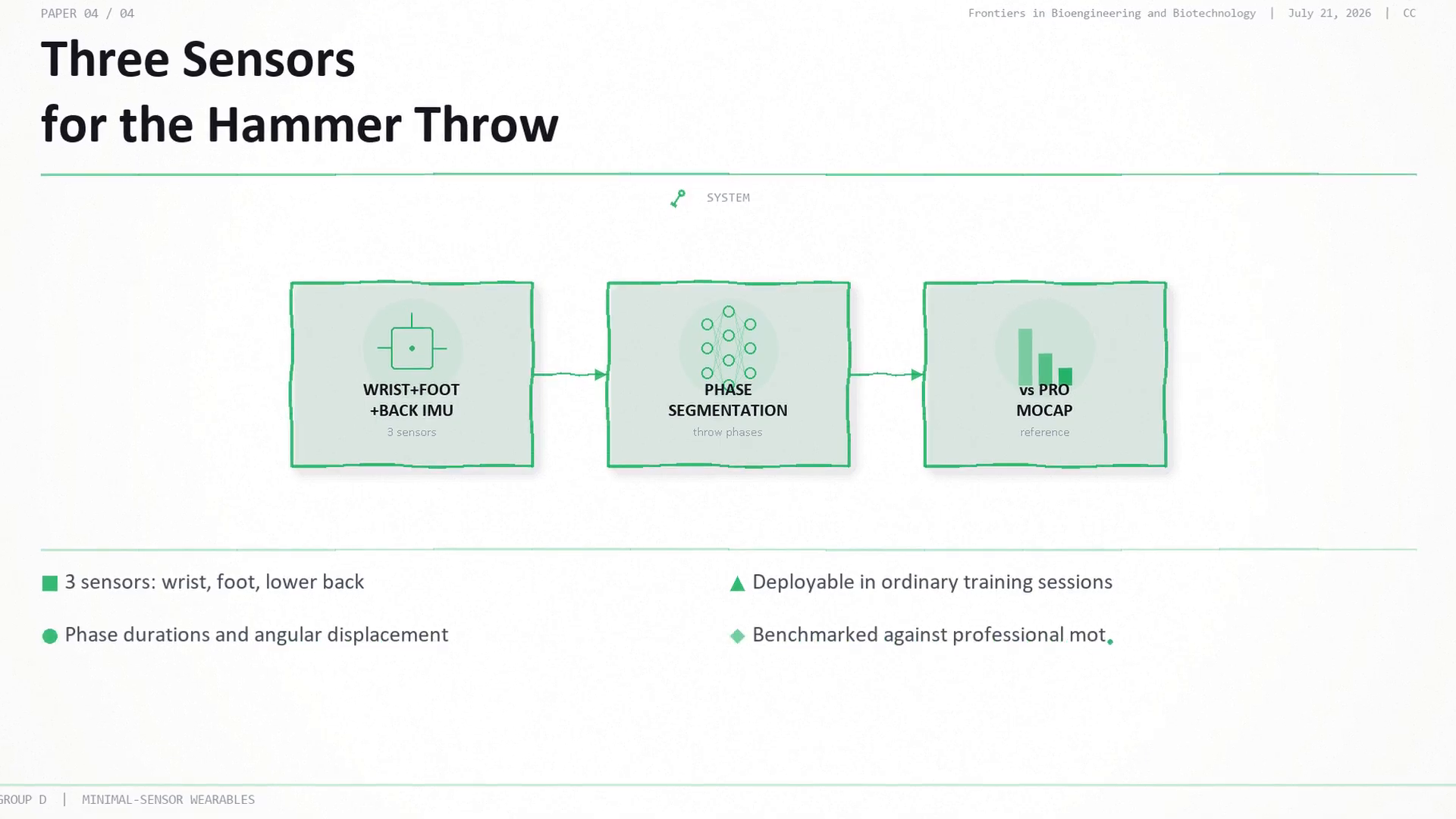
The caveat: throw count, fatigue effects and skill-level range are not detailed to the same depth as the running study, so how the method holds up across a full training cycle remains open.
One minimal set per sport?
Here is the honest summary across all four. Each minimal configuration validates well within its own narrow task — and none has been tested against another sport’s protocol in the same study. Running needs one to three sensors depending on the metric. Jump testing needs one. Base-running and hammer throw add more.
So whether a single lumbar sensor generalises across running, jumping and throwing — or whether every sport-specific skill requires its own bespoke sensor count and placement — remains open. It is the kind of question a single cross-sport validation study could resolve, and that none of these four attempts. For the camera-based side of the same field-deployment problem, see our review of motion capture without cameras or markers.
Frequently asked questions
How many IMU sensors do you need for running gait analysis?
One lumbar sensor recovers most gait metrics with R² above 0.95. But if you care about left–right asymmetry you need three: the lumbar sensor plus two at the ankles, which brings asymmetry from R² 0.52 up to 0.91 and matches a full 17-sensor rig.
Can one sensor replace a force plate for jump testing?
For countermovement jumps, largely yes — a 1 kHz lumbar sensor matched a force platform across 119 jumps with detection above 97% and low bias. The jump is a favourable case though: vertical, symmetric and repeatable.
Does a minimal sensor set work across different sports?
Unknown, and that is the point. Every configuration here was validated inside its own task, and none was tested against another sport’s protocol in the same study. Sport-specific placement is currently the safer assumption.
References
[1] Yuan, Y., Yu, Y., Cai, S., & Cheng, W. (2026). Optimizing wearable IMU configurations for running gait analysis. Frontiers in Bioengineering and Biotechnology.
[2] Martinez-Rodriguez, J. A., Crotin, R. L., Neville, J., & Cronin, J. B. (2026). New Perspectives on Analyzing and Interpreting Base Running Efficiency. Applied Sciences, 16(11), 5668.
[3] Pousibet-Garrido, A. et al. (2026). A High-Frequency Wearable IMU-Based System for Countermovement Jump Assessment. Sensors, 26(5), 1408.
[4] Sanchez-Moreno, J., Moreno-Salinas, D., Revuelta-Parra, C., & Alvarez-Ortiz, J. C. (2026). A wearable IMU-based method for measuring biomechanical parameters in hammer throwing. Frontiers in Bioengineering and Biotechnology.
Takashi Fukushima — Sports Science & Pose Estimation.
▶ Subscribe on YouTube · Website · ORCID · Contact