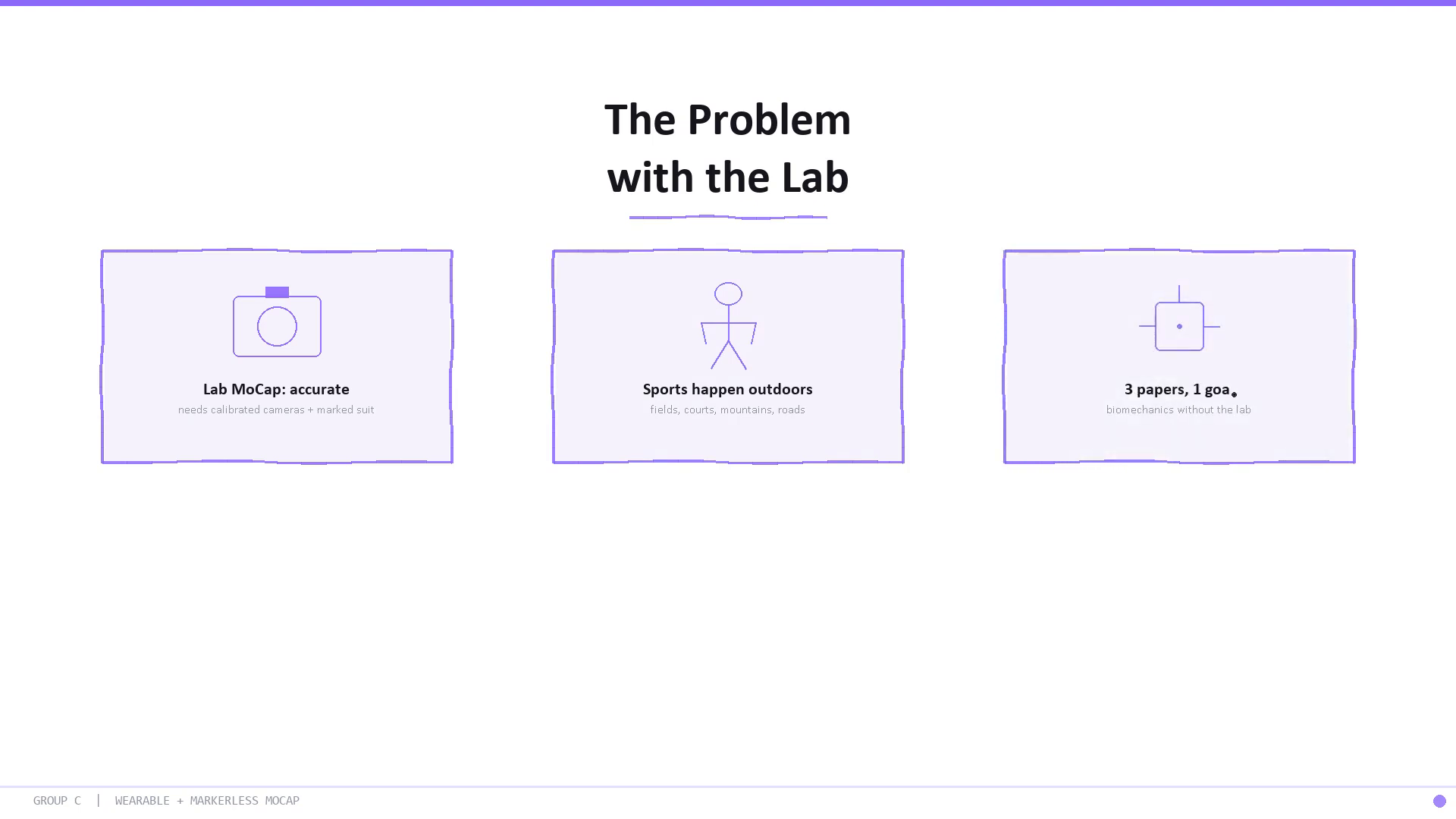
Optical motion capture is accurate — but it needs a controlled space, calibrated cameras, and a marked suit. Real sport happens on fields, courts, mountains and roads. These three recent papers approach the same core problem, field-deployable sensing, from orthogonal hardware assumptions: sparse IMUs with ranging, markerless multi-view cameras, and full-body wearables used to audit a simulator. This post (summarised in the video above) looks at what each contributes to markerless motion capture outside the lab — and at the distinct unresolved question each one leaves behind.
Table of Contents
Why these three papers belong together
Lab motion capture is accurate, but it needs calibrated cameras and a marked suit. Sport happens outdoors. These three papers share a single design constraint — field-deployable sensing — while making deliberately different hardware bets. That they appear in the same publication period is itself informative: it suggests a field-level view that the bottleneck has shifted, from achieving accuracy under controlled conditions to achieving deployability in ecologically valid ones.
Paper 01 — Ultra Diffusion Poser: full-body pose with zero cameras
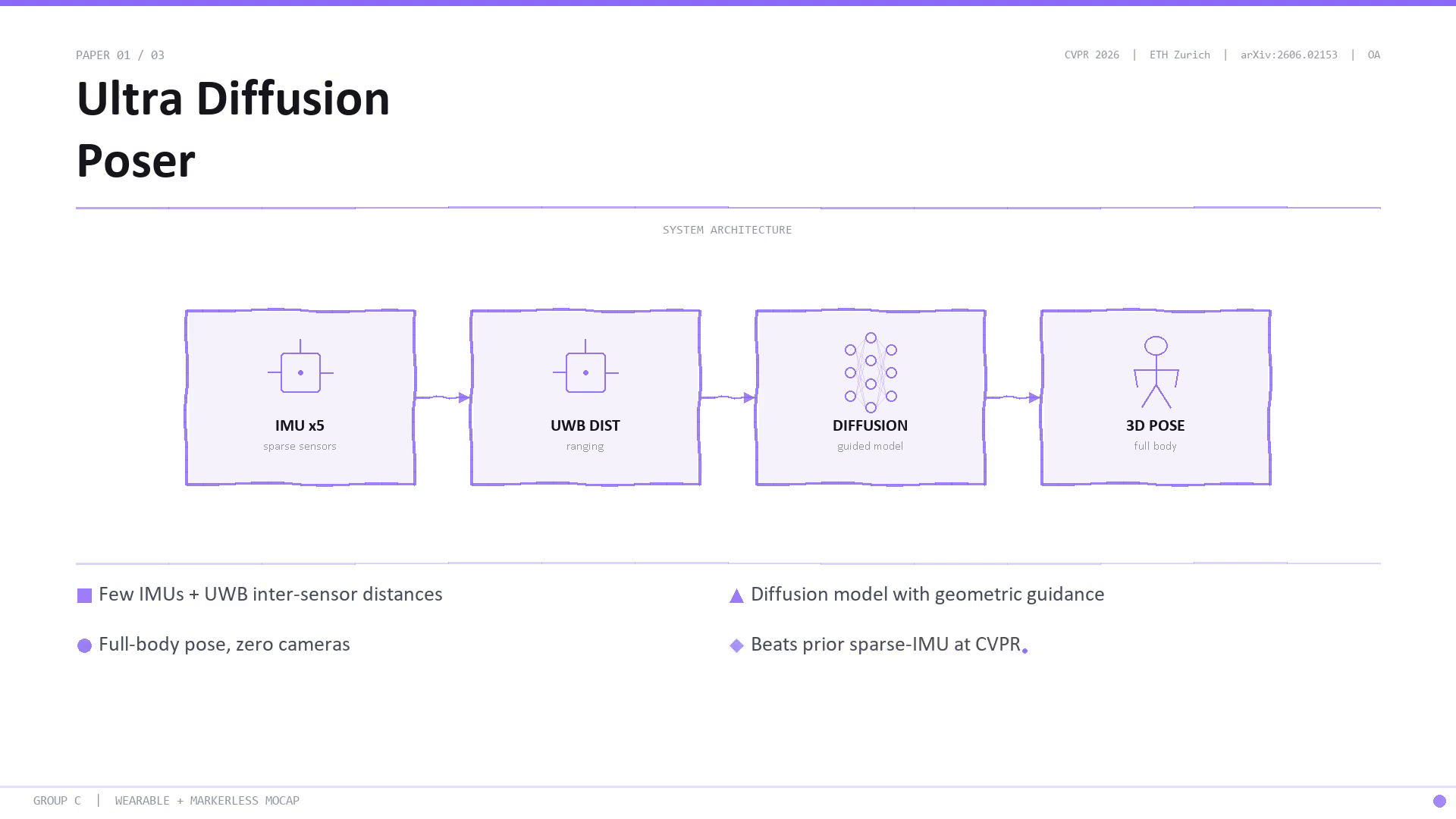
Ultra Diffusion Poser (CVPR 2026, ETH Zürich) reconstructs full-body motion from just a few IMUs plus UWB (ultra-wideband) inter-sensor ranging. It frames sparse-IMU reconstruction as a diffusion process conditioned on geometric inter-sensor distances. The theoretical claim is neat: distances between body-mounted sensors carry enough relative geometric information to disambiguate what is otherwise an underdetermined inverse-kinematics problem. The result is a geometrically consistent full-body pose with no camera at all, built for outdoor fields where installing cameras is impossible — and it significantly outperforms prior sparse-IMU methods.
The open question: this is plausible for typical body proportions, but sensitivity to anthropometric variation — body proportions not represented in the training data — and drift accumulation over extended deployment are not fully characterised in the reported evaluation. Both matter a great deal the moment you leave the lab.
Paper 02 — Biomechanics-aware markerless hand capture
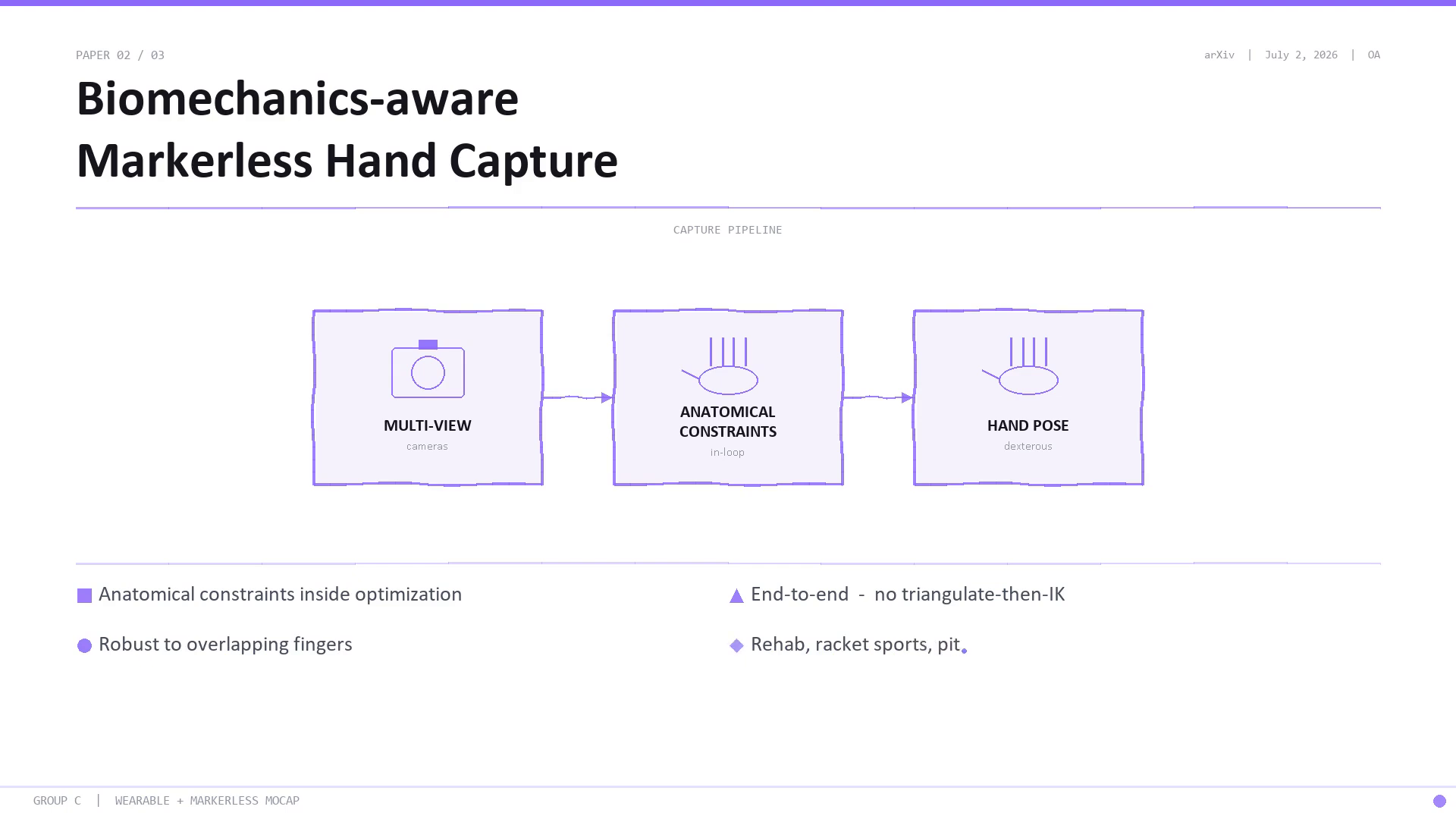
The second paper embeds anatomical joint constraints directly inside the optimization loop — end-to-end and constraint-aware, rather than the usual two-stage triangulate-then-IK approach. That is a principled response to a known failure mode: when intermediate keypoints are unreliable because of occlusion (overlapping fingers being the obvious case), unconstrained inverse kinematics produces non-physiological configurations. By keeping errors biomechanically bounded, the system should degrade more gracefully. Applications include hand rehabilitation, racket sports, and pitching mechanics.
The open question: biomechanical plausibility and biomechanical accuracy are distinct properties. A constrained estimate can be anatomically feasible and still be wrong — the constraint guarantees it looks like a hand, not that it is your hand. Telling the two apart requires ground-truth finger position data that is not routinely available in practice.
Paper 03 — Wearable sensors reveal the VR reality gap
The third paper turns wearables on simulation itself. Six IMUs at 120 Hz, the same rider on the same route: a real urban course versus a VR simulator. VR captured pedalling rhythm and cadence, but missed trunk rotation amplitude and head movement. The surprise is that this biomechanical gap did not correlate with simulator sickness or immersion ratings. “Feeling real” and “moving like real” are different things.
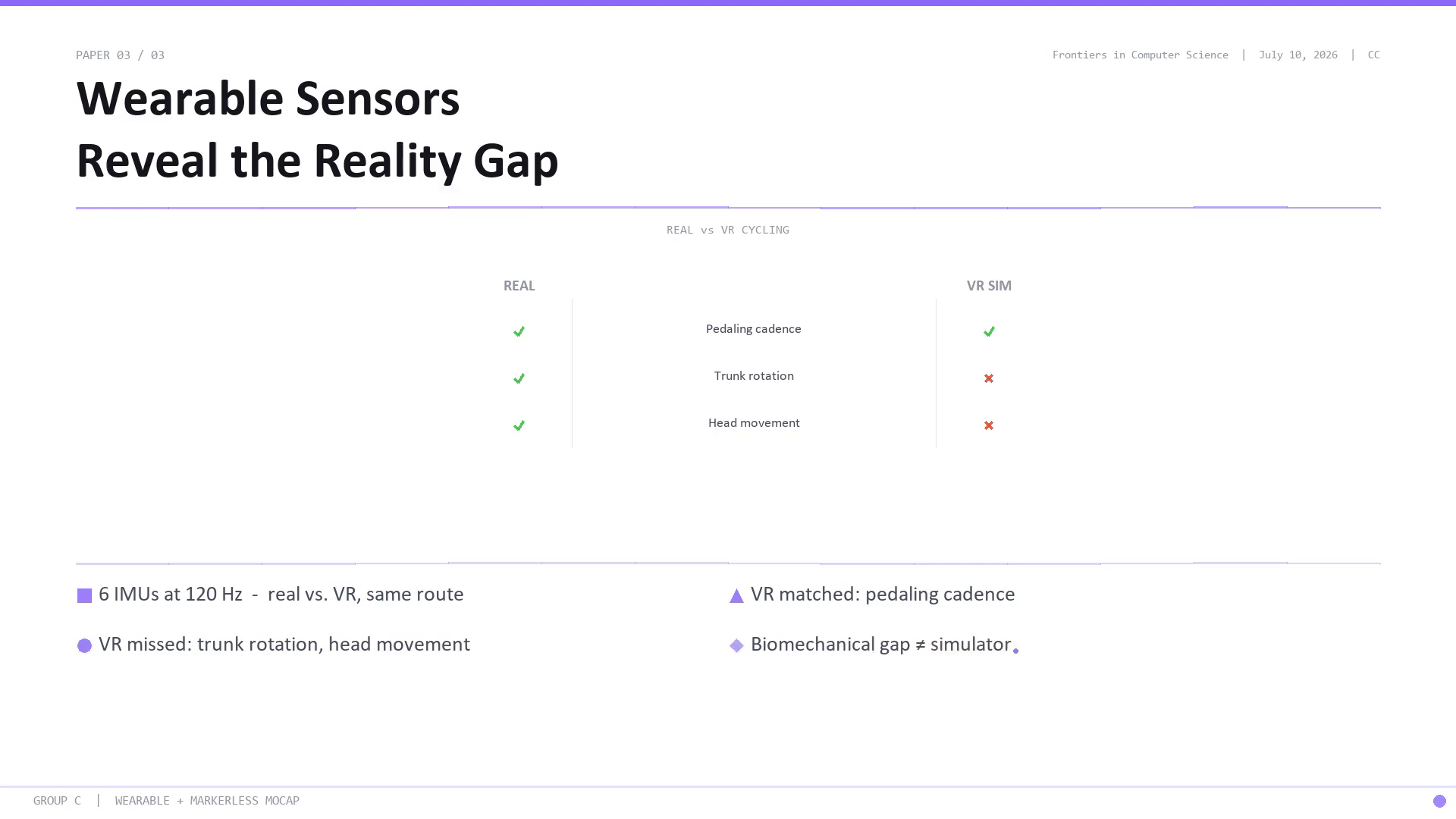
That dissociation — cadence preserved, trunk and head motion not — fits the hypothesis that VR simulators replicate mechanical task constraints more faithfully than the proprioceptive and vestibular feedback that modulates postural control in natural riding. If that holds, training adaptations may transfer selectively: lower-extremity power and cadence are more likely to carry over than reactive balance and postural coordination under external perturbation. That has direct implications for VR rehabilitation protocols where postural control is the treatment target. These conclusions stay tentative given the small sample and single-sport scope.
The field is the future — and three open questions
Ultra Diffusion Poser goes cameraless. The hand capture system goes markerless. The VR study uses wearables to audit the limits of simulation. Across all three, a provisional synthesis: camera-free and marker-free sensing appears to be approaching the accuracy threshold for field deployment — but each introduces a distinct unresolved question. Anthropometric generalization for IMU diffusion systems. Accuracy versus plausibility for constrained hand capture. Selective transfer for simulation-based training.
The VR cycling data carries the sharpest implication of the three: closing the reality gap may require modelling sensory feedback, not only mechanical task structure — a constraint current simulation architectures do not address. All three point the same way: real biomechanics data must escape the lab to matter. For the camera-based side of this story, see our overview of 3D markerless motion capture approaches and our breakdown of pose estimation accuracy across six models.
Frequently asked questions
Can you do motion capture without any cameras?
Yes. Ultra Diffusion Poser reconstructs full-body pose from a few body-worn IMUs plus UWB ranging between the sensors, with no camera in the loop. The inter-sensor distances supply the geometric information needed to resolve an otherwise underdetermined pose — which is what makes outdoor, camera-free capture viable.
Why embed anatomical constraints inside the optimization?
Because two-stage pipelines fail badly under occlusion: if the intermediate keypoints are wrong, unconstrained inverse kinematics happily produces a hand that no anatomy allows. Solving with the constraints inside the loop keeps the error biomechanically bounded, so the system degrades gracefully instead of catastrophically.
Does VR training transfer to real riding?
Partly, and that is the point. The wearable data suggests VR reproduces the mechanical task — cadence, pedalling rhythm — but not the trunk and head motion driven by proprioceptive and vestibular feedback. So power and cadence should transfer more readily than reactive balance and postural control. Notably, riders’ sickness and immersion ratings did not predict this gap.
References
[1] Hollidt, D., Bendinelli, T., & Holz, C. (2026). Ultra Diffusion Poser. CVPR 2026. arXiv:2606.02153
[2] Firouzabadi, P. et al. (2026). Biomechanics-aware Markerless Hand Capture. arXiv:2607.02796
[3] Pohler, J. et al. (2026). Wearable Sensors Reveal the Reality Gap. Frontiers in Computer Science. doi:10.3389/fcomp.2026.1853976
Takashi Fukushima — Sports Science & Pose Estimation.
▶ Subscribe on YouTube · Website · ORCID · Contact