Two 2026 papers, published months apart, take opposite bets on how sports AI should be built: pool hundreds of teams onto one shared problem, or check a single commercial device against lab references. They sit at opposite ends of the field — a large, repeatedly run community benchmark concentrating effort on one team sport, versus one lab’s validation of one wearable for one individual sport. Neither is more correct than the other. They answer different questions, at different scales.
Table of Contents
Same year, opposite scales
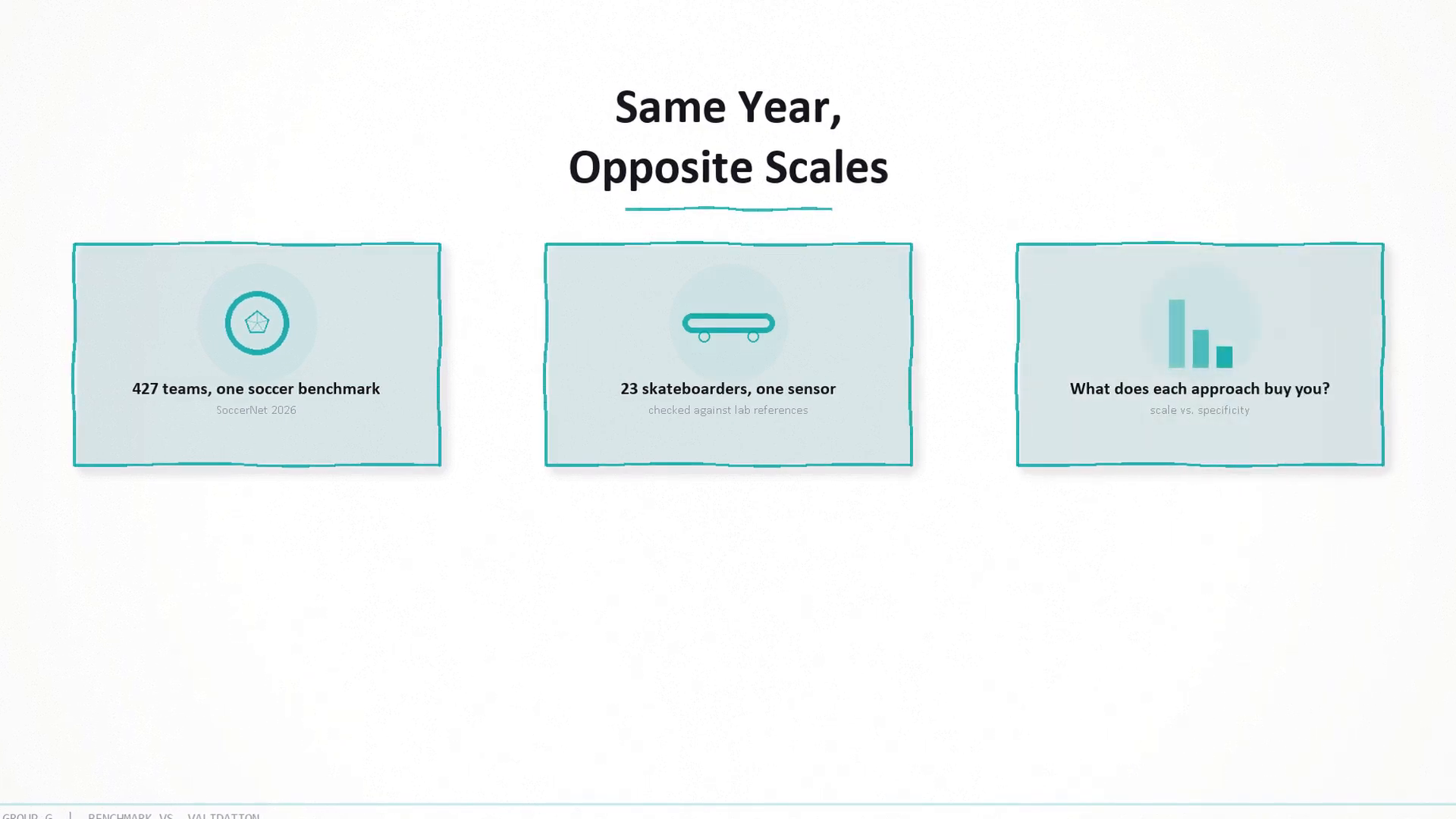
427 teams on one soccer benchmark. 23 skateboarders and one sensor, checked against lab references. Same year, and about as far apart as sports AI research gets — which is exactly what makes the comparison useful.
Paper 01 — 427 teams, one benchmark
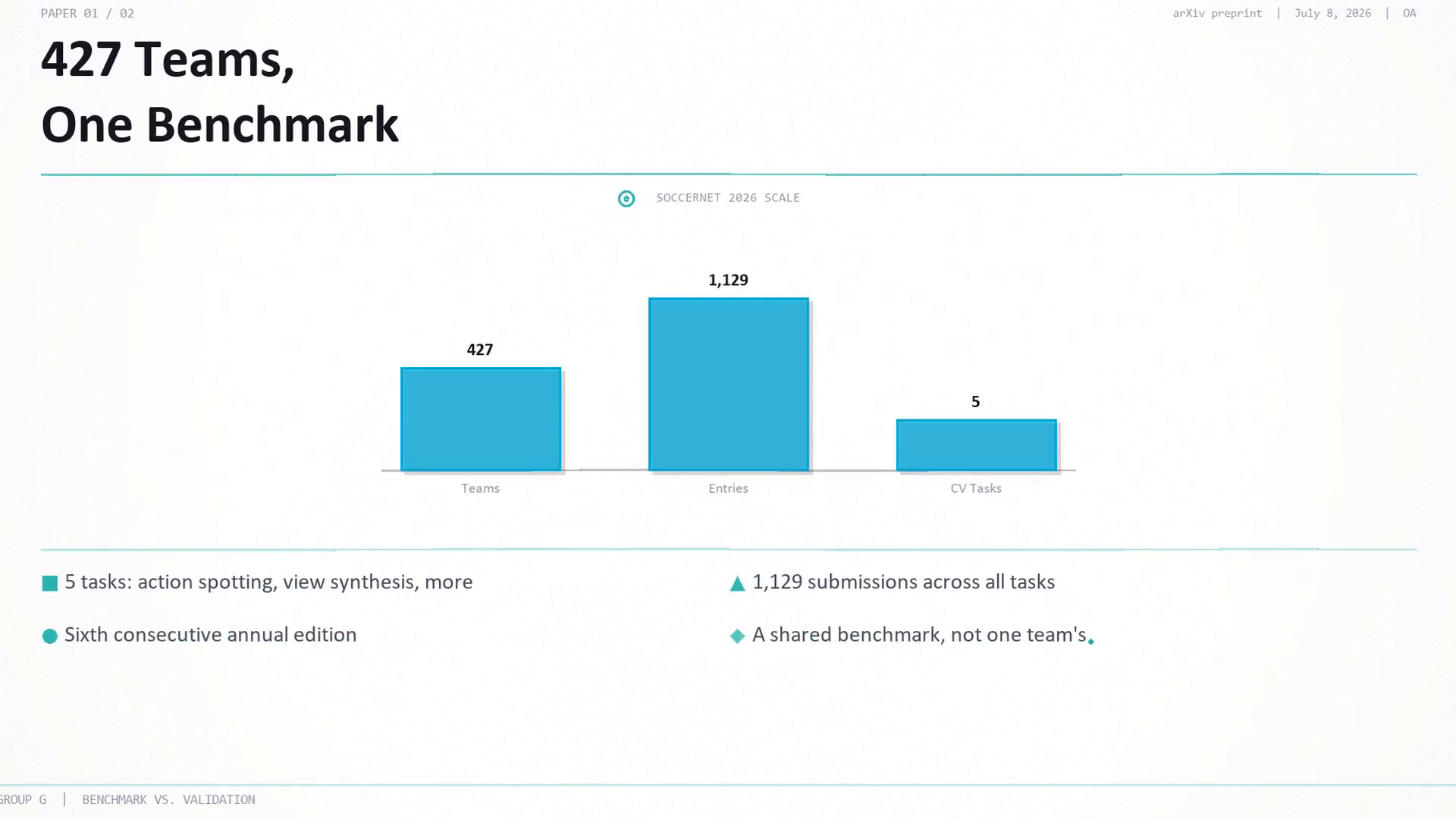
SoccerNet 2026 covers five tasks including action spotting and view synthesis, with 1,129 submissions across all tasks in its sixth consecutive annual edition. As a challenge-results paper rather than a single-method paper, its contribution is infrastructural: a shared benchmark against which hundreds of teams’ methods can be compared under identical conditions. The value is that it is a shared benchmark, not one team’s claim.
The open question: this concentrates a large amount of collective effort onto a small number of well-defined tasks in one sport. Whether the resulting gains are specific to soccer’s particular camera angles and rules, or transfer to other team sports, is not addressed by the challenge itself.
Paper 02 — One sensor, mixed results
23 skateboarders and one wearable device. Trick detection and distance showed high validity. Speed, height and airtime carried large errors — and trick classification also fell short. The result is uneven rather than uniformly positive: the device is validated for detecting that a trick occurred, but not for classifying which trick it was.
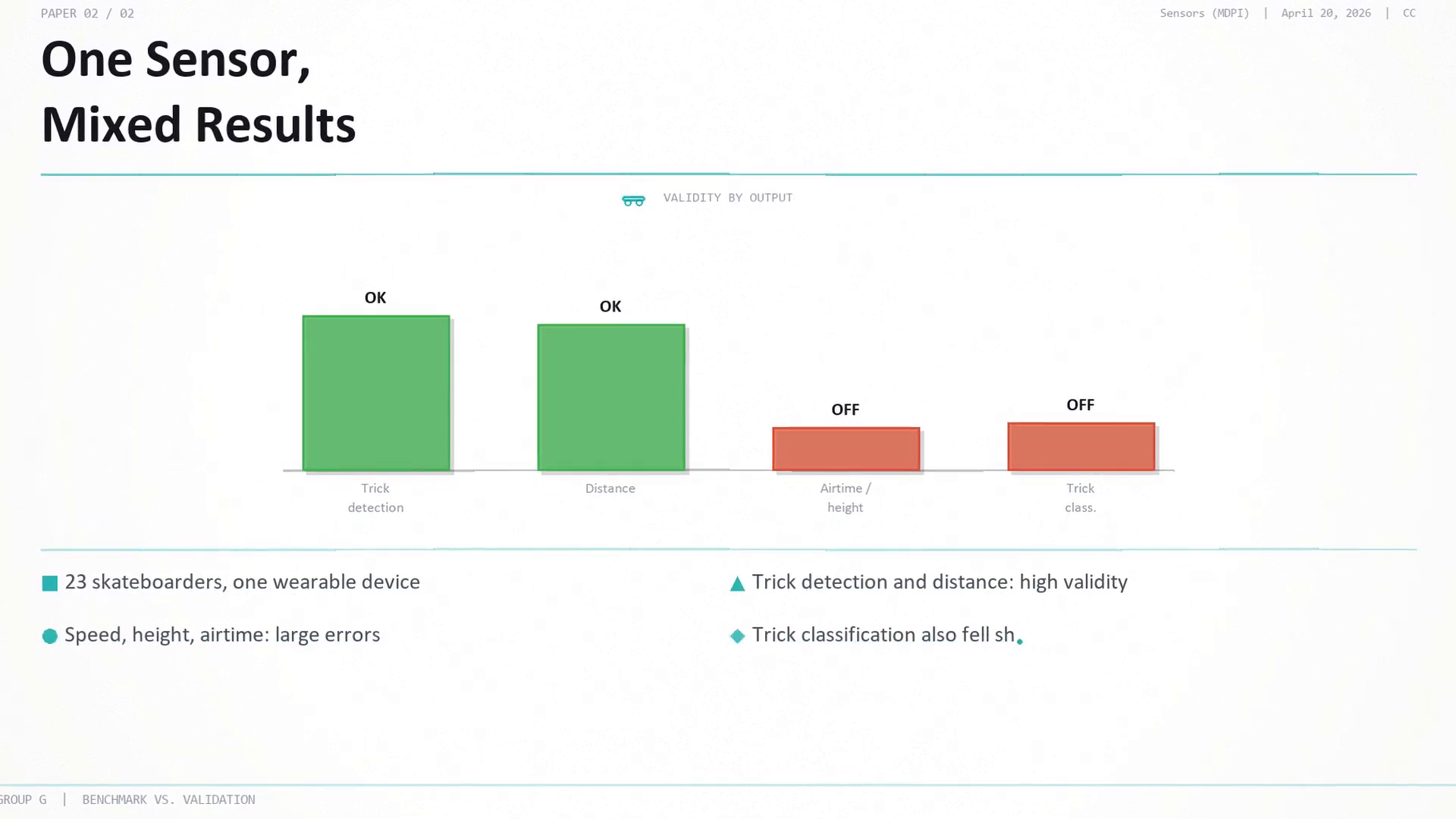
That split is a useful reminder: a device described as “AI validated” can carry a much narrower claim than it sounds like. Detection and measurement turned out to have different validity within the same sensor, so passing one part of a pipeline does not establish the rest.
Same year, opposite bets
These two papers make a useful contrast precisely because they differ in almost every dimension except publication year: community scale versus single-lab validation, a global team sport versus an individual trick sport, open benchmarking versus proprietary hardware assessment.
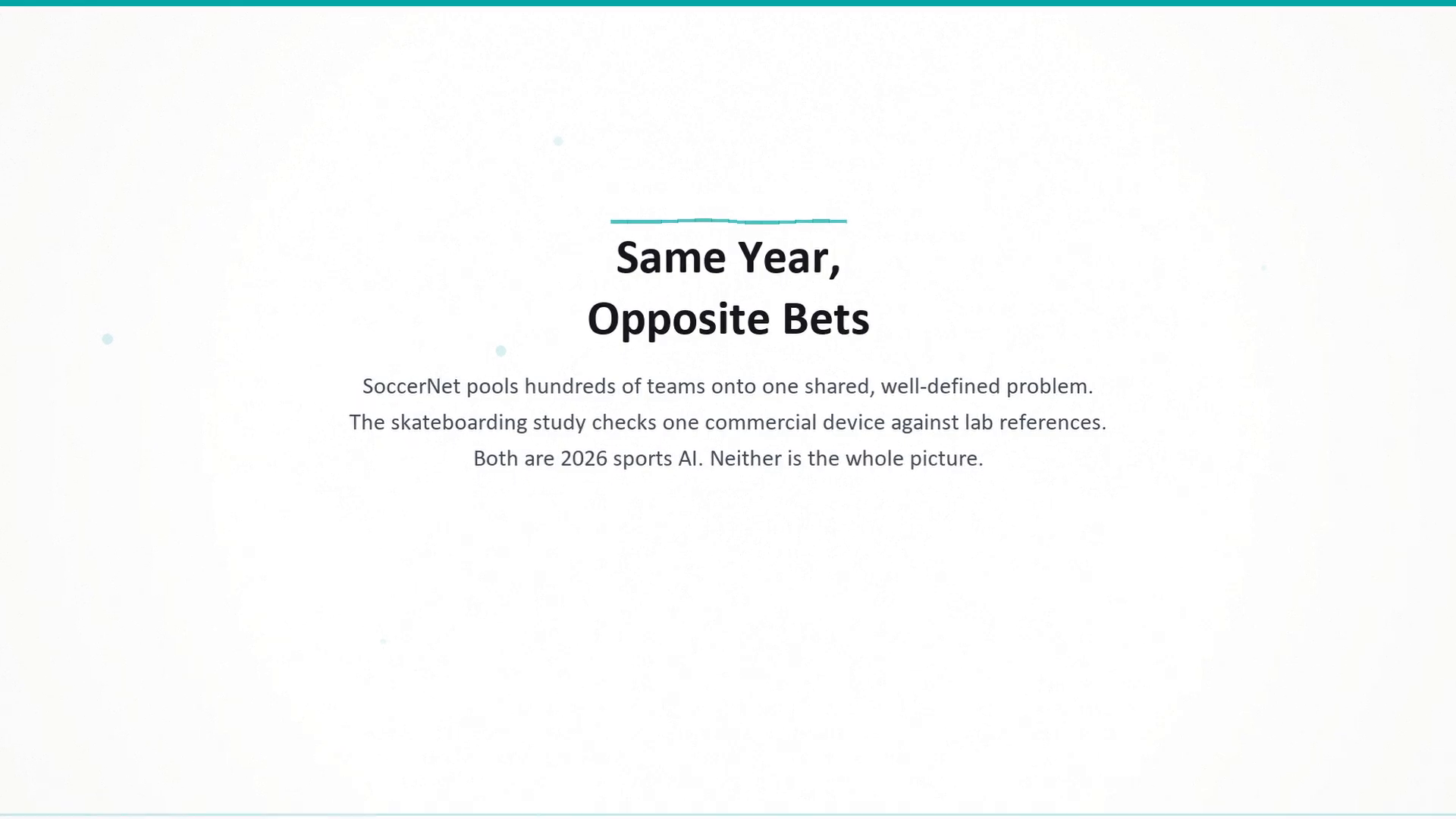
If there is a shared lesson, it may be that sports AI in 2026 is not one field on one trajectory, but several distinct efforts running in parallel — with limited evidence so far on how findings from one setting transfer to another. For the benchmark side of that argument, see our write-up of the CalTennis sports-AI benchmark; for the device side, our roundup of smartphone motion-capture apps.
Frequently asked questions
What is SoccerNet?
An annual shared computer-vision benchmark for soccer, now in its sixth consecutive edition. The 2026 challenges drew 427 teams and 1,129 submissions across five tasks including action spotting and view synthesis, letting hundreds of methods be compared under identical conditions.
Are wearable devices for skateboarding accurate?
Partly. Across 23 skateboarders, one device was highly valid for detecting that a trick happened and for distance, but showed large errors for speed, height and airtime, and fell short at classifying which trick it was.
Does “AI validated” mean a device measures everything well?
No — and the skateboarding study is a good example. Detection and measurement had different validity within the same sensor, so a device passing one part of its pipeline says nothing about the rest. Always check which specific output was validated.
References
[1] Cioppa, A., Giancola, S., Ardo, H., Dalal, M., et al. (2026). SoccerNet 2026 Challenges Results. arXiv:2607.07320
[2] Palazzo, L., Suglia, V., Grieco, S., Buongiorno, D., Brunetti, A., et al. (2026). Validity of a Commercially Available Inertial Measurement Unit for AI-Based Trick Detection and Kinematic Performance Assessment in Skateboarding. Sensors, 26(8), 2537.
Takashi Fukushima — Sports Science & Pose Estimation.
▶ Subscribe on YouTube · Website · ORCID · Contact