Two reviews and one study, taken together, show the distance between what AI-plus-wearables promises for injury prediction and what has actually been built. The reviews describe the field’s ambitions; the third paper is a single primary study. Reading that study against the reviews’ own stated open problems is a way of checking how far current practice has really progressed toward what the field says it wants.
Table of Contents
Promise vs. proof
Wearables stream fatigue signals — IMU, EMG, sensing textiles, video. AI looks for the warning sign before the injury, not after. That is the promise. The question this group is built around is what has actually been proved.

Paper 01 — The state of the field
A survey across IMU, EMG, physiological and flexible sensors, and across methods from classical ML through Transformers and GNNs. It frames the goal as proactive, continuous, personalized care. Crucially, as a narrative review it surveys direction rather than reporting one validated system — and it names its own open problems explicitly: data standardization, model interpretability, and generalizability across populations.
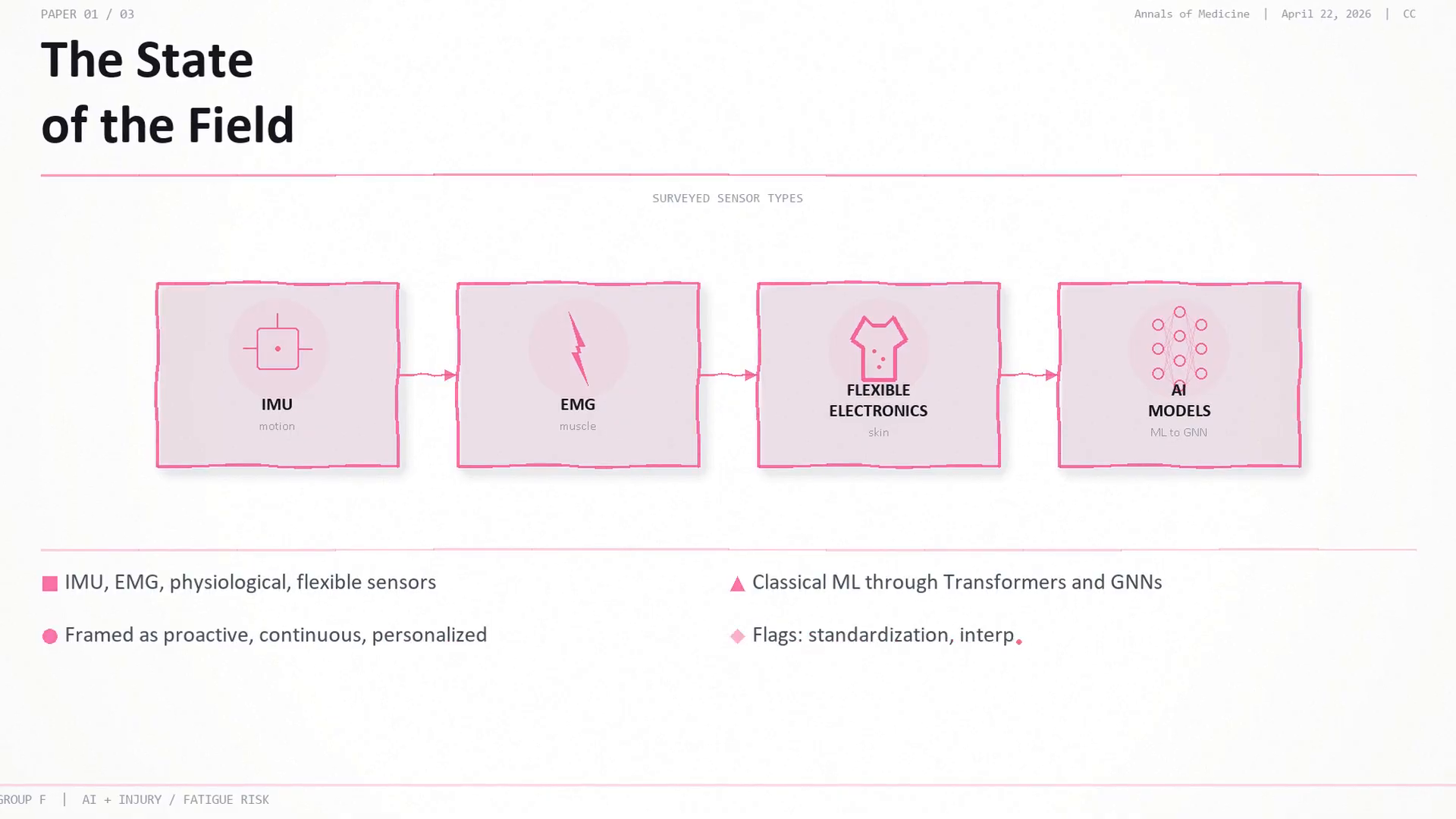
Those three named gaps are worth holding in mind against the next paper — a single primary study — to see how far current practice has actually closed them.
Paper 02 — One working example
412 adolescent table tennis athletes, ages 12–17, fusing video, skeletal keypoints and kinematics. The results: 81% F1 for posture asymmetry and 0.86 AUC for injury risk. Genuinely good numbers — and the study runs directly into two of the exact gaps the previous review named.
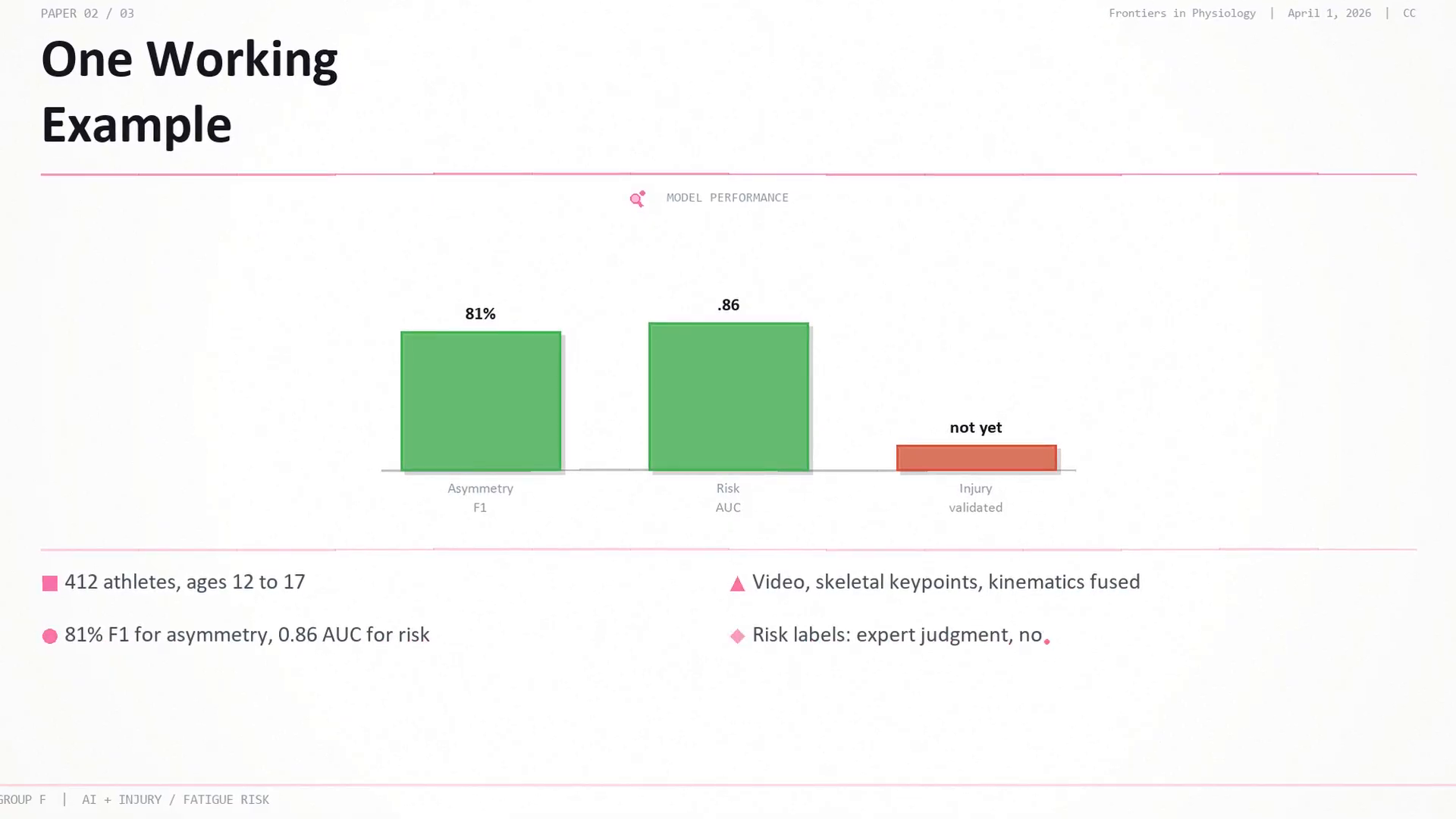
This is the part worth reading carefully. The injury-risk labels come from expert clinical interpretation of asymmetry evidence, not from confirmed injury outcomes. And the cross-sectional design cannot establish whether asymmetry precedes or follows the onset of strain. So the reported accuracy describes how well the model reproduces expert judgment — not, yet, how well it predicts an actual future injury, which is the harder and far more clinically relevant claim.
Paper 03 — A narrower technical bet
Triboelectric, piezoresistive and liquid-metal sensors, with CNNs, LSTMs and Transformers over textile signals. It proposes a causal chain from fatigue → compensation → injury, framed as closed-loop automatic intervention.
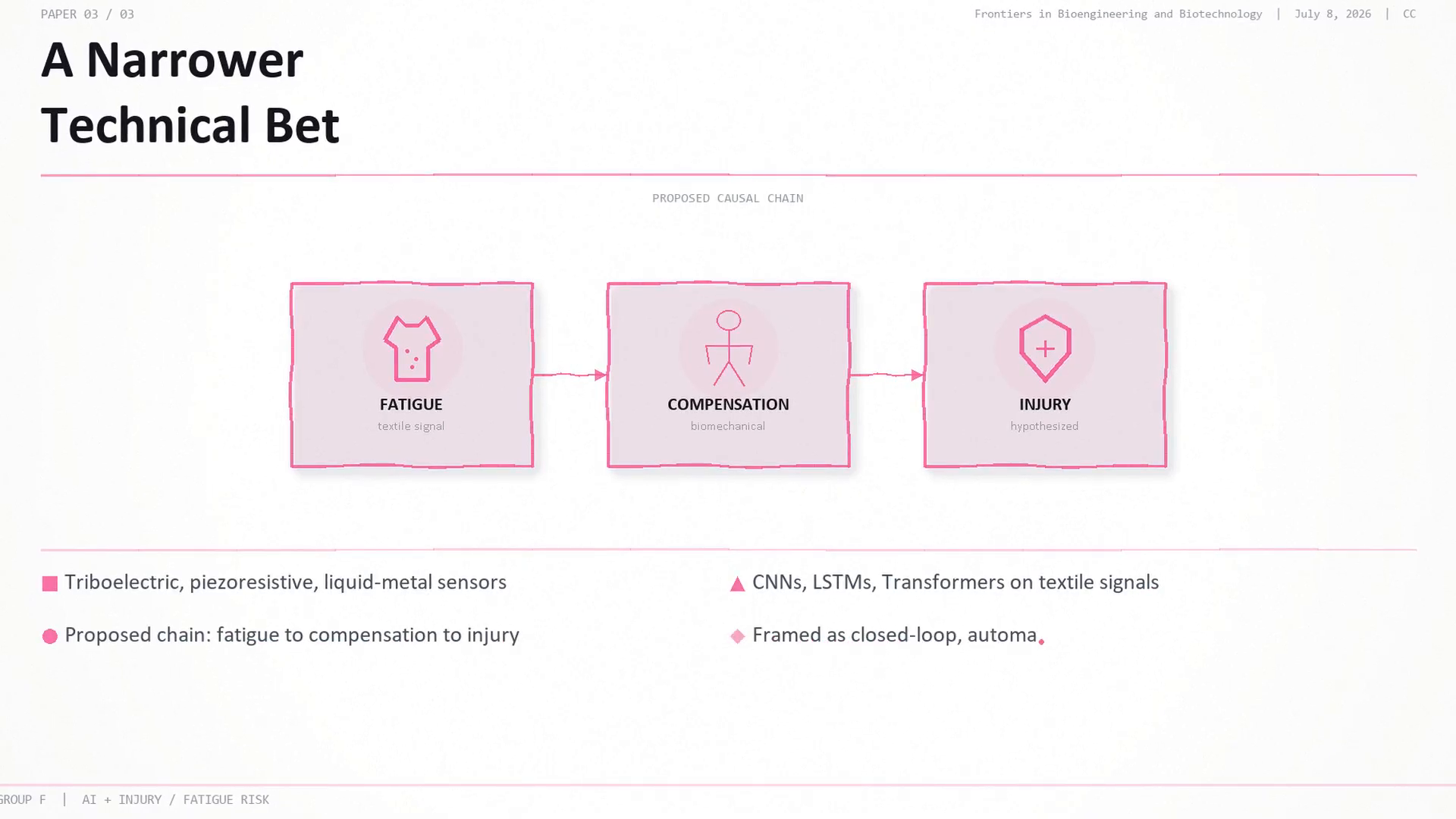
Two things to keep straight. That causal chain is a hypothesis about mechanism, not a demonstrated one — confirming it would need the same prospective longitudinal injury data that neither review nor the table-tennis study currently has. And the “closed-loop automatic intervention” framing describes a target architecture the authors are motivating, rather than a system built and tested end to end.
The gap between promise and proof
Read together, the field’s technical capacity has moved faster than its evidentiary base — multimodal fusion, deep sequence models and novel sensing materials are all well ahead of the validation behind them. The one concrete study here is explicit that its risk labels are not epidemiologically validated, and both reviews name that same gap as an open problem.
Which points to an unglamorous conclusion: closing that gap likely requires prospective cohort studies more than new model architectures. That remains a stated intention across this literature rather than a demonstrated result. For the sensing side of the same problem, see our review of motion capture without cameras or markers.
Frequently asked questions
Can AI predict sports injuries before they happen?
Not yet, in the strict sense. The best working example here classifies posture asymmetry and reproduces expert risk judgment well (0.86 AUC), but its labels come from expert interpretation rather than confirmed injury outcomes — so it has not been shown to predict a future injury.
What is missing from AI injury-prediction research?
Prospective longitudinal data. Both reviews name data standardization, interpretability and cross-population generalizability as open problems, and the concrete study is cross-sectional — so it cannot tell whether asymmetry precedes or follows strain.
Are sensing textiles ready for injury prevention?
They are promising as hardware, but the fatigue → compensation → injury chain they are built around is still a proposed mechanism, and the closed-loop intervention idea is a target architecture rather than a system tested end to end.
References
[1] Dong, G., Tan, X., Yuan, P., & Li, Y. (2026). Artificial intelligence and wearable sensors in sports injury risk prediction. Annals of Medicine.
[2] Wang, D., & Guo, Y. (2026). A multimodal deep learning-based model for posture asymmetry recognition and sports injury risk prediction in adolescent table tennis athletes. Frontiers in Physiology.
[3] Chen, D., Chen, H., & Guo, J. (2026). Research progress in exercise-induced fatigue monitoring and injury early warning based on flexible sensing textiles and deep learning. Frontiers in Bioengineering and Biotechnology.
Takashi Fukushima — Sports Science & Pose Estimation.
▶ Subscribe on YouTube · Website · ORCID · Contact