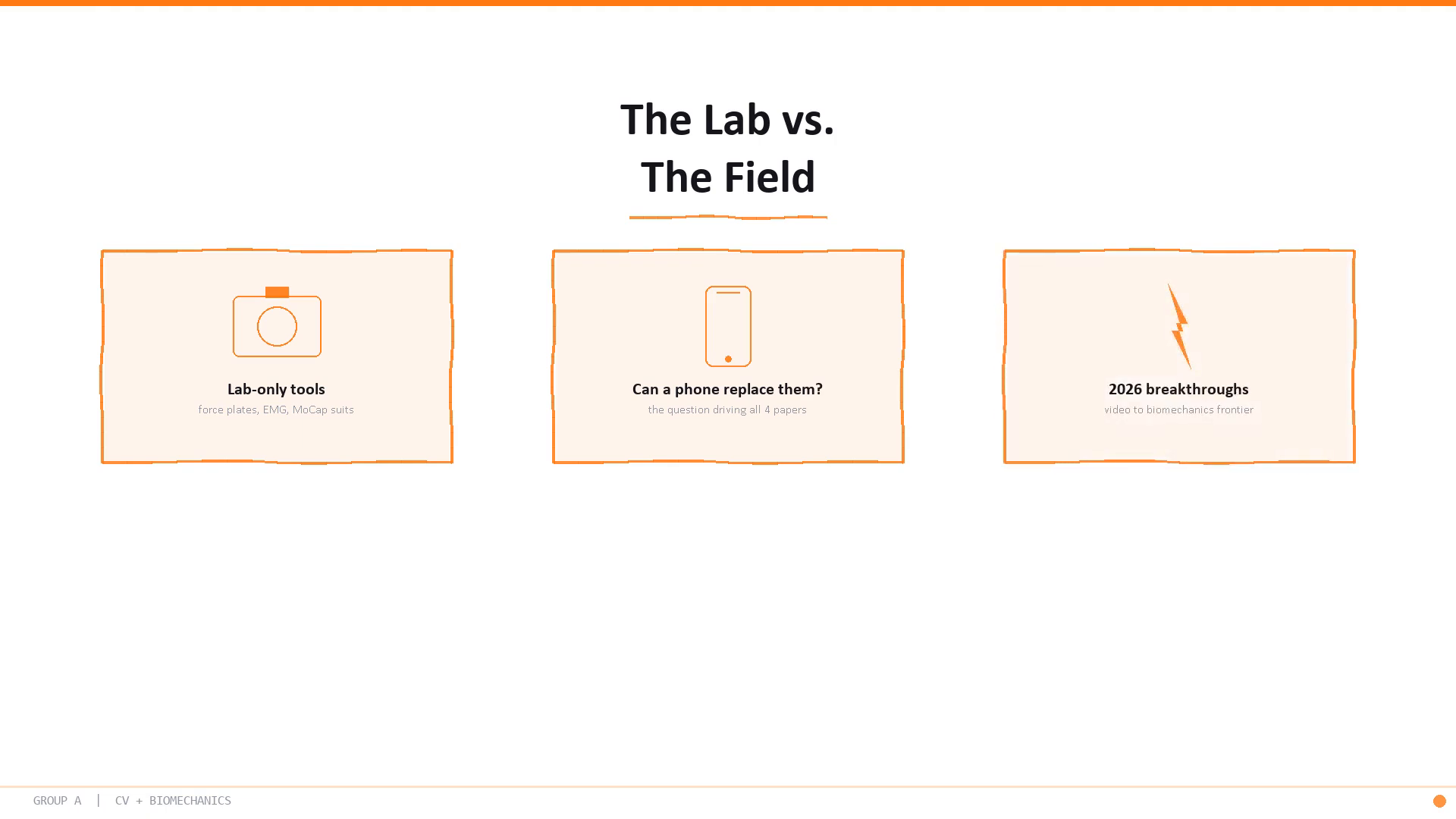
Four papers from June–July 2026 all point the same way: the biomechanics lab is collapsing into a smartphone camera. Force plates, MoCap suits and EMG electrodes are accurate but confined to the lab, and these papers ask whether a single phone can replace them. Their shared premise is that learned visual priors may be sufficient to approximate lab-grade biomechanical measurement from monocular video. Whether that approximation holds at the precision needed for individual-level clinical decisions, rather than population-level screening, is an empirical question none of them fully resolves — and that tension is what makes them worth reading together.
Table of Contents
The lab vs. the field — and the shared ceiling
Force plates, EMG electrodes and MoCap suits are accurate, and they are lab-only. That is the constraint all four papers attack. But the more interesting structural point is what they share: across every one of them, upstream pose accuracy functions as a ceiling. Forces, muscle activity and biomechanical attributes are all bounded by the fidelity of the initial 3D pose estimate.
That has a pleasant consequence: improvements in video-based pose estimation propagate into all four systems simultaneously, which suggests the field’s current investment in that problem may have compounding returns. The magnitude of that propagation, though, depends on whether pose errors are systematic or random — a distinction that matters more than it first appears.
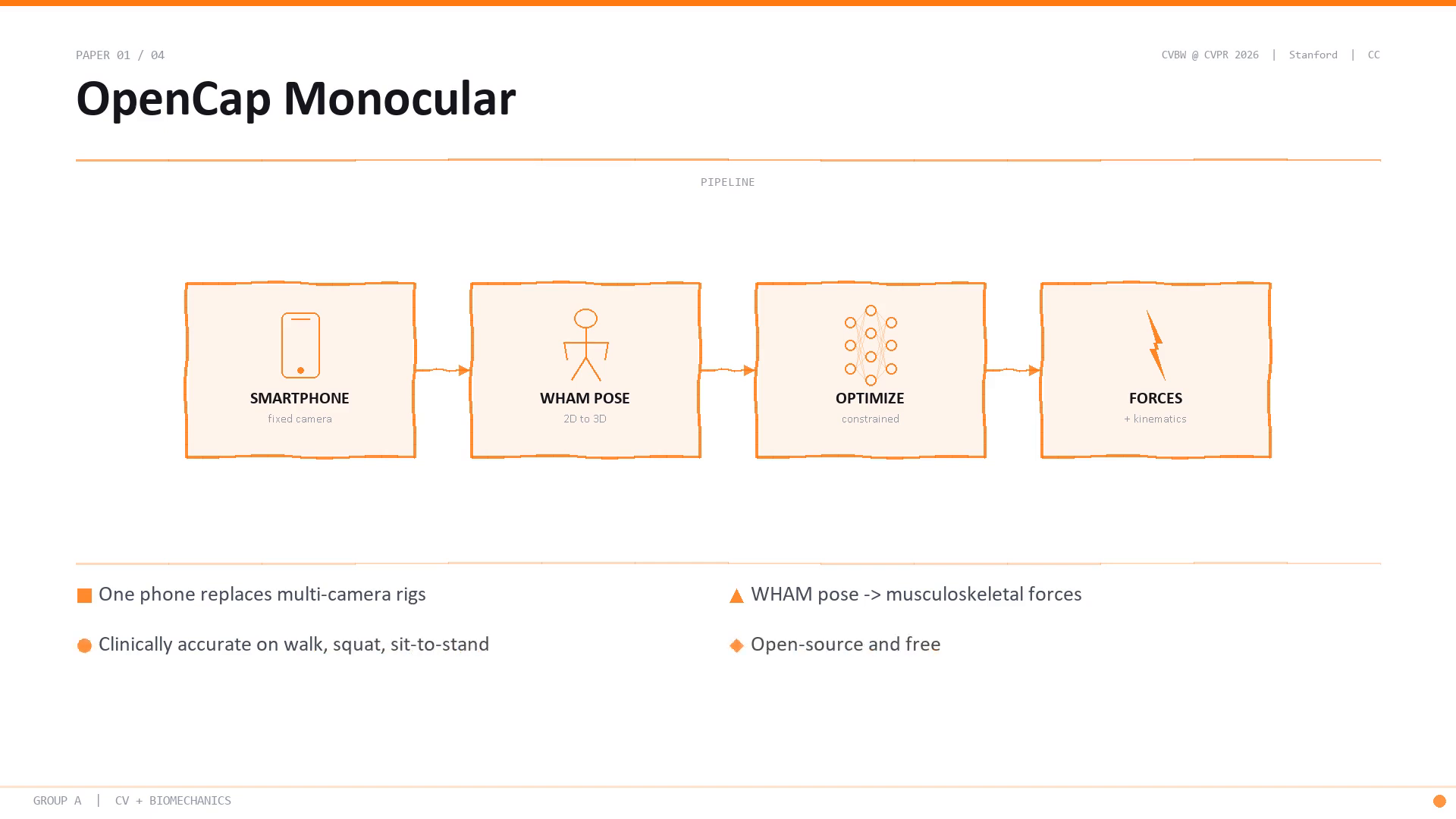
Paper 01 — OpenCap Monocular: the lab in one phone
OpenCap Monocular (CVBW @ CVPR 2026, Stanford) gets 3D kinematics and musculoskeletal dynamics from one fixed smartphone. The pipeline is WHAM pose estimation → constrained optimization → musculoskeletal simulation: in other words, it applies constrained musculoskeletal optimization downstream of a video pose estimator. It reports clinically acceptable accuracy on walking, squat and sit-to-stand, and it is open-source and free — which matters as much as the accuracy for anyone hoping to actually use it.
Paper 02 — BioHuman: muscle activation from video
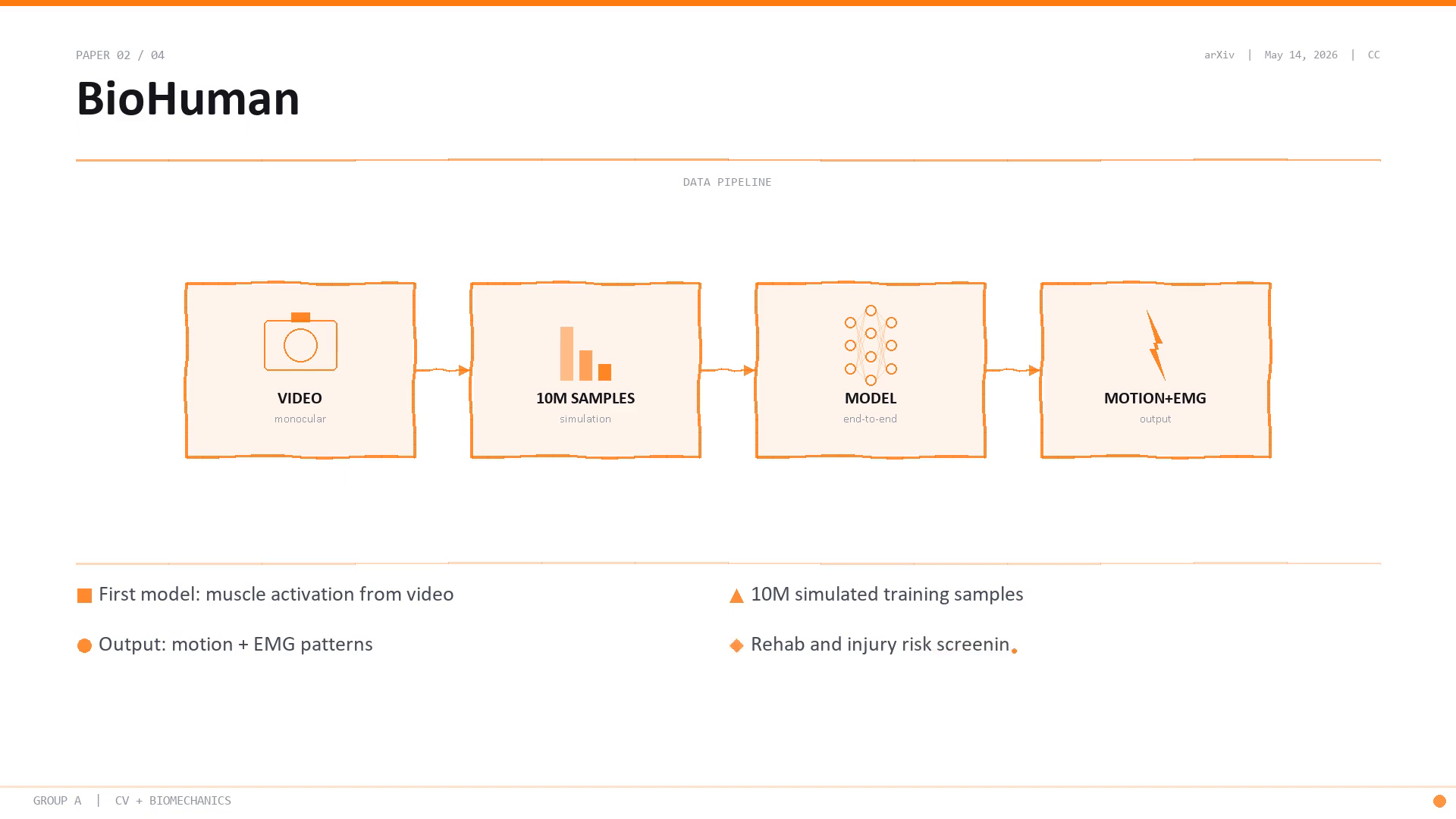
BioHuman is the first model to estimate muscle activation patterns from monocular video. Video in, full-body motion and muscle activity out. It is trained on BioHuman10M — 10 million samples with video, MoCap and EMG annotations — and is aimed at rehabilitation tracking and injury-risk screening.
The open question: that 10-million-sample corpus is generated entirely through musculoskeletal simulation, and the simulation-to-real gap for EMG is far less well characterised than for kinematics. Simulation reproduces joint angles with reasonable fidelity, but muscle activation is shaped by individual motor strategies that simulation does not capture. Whether the model’s outputs correspond to measurable EMG in vivo — particularly during high-load athletic tasks — is not established here. Plausible for population-level screening; likely needs individual calibration before clinical use.
Paper 03 — From Pixels to Newtons: joint contact forces
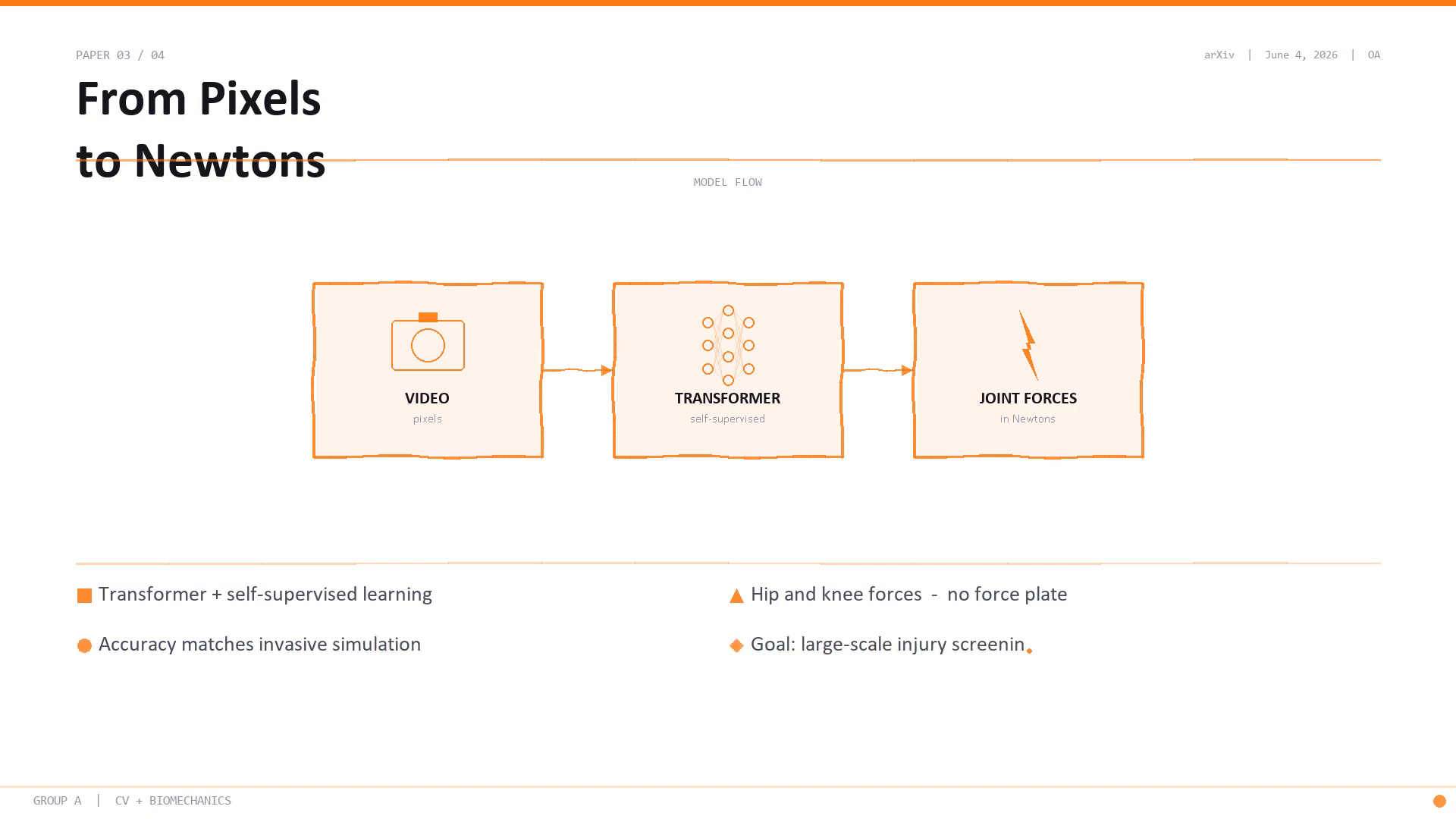
From Pixels to Newtons uses a Transformer with self-supervised learning on a parametric body model to predict hip and knee joint contact forces — no force plate, no markers — with accuracy the authors describe as comparable to invasive biomechanical simulation, aimed at injury-risk screening at scale.
The open question: “comparable to invasive simulation” deserves a second look, because the reference standard is itself a model-based approximation of in vivo contact forces. The uncertainty compounds — video pose error propagating into a simulation-based reference that is already an approximation — which makes the absolute accuracy of the force predictions hard to bound independently. For injury-risk stratification the operationally relevant question may be different anyway: does the model correctly rank individuals by risk? Answering that needs prospective longitudinal data that does not yet exist.
Paper 04 — Pose-to-Biomechanics: a plug-in module
Pose-to-Biomechanics contributes BioModule, a lightweight Temporal Transformer that plugs into any existing 3D pose estimator with no retraining, plus a new dataset aligning Human3.6M frames with biomechanics labels. Its key reported finding is the one that runs through this whole post: upstream pose accuracy directly determines downstream biomechanics accuracy.
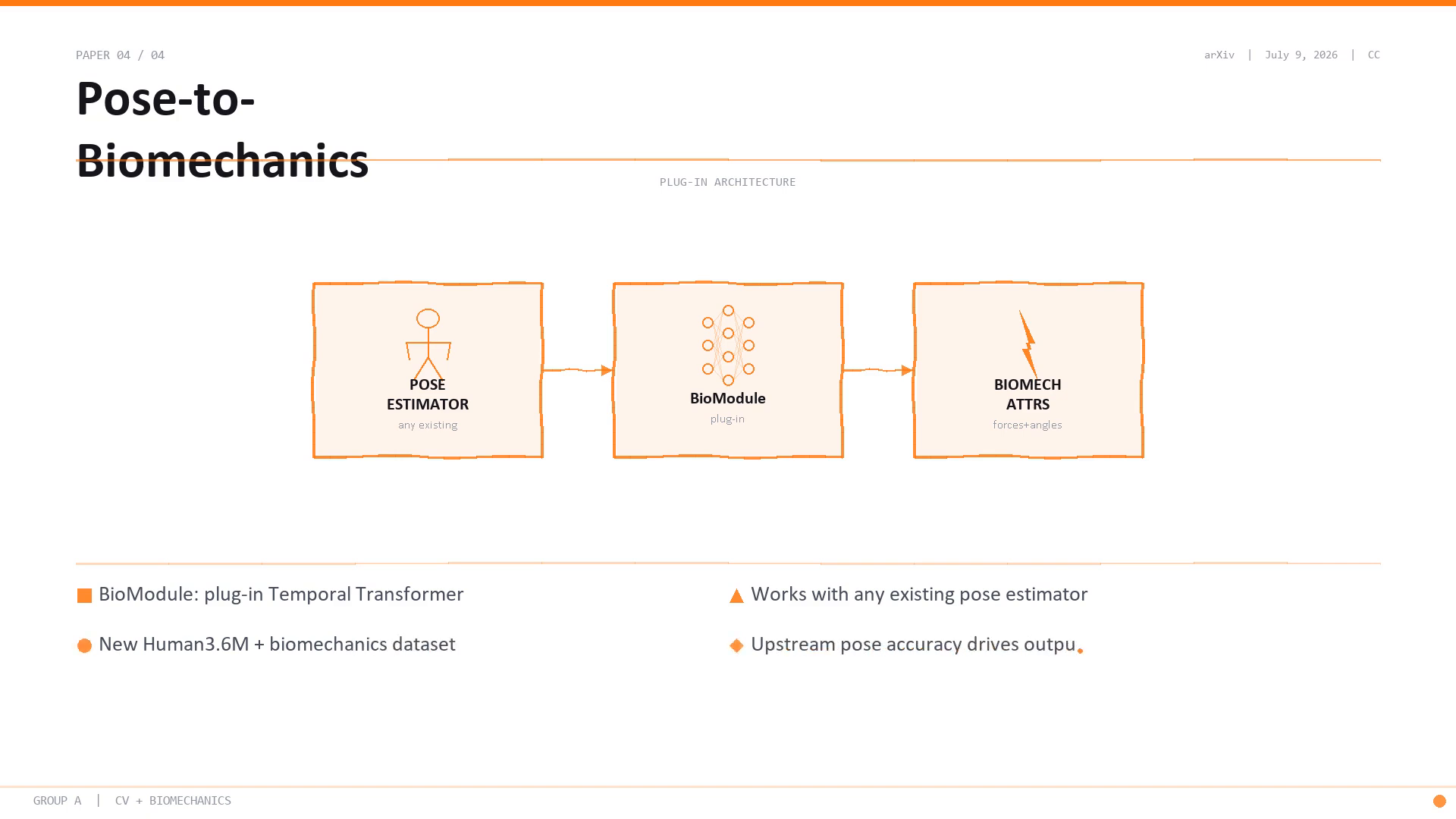
The open question: decoupling attribute prediction from the pose estimator is convenient, but it means errors from any upstream estimator propagate into the biomechanical outputs through a learned, non-transparent mapping. Whether that mapping generalises to movement populations not represented in the Human3.6M alignment — specifically high-velocity, sports-specific actions — is uncharacterised. The architecture is potentially valuable; the generalisation boundary needs explicit out-of-distribution evaluation before anyone deploys it in an athletic context.
A consistent story: screening now, clinic later
Four papers, four layers of the same pipeline — pose, forces, muscles, attributes. Collectively they suggest that video-based biomechanical analysis may reach screening-grade utility in the near term, while individual-level clinical precision will likely require additional anatomical priors or subject-specific calibration. That distinction — screening versus clinic — is the honest summary, and it is stronger than either “the lab is obsolete” or “this is just a demo”.
The consistent upstream dependency on pose quality implies that a single focused advance in video pose estimation could benefit the entire stack at once. Whether that advance transfers to fast, occluded athletic motion remains the open empirical question. For where pose estimation stands today, see our breakdown of pose estimation accuracy across six models, and for the sensing side of the same shift, our review of 3D markerless motion capture approaches.
Frequently asked questions
Can a smartphone really replace a biomechanics lab?
For screening, increasingly yes — OpenCap Monocular reports clinically acceptable accuracy on walking, squat and sit-to-stand from one fixed phone. For individual-level clinical decisions, not yet: that precision will likely need anatomical priors or subject-specific calibration on top of what video alone provides.
Can AI estimate muscle activation from video?
BioHuman is the first model to try, trained on 10 million simulation-generated samples with EMG annotations. The caveat is that muscle activation depends on individual motor strategies that simulation does not reproduce, and the simulation-to-real gap for EMG is less well characterised than for joint angles — so agreement with real in-vivo EMG during hard athletic tasks is still unproven.
Why does pose estimation accuracy matter so much?
Because it is the ceiling for everything downstream. Forces, muscle activity and biomechanical attributes are all computed from the 3D pose, so pose error propagates into all of them. The upside is symmetric: one good advance in video pose estimation lifts the entire stack at once.
References
[1] Gilon, S., Miller, E. Y., & Uhlrich, S. D. (2026). OpenCap Monocular. CVBW @ CVPR 2026. arXiv:2603.24733
[2] Huo, Y. et al. (2026). BioHuman. arXiv:2605.14772
[3] Lauer, J. (2026). From Pixels to Newtons. arXiv:2606.06631
[4] Eghbalian, A., & Desai, K. (2026). Pose-to-Biomechanics. arXiv:2607.08725
For more on field-deployable, camera-light sensing, see our companion roundup on three papers on motion capture without cameras or markers and our look at what the CalTennis sports-AI benchmark reveals. If you’re building your own capture pipeline for XR, our Meta XR SDK setup guide for Unity covers the tooling side end to end.
Takashi Fukushima — Sports Science & Pose Estimation.
▶ Subscribe on YouTube · Website · ORCID · Contact